How to Allocate Your Ad Budget In 2026: What Is An Ad Budget?
Introduction
The worldwide advertising revenue forecasted by Statista’s global advertising market outlook will exceed one trillion dollars in 2026, reflecting continuous growth across both digital and traditional media.
Are you increasing your ad budget this year while also maintaining control over your budget, or has the budget taken control of its own?
In 2026, there will be no longer be a predictable ecosystem for your advertising dollars; this is mainly due to new privacy regulations imposed by the government, significant changes to attribution due to the lack of platform-level signals, more competition in the auction marketplace resulting in significant fluctuations in cost per install, and an overall shift in user behaviour from a linear pathway through the use of multiple channels (e.g., seeing an ad as a video to reading reviews to downloading an app to making a conversion) has created uncertainty for advertisers.
This makes managing your advertising budget highly challenging and stressful.
It isn’t just about how much you spend, but it is also about how wisely you spend your advertising budget.
As the clarity of the signal deteriorates, random scaling becomes a costly endeavour. As acquisition costs rise, every dollar that is misallocated adds further to the inefficiencies of the overall process. Furthermore, the increasingly fragmented nature of consumer journeys means that more detailed measurement is necessary and is not accounted for by wider advertising expenditures.
When working within a privacy-friendly ecosystem, the ability to determine your mobile attribution strategy will decide whether or not your advertising budget translates to installs or to an ongoing source of value. Through the use of structured measurement frameworks, such as those that span Apptrove’s mobile measurement ecosystem, you can obtain visibility into the aspects that drive true growth rather than just appear to produce conversions.
Ultimately, your advertising budget is no longer merely a financial investment, but an essential component in your overall growth strategy.
Let’s discuss the correct way to structure your budget.
What is an Ad Budget?
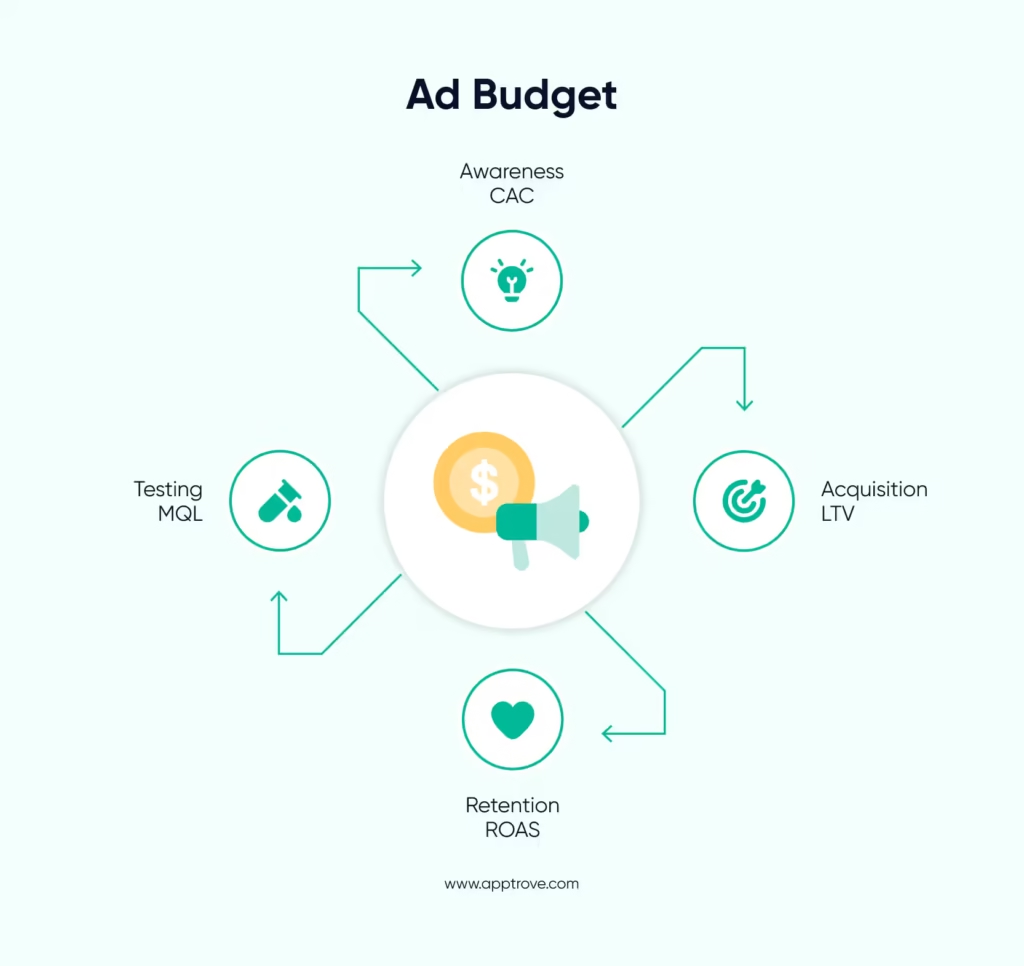
An ad budget is more than simply a sum of all money allocated to advertising; it is also an organised plan for determining how and when to allocate funds to advertise. Ad expenses indicate the actual amount of money spent on advertising, while an advertisement budget is the planned strategy for determining how much to spend on ads.
Both definitions of advertising budgets and advertising expenses are more relevant now than they ever have been.
Ad expenses are reactive, while an advertising budget is proactive. By separating your planning from your execution, you can manage your performance rather than chasing after it. Instead of allocating money to media, you can allocate funds in accordance with business objectives.
A well-organised advertising budget is related to the following four metrics: Customer Acquisition Cost (CAC), Life Time Value (LTV), Return on Advertising Spend (ROAS), and Marketing Qualified Lead (MQL). If your CAC is rising while the LTV remains the same, you must revise your advertising budget. If you have a new creative group and your ROAS has increased, your resource allocation will now change.
This is why planning is much better than spending.
You don’t create an ad budget based on assumptions alone, but on measurable intentions.
How to Build Your Ad Budget by Channel
Your intention in structuring your ad budget by channel should be to create delusion. Diversifying across channels allows for stability in your metrics; excessive fragmentation will dilute the overall impact of all channels. Therefore, finding a balance between the two — neither will you put all your eggs in one basket, nor will you go on a blind journey to new channels.
If you continue to allocate the majority of your ad spend to one platform, you run the risk of exposing your growth to an unnecessary amount of risk. When the algorithm changes on one platform, or when the auction becomes volatile, when you become fatigued of your creative(s), and/or when there are policy changes, your results could change drastically overnight. With a diversified channel mix, you can create stability in your customer acquisition cost (CAC) while also enabling you to continue testing new and different ways of creating incremental advertising conversions through various touchpoints.
In addition to considering channel balance, you also need to balance your budgets by platform. The Android and iOS ecosystems will require different types of logical budget allocation. Android generally has large-scale volume-based efficiencies, whereas there are more constraints placed on iOS as it pertains to privacy and information about aggregated data, which means that optimally allocating budgets among the various platforms could produce skewed ROAS results, leading to inaccurate forecasting.
Changes in data regulation and the shift of businesses toward privacy-first practices have affected allocation decisions, specifically concerning the use of aggregated conversion data in conjunction with SKAN. The last-click attribution model cannot be used to guide budget allocation decisions; instead, you will need to use modelled insights, trend analysis and conversion quality in your budget allocation decision-making.
Industry reports support this claim — for example, eMarketer estimates that mobile advertising in the U.S. will total $200 billion in 2024, 66% of total digital ad spending. Therefore, mobile budget allocation is essential to successful advertising.
In order to ensure that each channel receives a reasonable portion of your advertising budget, you must base your advertising budget upon measurable evidence, rather than upon instinctive habits or assumptions.
Impact of Creative Testing on the Efficiency of Your Ad Budget
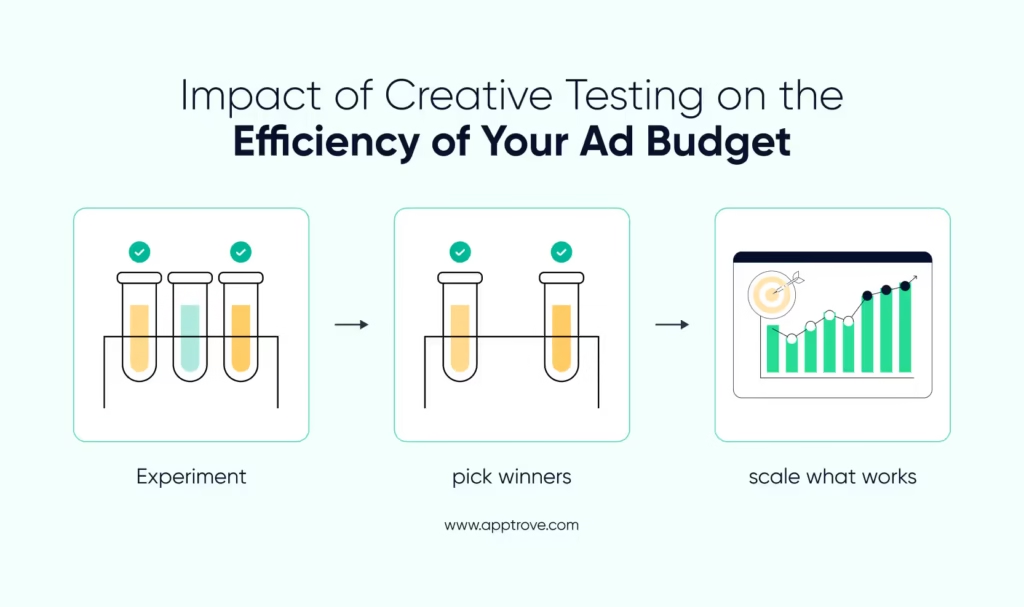
Creative testing is one of five major factors when driving ad budget efficiency (the other four are the ad creative itself, the audience targeted, placement of the ads, and timing). If your ad has been on the same creative for too long, it will start to experience creative fatigue, causing a decline in engagement and click-through rates, which will ultimately cause the platforms to charge you a higher CPM. Therefore, not only are you having to spend additional money to reach the same audience, but you will also see that your ROAS is steadily declining.
Because of this reason, you should never merge your testing budget with your scaling budget. Scaling is about amplifying the success of previously validated campaigns (creatives, audiences, placements, etc.), whereas the purpose of your testing budget is to discover what works. When you combine testing and scaling, you run the risk of either overfunding unproven creatives or underfunding experimentation. Having a structured allocation between the two ensures that performance campaigns are not negatively impacted while continuing to drive innovation.
Testing iteratively beats a seasonal burst. With consistent testing, instead of changing creatives at the peak of an advertisement campaign, it’s possible to experiment with message content, format, and audience resonance to identify optimal ad creatives in real time. Over time, these incremental improvements will compound into significant gains.
In order for structured experimentation to succeed, it’s essential to establish the hypothesis, isolate potential variables, and measure results with clear metrics. When measurement allows you to distinguish the effect of your ad creative from the influence of your target audience, there is increased confidence in your results. You will no longer be guessing which creative was most effective, but will understand the reason why that creative was effective.
With clarity of measurement supporting the creativity of your advertising strategy, the use of your advertising budget can be transitioned from reactive, or merely spending money on ads, to performance-based and continually improving.
How to Determine the Proper Ad Budget for Continuous Expansion?
When calculating the proper advertising budget, start with revenue generation, not cost. Revenue first will produce a reversal of the goal of achieving your continued growth. Instead of asking the question, “How much can we afford to spend on advertising?” ask the question, “What revenue do I want to achieve, and how much will I spend on acquiring new customers in order to achieve that goal?”
This is where it is critical to align your CAC (cost of acquiring a customer) to your LTV (the projected lifetime value of a customer). If your CAC rises significantly and approaches or surpasses your LTV, you have a growing concern about the overall stability of your ability to continue to scale. You can only expand your investment in acquiring new customers if the unit economic model shows that the customer you acquire will generate a sufficient and sustainable profit stream.
When you start to scale too rapidly (or too quickly), you introduce unnecessary inefficiency in the process. As your budget goes up, your return on the dollar you spend on advertising will typically begin to decline. As you grow, you will further slow down your returns because you are reaching a point of saturation with your potential audience and because you are entering a more competitive environment for the auction to acquire your potential or current customers. If you do not monitor and control your pacing of performance, your advertising budget will inflate much faster than your return.
You need to separate your advertising budget into seasonal advertising and evergreen advertising. You may need to increase your advertising budget in seasonal periods when the demand for your products is the highest, but your evergreen budget should continue to see a consistent and steady improvement over time. Creating an advertising budget for each ensures that you do not overspend in high season or remain under-budgeted during the stable growth period.
If your LTV is unknown, your advertising budget will become nothing more than a guess.
Measurement Role In Protecting Your Ad Budget
Your advertising budget is only as good as the measurement framework that you rely upon. Without accurate attribution, even the best allocations of money can become wasted and inefficient, therefore making your ads as wasteful or inefficient as possible.
Attribution windows directly impact how campaigns are credited with performance. If you have a short attribution window, you may not credit as many conversions as you really should, which could lead you to cut funding to high-performing campaigns sooner than you would have otherwise. Conversely, having an attribution window that is too long may give too much credit to a channel that assisted rather than drove the install. Both situations can adversely affect your ability to redistribute your advertising money.
View-through impressions add an additional layer of complexity when assessing the effectiveness of your advertising. Many individuals will view an ad before they convert, but may not actually click on the ad until they are ready to convert. If you do not assign value to these view-through impressions, you may be undervaluing your awareness campaigns. On the other hand, if you assign too much value to view-through impressions that have not been properly verified, you could be misrepresenting the effectiveness of your advertising campaigns. Therefore, it is essential to have a balanced perspective when interpreting this kind of information.
With incrementality testing, you can answer an important question: Did your ad budget actually help generate that conversion? If you do not have incrementality insights, your ad budget may be spent on support channels that simply capture existing demand rather than helping to create new growth.
A third issue to consider is fraud; click injection, bot traffic, and attribution manipulation are all stealing money from your ad budget undetected while appearing to be legitimate on most surface metrics.
Inaccurate measurement can misreport results but also mislead future allocation decisions. To protect your ad budget, you must ensure that the signals leading to your ad budget allocation are trustworthy, validated and strategically interpreted. To learn more, feel free to contact us.
FAQs
1. What factors should be considered before increasing your ad budget?
Prior to increasing advertising budgets, businesses should assess the stability of performance, the effectiveness of the creative, saturation of their channel and their unit economics, such as Customer Acquisition Cost (CAC) and Customer Lifetime Value (LTV). Growing without stable underpinnings can create inefficiencies rather than provide for long-term growth.
2. Why does poor attribution lead to wasted ad budget?
Inaccurate attribution misrepresents where true conversions come from, leading businesses to overinvest in channels that don’t perform well. Without proper metrics, companies may grow their campaigns based on results that seem positive but ultimately do not provide any real additional benefits.
3. How should businesses split their ad budget between testing and scaling?
Companies need to set aside some of their advertising spending to test new ideas and use the majority of that spend to expand existing ideas that have been proven effective through experimentation in order to continually learn and not detract from their revenue-generating strategies at the same time.
4. What role does market competition play in ad budget allocation?
Continuing to raise competition for ads in auctions impacts your CPMS and CPMS directly, requiring you to continually adjust your ad budgets dynamically. You must constantly monitor the competitive environment of the market so that you do not overspend on advertising but still have a competitive presence in key channels that you are using to grow your business.
5. How can businesses make their ad budget more resilient to platform changes?
By diversifying your advertising efforts, including across channels and platforms, you can avoid becoming overly reliant on a single source of income. Having a well-defined advertising budget combined with a good measurement framework can provide a level of stability that supports your ability to adapt to changes in algorithm, policy, or market conditions.
from Apptrove https://apptrove.com/ad-budget-allocation-2026/
via Apptrove
Comments
Post a Comment