The Privacy-Performance Balance: How App Marketers Are Adapting in a Post-IDFA World
The world of mobile advertising is changing from one of plenty to one of limits. Apple’s ATT framework is at the heart of this change. The company has created an environment where access to the Identifier for Advertisers is no longer guaranteed or is subject to certain permissions (user consent was required before users would provide their IDFA). Therefore, the IDFA is no longer the default signal; it will now be a conditional signal for marketers measuring their results.
Before the ATT framework, the IDFA provided deterministic tracking. This provided marketers with the ability to link ad interactions directly to installs and the related in-app activity with a very high level of accuracy. Therefore, the IDFA was essential for accurately attributing ad spending to install activity (and vice versa), enabling precision targeting at the user level, and optimising campaigns in real-time. As a result, marketers had a clear view of their campaign performance and could therefore make educated decisions.
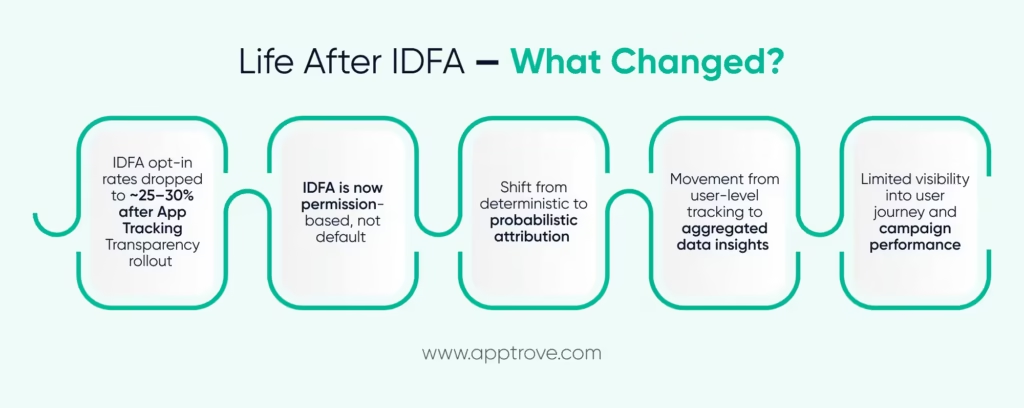
However, since the ATT framework requires a user to provide their IDFA before it can be used, the number of users with an IDFA is decreasing (and therefore the reliability of IDFA-based tracking models has decreased as well); therefore, there will be uncertainty in measuring user performance. This marks the end of the time period when IDFA has defined success.
Privacy has assumed centre stage in all of this; therefore, marketers need to rethink how they measure performance, both in terms of effectiveness and in terms of scalability. Therefore, the Identifier for Advertisers is no longer a foundational signal; it is simply one of many limited signals that exist in the broader, privacy-first advertising ecosystem.
The Emerging Privacy–Performance Tradeoff
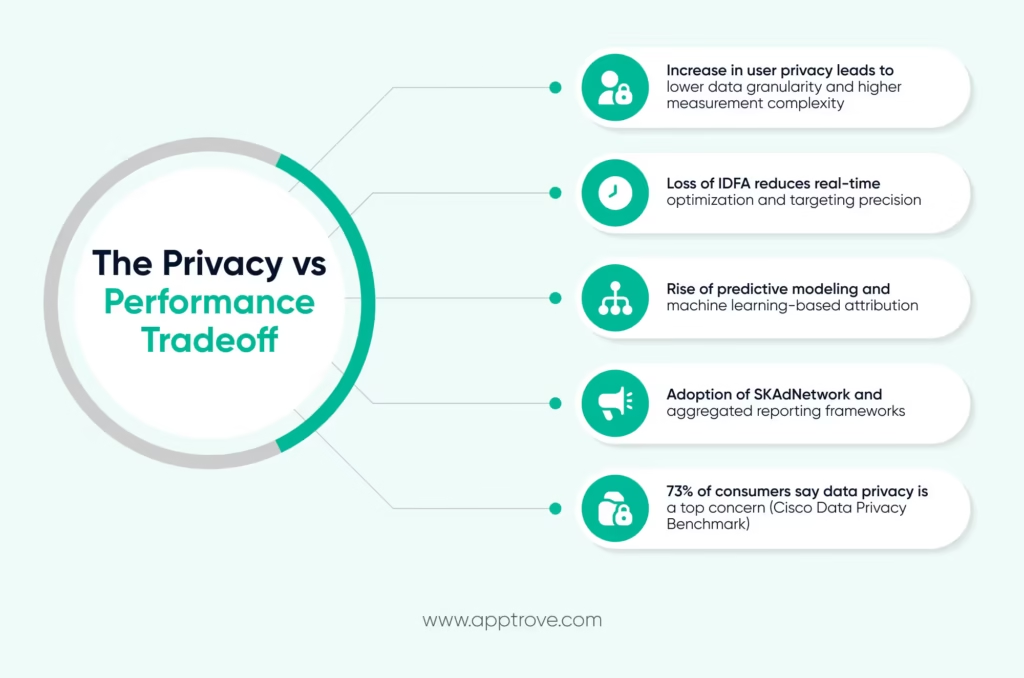
Users have become more sensitive to their privacy when using apps. This sensitivity has made it increasingly difficult for marketers to effectively measure performance from their marketing efforts, as marketers need access to aggregated performance metrics and large sample sizes in order to accurately determine which content generates higher metrics. As a result of this tension between user privacy and marketer effectiveness, the use of idle signals will be essential unless marketers develop new ways of measuring the performance of their campaigns using functions other than those provided by idle signals.
For example, from an MMP perspective, marketers must be able to develop new forms of performance measurement that do not depend heavily on idle signals. This may include the use of aggregated data sources, or the use of probabilistic modelling, whereby the importance of idle signals in measuring a campaign’s performance will diminish.
In addition, marketers will need to build their performance measurement strategies to either comply with or effectively compete with performance measurement methods that do not rely solely on idle signal data.
The Role of Mobile Measurement Partners in This Transition
With the post-IDFA environment, MMPs are now critical pieces of infrastructure. With reduced access to IDFA, marketers rely on MMPs to fill the measurement gap and deliver trustworthy data.
MMP’s solve for privacy-safe attribution by leveraging multiple data points to create a single data source rather than exclusively relying on IDFA. They convert fragmented signal sources into actionable insights so that campaign results can still be assessed accurately.
Solutions like Apptrove were built for measurement in a world with limited access to IDFA. By providing advanced attribution methodologies and aggregated reporting, they allow marketers to receive visibility into performance without sacrificing user privacy.
From our perspective, IDFA is no longer at the centre of measurement; rather, it is a small piece of a larger puzzle. MMPs are now responsible for assembling this puzzle so that performance and privacy can coexist.
The Rise of Privacy-First Mobile Ecosystems
How Apple’s App Tracking Transparency Reshaped Mobile Marketing
The introduction of Apple’s App Tracking Transparency (ATT) framework had a transformative impact on the world of mobile marketing and how the IDFA is used and accessed. By requiring apps to request permission from users before tracking their activity on other apps or websites, ATT has fundamentally changed the way marketers can operate.
Since being required to obtain user consent at the app-level before being able to access an IDFA, the availability of IDFAs has been significantly curtailed. Where an IDFA used to be readily available, it now relies on users opting in via their settings; the consistency as well as the volume of IDFAs have declined dramatically in comparison to previous years.
The new IDFA limitations will force MMPs (Mobile Measurement Providers) to rethink their entire system of measurement. IDFAs can no longer be considered a guaranteed signal; rather, they will now become one of many datapoints used by MMPs, where commonly there will be insufficient data to rely solely on IDFAs.
How Deterministic Tracking Has Been Affected
Prior to ATT, marketers relied on IDFAs as the primary mechanism of deterministic tracking and enabling marketers to accurately attribute their successes as they pertained to the utilization of their advertising budgets. For many years, IDFAs have allowed marketers to determine which advertisers or campaigns drove installs or generated revenue.
From an examination of the marketplace, the changes to IDFA have created major upheaval in the marketing industry. Marketers no longer have a one-way association with their consumers as a result of the elimination of deterministic measurements. MMPs (measurement partners) must rely on other ways to establish their own measurement processes when using IDFA data.
When looking at the changes to IDFA, we also see a growing number of global privacy regulations that continue to decrease the ability to depend upon IDFA as a source of measurement data. GDPR, CCPA/CPRA have both developed rules on how businesses can collect and manage user data and have impacted their ability to use IDFA as a source of measurement.
These regulations have created new regulations to find out whether or not the collection and management of user data has gained the consent of an individual to use his or her data. Thereby, it has shifted the responsibility of MMPs to ensure that a business’s use of IDFA is compliant and to have an understanding of
How to measure when IDFA is lost?
The emergence of new user protection regulations, coupled with the changes at the level of the dominant platforms, will create an expectation of not depending on IDFA.
The change in user perception toward their data has created an entirely different view of how users feel about the tracking nature of IDFA. Users have now begun to understand their right to privacy and their control over how their data is managed. Users have now begun to speak out concerning how they feel about the collection and management of their data, thus moving Identifier for Advertisers from a largely invisible aspect of tracking their actions on mobile devices to a much larger conversation concerning privacy and control.
Users expect to understand why their data is being collected and how it will be used. This expectation reduces the likelihood of widespread IDFA opt-ins, further limiting its availability.
For marketers and MMPs, this shift presents both a challenge and an opportunity. While IDFA access is restricted, adopting privacy-first practices builds trust and long-term user relationships. In this new ecosystem, success is not defined by how much IDFA data is collected, but by how responsibly it is used.
Measurement Disruption in the Post-IDFA Era
Attribution Without Device-Level Identifiers
With the IDFA now on the decline, the way in which attribution operates has changed dramatically. Attribution models were built on deterministic signals, where the IDFA allowed a direct line from an ad exposure to a user’s action. This created a very accurate and easy-to-validate attribution model.
Now that IDFA is no longer consistently available, these models are starting to fall apart. Without access to the IDFA, it’s harder to connect impressions to installs at a user level. This creates holes in attribution, where a conversion cannot always be directly tied back to a specific campaign.
For MMPs, the challenge is clear: Attribution must still be able to take place even in the absence of the IDFA. To do this will require moving away from deterministic attribution methods and exploring alternative options that will allow for the ability to utilise alternative means without using only IDFA signals.
Lack of Visibility In the User Journey
Previously, the Identifier for Advertisers allowed you to see the entire user journey seamlessly, i.e., from the time they were exposed to the first ad to the time that they engage with the app, etc. With much less IDFA being available now, the visibility has become fragmented.
Your data is spread across multiple platforms, each of which has limited access to the IDFA; therefore, building a complete picture of how users behave in a way that makes sense has become very difficult. In addition, as MMPs will tell you, Multi-touch attribution has become very challenging, as the lack of IDFA creates a situation where tracking across multiple reach points is impossible.
Delayed and Aggregated Data Signals
The change to aggregating reporting mechanisms is a significant point of change from IDFA usage. Privacy regulations restrict access to data that is captured by the IDFA, which ultimately produces a lag for performance reporting and reporting on users in a manner that raises privacy concerns.
Marketers formerly received IDFA-driven real-time performance data on a user level; now they need to rely on aggregated data to analyze performance and to optimize their campaigns individually for these users. With respect to MMPs, the manner in which marketers and MMPs approach how to optimize campaigns on a real-time (i.e., user-by-user) basis is now being modified to provide assistance in determining if the aggregated data provides marketers the information they need to correctly optimize campaigns on an individual user basis.
The Performance Marketing Blind Spot
The loss of the IDFA to performance marketers has produced a considerable void in how marketers measure the effectiveness of their campaigns. The absence of granular information makes it increasingly difficult for marketers to ascertain what marketing channels, ad creatives, or audience segments are most effective.
Previously, the Identifier for Advertisers allowed performance marketers to recognize the high-value users across all of their digital channels. This particular level of precision is going to be difficult to replicate due to a limited number of IDFA signals. As you are looking at aggregated data, it will require broader-based insights that rely more heavily on trends rather than the actual data points.
Addressing this performance marketing void is a priority for MMPs; in addition to the portion of users’ data provided by IDFA to contribute towards the user’s performance, MMPs need to supplement this information with modelled insights and aggregate analysis to provide accurate, actionable performance insights for marketers.
The Evolution of Attribution Methodologies
Probabilistic Attribution and Modeled Measurement
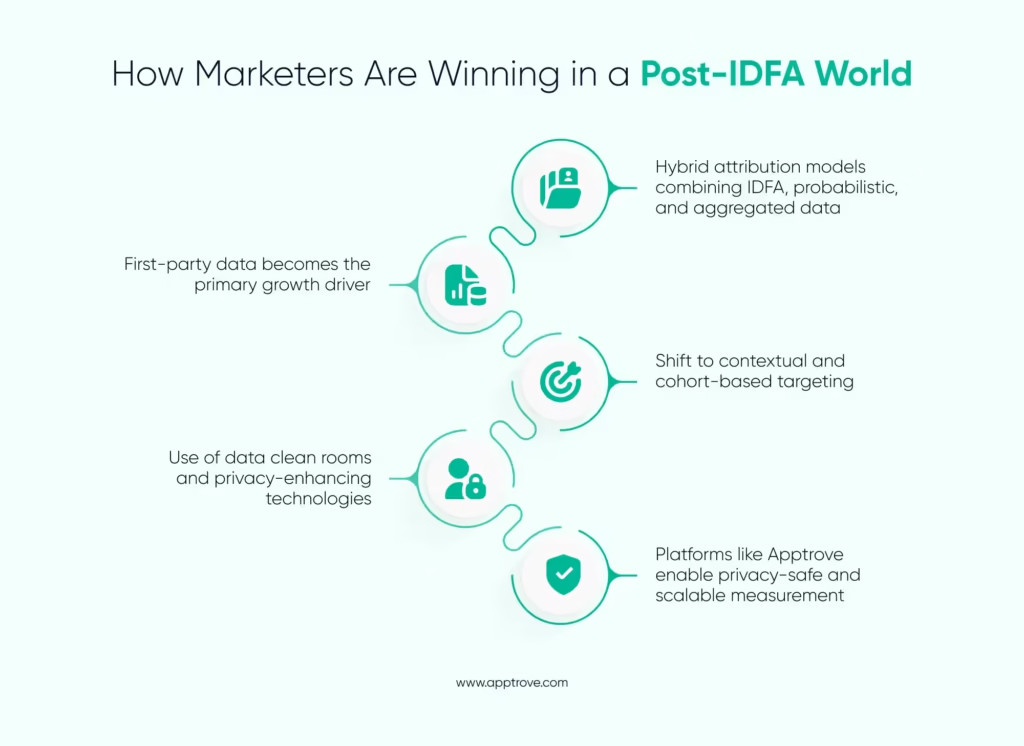
With the lack of access to the IDFA, the emerging solution for measuring the impact of marketing campaigns is the use of probabilistic attribution to help fill in the missing data. Probabilistic methods use statistical analyses of events to estimate how marketing activities have impacted app installs and conversions, whereas deterministic methods rely on direct access to the Identifier for Advertisers. Probabilistic attribution models consider factors such as: device type, interaction time, location data signals, and user behaviour trends without solely relying on the IDFA as the primary data input. Deterministic attribution models provide a high degree of certainty (e.g., one-to-one relationship) regarding performance, whereas probabilistic models allow marketers to gain a more directional view of the performance of their marketing efforts.
From the MMP perspective, the other key technology component concerning probabilistic attribution is predictive analytics. Utilizing machine learning technologies, we can predict future performance and determine trends, even in cases where data related to the Identifier for Advertisers is unavailable or incomplete—marketers can continue to optimise their marketing activities based on insights generated from probabilistic attribution data instead of solely based on the IDFA being available.
Privacy-Preserving Attribution
On the continuum of privacy, with the changes to IDFA, privacy-centred attribution frameworks, such as Apple’s SKAdNetwork, have become essential tools for marketers to measure and report on marketing activity without sacrificing privacy to user-level data tied to the Identifier for Advertisers. The SKAdNetwork provides aggregated, anonymised data for each marketing campaign; limits the amount of information that can be shared; implements privacy thresholds based on minimum data volume size; and limits reporting of aggregated data.
Hybrid Attribution Models
There is no single method we can replace with IDFA. Hybrid attribution models are used more often in the industry; they involve combining multiple data sources, including deterministic signals from IDFA and non-deterministic/probabilistic estimates and aggregate data from privacy frameworks. Hybrid models provide advertisers with a blended understanding of their performance because IDFA is no longer the sole measurement source; it is only one of many competing sources used to establish performance. Hybrid attribution models represent a balanced approach to attributions; they allow for lowering dependence on the IDFA while providing sufficient accuracy to support the decision-making process.
As IDFA becomes less useful, clean rooms will become increasingly popular and valuable for advertisers. Clean rooms allow advertisers and platforms to work together using an anonymized data set while not having to reveal user identifiers (IDFA). Clean rooms not only allow advertisers to securely and privately match and analyze data; they also provide a level of compliance with the law. Because of that, advertisers do not need to use IDFA as a basis for cross-platform insights.
The second responsibility of an MMP is to support the creation of these clean rooms by enabling them to share securely with other advertisers and by using aggregated/anonymized data. Providing secure data-sharing environments will ensure that advertisers continue creating cross-platform insights even when the Identifier for Advertisers is not available due to privacy legislation or other restrictions.
The Strategic Role of MMPs in a Privacy-First World
MMPs as Measurement Infrastructure
As a result of the shifting landscape toward privacy-first systems, MMPs have become the backbone of the industry. The decline of Identifier for Advertisers has made it imperative to have a central point through which advertisers, ad networks and analytics platforms all connect.
With IDFA being the connective tissue of the ecosystem, it enabled the electronic flow of data and attribution. With the decrease in availability of the IDFA, there has been a loss of that continuity. The MMPs now act as the bridge to connect the disparate pieces of data so that the data can continue to be connected and interpreted.
In our view, the MMP is no longer measured; they are orchestrating the various fragmented inputs (PARTIAL IDFA SIGNALS, etc.) into a single coherent view of performance.
Privacy-compliant Attribution
The primary role of MMP’s as of today is enabling privacy-compliant attribution. Given that there are restrictions on Identifier for Advertisers, measurement frameworks such as SKAdNetwork are essential for campaign measurement.
MMP’s manage these types of integrations, making sure that data flows appropriately and in compliance with platform rules. Thus, even without an Identifier for Advertisers, our teams ensure marketers receive aggregated performance data that reflects the performance of the campaign.
Compliance is a must. All regulations and platform policies need to be adhered to at all times; IDFA cannot be used without consent.
Unified Data and Cross-Channel Visibility
Typically, when Identifier for Advertisers signals are limited, channels have different (and often fragmented) data visibility. Because each channel/platform may only provide a portion of the overall picture for performance, it is challenging to understand performance.
Multiple Data Sources Unified
MMPs consolidate multiple databases of data points into one system, thus solving this problem. When coverage of IDFA is inconsistent, we are able to combine all types of signals, including but not limited to deterministic, probabilistic, and aggregated, to provide a more complete picture.
With all types of signals combined to create one view, marketers will still have a way to make decisions based on data and guidance, even though full IDFA visibility may never again be available. Flexibility is the goal in the absence of IDFA, but measurement will not break down in the absence of an Identifier for Advertisers.
Data Integrity and Fraud Prevention
When the reliability of IDFA signals diminishes, the potential for fraud increases. Fraud can affect attribution due to gaps in the verification of the identity of users with deterministic signals, due to limited IDFA coverage.
Maintaining the integrity of the data sources collected is one area that MMPs have been charged with helping. In conjunction with MMPs, verification layers will analyse patterns and detect anomalies in packets, irrespective of the extent to which IDFA is used or users are actually in those validation records.
The ability to provide trustworthy information about campaign performance from all sources, regardless of whether or not IDFA was previously or is still being widely used, is critical to the success of any marketing initiative. While IDFA was once a strong measure of validation through tracking users, anti-fraud methodology must now work efficiently and effectively without solely relying on IDFA validation processes.
How Apptrove Helps Marketers Maintain the Privacy–Performance Balance
Apptrove is designed to solve issues that arise due to a post-IDFA world. The structure of the platform provides measurement via a privacy-first approach and a reduced dependence upon the IDFA and its associated measurement methodologies while providing attribution capabilities.
In addition, with the combination of multiple advanced attribution methodologies, Apptrove is the only solution that brings together SKAdNetwork data, probabilistic models, and aggregated insights into one solution. By employing this complete solution, all marketers will now have the ability to measure performance across all available channels, even in instances where Identifier for Advertisers signals have become limited or are no longer available.
Beyond the IDFA, Apptrove also delivers scalable analytics solutions that allow for the optimisation of performance across channels based on aggregate data sources. The focus of the platform is to provide marketers with actionable intelligence based on all data sources rather than solely relying on IDFA data.
Ultimately, the future of MMPs is about how to build solutions that operate beyond IDFA versus how to develop a solution that is capable of replacing IDFA altogether. Apptrove is representative of this trend and will allow marketers to meet their performance objectives while remaining fully aligned with privacy standards.
The Role of First-Party Data in App Marketer Growth Strategies
First-party data has quickly become one of the most important components of marketers’ app growth plans, as they transition to a model that no longer relies on IDFA. Instead, marketers are developing and maintaining direct engagement with their users to build and grow the direct relationships they have with their users.
The move towards an engagement model encourages apps to build relationships by exchanging value with users through personalised experiences, loyalty programs, and premium content, in exchange for users’ trust and data sharing with the application. With the Identifier for Advertisers no longer being consistently available, first-party data is an alternative that is more stable, compliant with privacy laws, and overall much more reliable.
The collection of consent-based data from users is a vital component of the new strategy being implemented. Unlike IDFA, which is a cross-app interface that allows marketers to collect user-level data across multiple applications, first-party data is generally gathered by marketers through the application itself, with the users giving their explicit permission to collect their data. From an MMP perspective, this is not only a more reliable form of data collection but also a better fit for the evolving privacy framework.
Contextual Targeting and Cohort-Based Targeting
With the decrease in the number of individuals that can be targeted with IDFA, marketers are moving away from using individually-based targeting and are utilizing more global methods of targeting, such as contextual targeting and cohort-based targeting, to reach consumers without using IDFA to identify a user.
Contextual targeting focuses on the content and context where an advertisement is served, and cohort-based targeting groups consumers together by behaviours that they share with other consumers.
For MMPs, this shift means supporting measurement frameworks that work without direct IDFA signals. By analyzing aggregated patterns, we help marketers understand which cohorts perform best, even when IDFA data is minimal or unavailable.
Creative Optimization and Incrementality Testing
First-party data has quickly become one of the most important components of marketers’ app growth plans, as they transition to a model that no longer relies on Identifier for Advertisers. Instead, marketers are developing and maintaining direct engagement with their users to build and grow the direct relationships they have with their users.
The move towards an engagement model encourages apps to build relationships by exchanging value with users through personalised experiences, loyalty programs, and premium content, in exchange for users’ trust and data sharing with the application. With the Identifier for Advertisers no longer being consistently available, first-party data is an alternative that is more stable, compliant with privacy laws, and overall much more reliable.
The collection of consent-based data from users is a vital component of the new strategy being implemented. Unlike IDFA, which is a cross-app interface that allows marketers to collect user-level data across multiple applications, first-party data is generally gathered by marketers through the application itself, with the users giving their explicit permission to collect their data. From an MMP perspective, this is not only a more reliable form of data collection but also a better fit for the evolving privacy framework.
Contextual Targeting and Cohort-Based Targeting. With the decrease in the number of individuals that can be targeted with IDFA, marketers are moving away from using individually-based targeting and are utilizing more global methods of targeting, such as contextual targeting and cohort-based targeting, to reach consumers without using IDFA to identify a user.
Contextual targeting focuses on the content and context where an advertisement is served, and cohort-based targeting groups consumers together by behaviors that they share with other consumers.
Building Privacy-First Measurement Frameworks
The one noticeable change in marketing after the deprecation of the IDFA will be reduced visibility. Because the IDFA is no longer available on a consistent basis, measurement techniques are unable to rely on complete (user) level data.
As a result, marketers’ perspectives on the definition of ‘successful’ must shift. Traditional KPIs defined based on deterministic attribution and Identifier for Advertisers accuracy will no longer provide a means of achieving success. For example, metrics such as exact cost per install (or exact cost per user based on return on advertising spend) may not provide effective ways of determining success, as access to IDFA signals will be limited.
Marketers need flexible benchmarks that provide for uncertainty. Marketing should focus less on exact numbers associated with IDFA and more on trends, the direction of performance, and aggregate results for all users of a marketing campaign. The objective is to build measurement systems that can provide reliable results even when the amount of coverage from the Identifier for Advertisers can vary. Due to the lack of access to IDFA, aggregated data now serve as the basis for modern measurement. Marketers who used to track and identify individual users through the use of the IDFA now perform analysis on a real-time basis by grouping users into cohorts.
Cohorts consist of groups of users who share common aspects, such as common behaviours, the same acquisition source, or similar timeframes. Although this form of grouping does not provide the level of granularity provided by IDFA tracking, cohort grouping can still yield useful metrics that provide insights about campaign effectiveness. The attribution modelling methods used to analyse these cohorts are performed by MMPs through the blending of aggregate reporting and probabilistic modelling. This shift may seem limiting at first, but it encourages more strategic decision-making based on broader performance trends rather than isolated data points.
Balancing Compliance with Marketing Effectiveness
Compliance with privacy regulations is now required as a foundational requirement rather than simply being viewed as something required after-the-fact. Due to this, including regulations and policies of platforms on using IDFA (i.e. Apple’s identifier for advertisers) will require marketers to directly align their measurement frame with these requirements.
From the MMP view, the main challenge to marketers is to continue to achieve marketing success and at the same time, reduce their dependence on Identifier for Advertisers. For instance, they must utilise privacy safe attribution methods, ensure that they are managing consent well, and limit their usage of any type of sensitive identifiers.
Performance cannot be ignored either. Performances are achieved when companies build their strategy on the foundation of compliance and do not treat compliance as an impediment to performance.
IDFA is no longer the focal point of measurement – it is simply a part of a bigger picture of measurement. Balancing the need for privacy with performance needs will allow marketers to build sustainable and effective frameworks that will continue to work into the future
The Future of Mobile Measurement:
The Shift Towards Modelled and Predictive Attribution. With the declining relevance of the IDFA as a measurement tool, it has become clear that the future of mobile measurement is going towards modelled and predictive attribution. Marketers have been shifting towards using more artificial intelligence and machine learning to provide user-level tracking and have compensated for the declining usage of IDFA by relying less heavily on IDFA for user-level tracking.
From an MMP perspective, this shift is both necessary and strategic. Predictive models analyze historical patterns, campaign signals, and aggregated data to estimate performance outcomes, even when IDFA is unavailable. While IDFA still contributes where present, it is no longer required to generate meaningful insights.
Machine learning enables faster and more adaptive decision-making. Campaign optimization can now be guided by trends and probabilities rather than solely by deterministic signals tied to IDFA. This allows marketers to maintain performance even in environments where IDFA access is inconsistent.
Privacy-Enhancing Technologies
Privacy-oriented technologies like Differential Privacy, which adds a layer of randomness to datasets to mask the identity of individual users, will have an impact on how we measure in the future and help to reduce the dependence on IDFA whilst protecting user information.
Privacy-enabling measurement tools such as Secure Multi-Party Computation will allow companies to collaborate on data analysis without sharing sensitive data directly between each party. This enables insight generation without revealing user identifiers such as the Identifier for Advertisers.
These types of technologies represent a vital resource for MMPs, giving MMPs a “how-to” toolkit so that they can continue to measure while still being “privacy-centric.” No longer will companies use IDFA as a primary signal, but rather, they will be able to produce insights in a compliant and secure way.
Collaboration throughout the mobile ecosystem is going to be critical in a world where Identifier for Advertisers will be in decline. Companies such as Advertisers, Ad Networks and MMPs will need to work together to develop standardised approaches for measuring that maintain user privacy – ultimately providing a consistent, privacy-safe measurement process.
No one company will be reliant on IDFA for generating insight anymore. Shared measurement frameworks, aggregated reporting systems, and interoperable measurement solutions will be imperative to maintain measurement consistency.
In particular, the collaboration approach for MMPs will enable the ecosystem to remain efficient and functional through the changing landscape of IDFA moving forward. The “what” about the future will change as well.
Conclusion: Navigating the Privacy-Performance Balance
The mobile marketing landscape has permanently shifted, and the decline of the IDFA reflects a broader move toward privacy-first ecosystems. IDFA is no longer a guaranteed signal, and its reduced availability has reshaped how marketers approach attribution, targeting, and optimization.
From an MMP perspective, this is not a temporary disruption; it is the new standard. Privacy is now a core part of the ecosystem, and strategies must be built to function with limited or inconsistent IDFA access.
While IDFA once powered precise measurement, its limitations do not mean performance marketing is no longer effective. Instead, measurement is evolving. By combining aggregated data, probabilistic models, and privacy-safe frameworks, marketers can continue to generate actionable insights without relying entirely on IDFA.
MMPs play a key role in this evolution. We help translate incomplete signals into meaningful performance metrics, ensuring that marketers can still optimize campaigns even when IDFA data is restricted.
As IDFA becomes less central, MMPs are defining the future of app growth. Platforms like Apptrove are designed to operate in environments where IDFA is limited, offering advanced attribution frameworks and scalable analytics.
By reducing dependence on IDFA and enabling privacy-safe measurement, MMPs ensure that growth remains sustainable. The balance between privacy and performance is no longer a challenge to overcome; it is a system to master, and MMPs are at the centre of making it work.
from Apptrove https://apptrove.com/post-idfa-how-marketers-are-adapting/
via Apptrove


Comments
Post a Comment