Cost per Click
What is Cost per Click?
The cost per click, or CPC, is a metric that provides advertisers with an idea of how much an ad was charged for each time someone clicked on it. Rather than being billed based on how many times someone viewed the ad (CPM or Cost Per Impression), CPC is a model used to measure advertisers’ performance by showing how much they have spent to get clicks to their website. When applied to different advertising mediums (e.g., search engine ads, social media ads, or display ads), CPC shows how effectively an advertiser is directing visitors from their advertising budget to their website.
With digital spending growing rapidly, CPC is going to be increasingly important to help you get the most out of each click and each rupee you spend. According to Statista, the total global spend on digital marketing is expected to be more than $950 billion by 2026. This demonstrates how critical it is for businesses like yours to maximise the effectiveness of every click.
Cost Per Click, or CPC, is one aspect of performance marketing that will link the cost you’re paying for an ad directly back to the audience engaging with your ads, as well as allow you to track the amount of traffic your ad is sending to your website or digital property while controlling your ad spend. The problem with using CPC is that simply getting clicks is insufficient. The only clicks that matter are the ones that lead to conversions, so using deeper analytics and tools such as Apptrove to evaluate your performance will provide you with an in-depth look into how much your campaigns are truly generating for you, as opposed to just surface-level metrics.
The purpose of this guide is to provide you with the information needed to understand how CPC is calculated, how you can influence it, how you should utilise it to create better results while avoiding wasteful spending, and what steps you need to take to increase your chances of success when using CPC.
What is Cost Per Click in CPC Advertising?
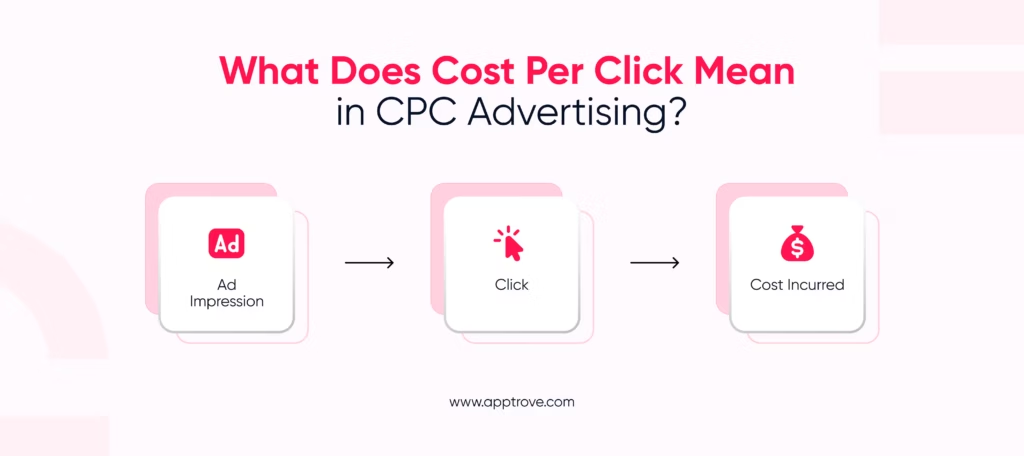
In real-world terms, when you pay for Cost Per Click (CPC) advertising, you are only billed if someone actually clicks on your ad and not if they merely view it. As a result, CPC advertising is one of the most action-oriented methods of digital marketing. You use your marketing budget to pay for user engagement, not just visibility.
CPC is typically used across multiple types of online advertising businesses. For example, in search ads, you pay a fee to bid on specific keywords for your ad to appear as a result of the user searching for similar keywords. In social media ads, CPC allows you to generate traffic to your website by targeting users in specific demographic groups. Similarly, in display ads, CPC allows you to be charged once the viewer has gone beyond just seeing your banner ad by clicking through to your website.
Advertisers prefer to use CPC due to its clear relationship between dollars spent and documented reader interactivity, while there’s no apparent or proven relationship between dollars spent on CPM per impression and engagement, CPC creates a direct correlation between the money you’re spending and the measurable action taken as a result of that spending. More clicks don’t necessarily indicate better performance, and it’s important to remember that if your clicks convert at a low rate, your spending quickly will become wasteful.
For this reason, quality should always be valued above quantity. A small number of very pertinent clicks can frequently provide far greater conversion success than a large amount of low-intent traffic. Ultimately, when CPC is strategically employed, it enables you to achieve the perfect balance of cost, intent, and resulting successful outcome for effective performance-based campaigns.
How Cost Per Click (CPC) Is Determined
Having a clear understanding of how Cost Per Click (CPC) works will allow you to make better choices by eliminating assumptions when creating your ad campaign. Simply stated, the CPC is an easy metric to understand; however, there are numerous dynamic variables that can affect it depending on how well your ads are performing and whether they are getting the most return on investment (ROI).
How CPC Works and What Is the CPC Formula?
CPC = Total Clicks / Total Cost
To explain it simply, you take your total campaign cost and divide it by the number of clicks that the campaign generated. The result is the average cost per click that you pay for each user to take an action (click).
For example, if you spend 5000 and get 1000 clicks, your CPC would then be 5.
That is going to be your base number to see if your campaign has cost effective.
CPC also indicates how well your ad is resonating with your audience, as a lower CPC indicates that your ad was relevant and engaging to your audience, and therefore, you’d want to continue to do what is generating those low CPCs. If your CPC is high, then you would likely need to optimise your campaign.
How Do Bidding and Competition Affect The Amount You’ll Pay Per Click?
The CPC will exist in a vacuum, but it is greatly influenced by the way that advertising platforms run their auction system. Each time your ad is shown, it competes against multiple advertisers who want that same audience.
These are the major factors affecting your CPC:
- Bidding Strategy: More aggressive bidding increases your chances of winning auctions, but can also result in higher CPC if you do not optimise.
- Keyword Competition: Popular or higher intent keywords are generally costlier due to demand.
- Ad Rank and Quality: Platforms consider the relevance of your ads, expected clickthrough rates, and experiences on your landing pages when assigning ad rank and consequently your CPC.
- Audience Targeting: Depending on the demand of your premium audience, targeting smaller or premium audiences will generally mean you will pay a higher CPC.
As a result, you will not always be charged the maximum bid; instead, the platform calculates your CPC based on the competition you are competing with directly below you and the ad quality of your ads. Therefore, ads that are well-optimised can still achieve low CPCs even in a competitive marketplace.
The Relevance of Cost per Click to Your Marketing Campaign
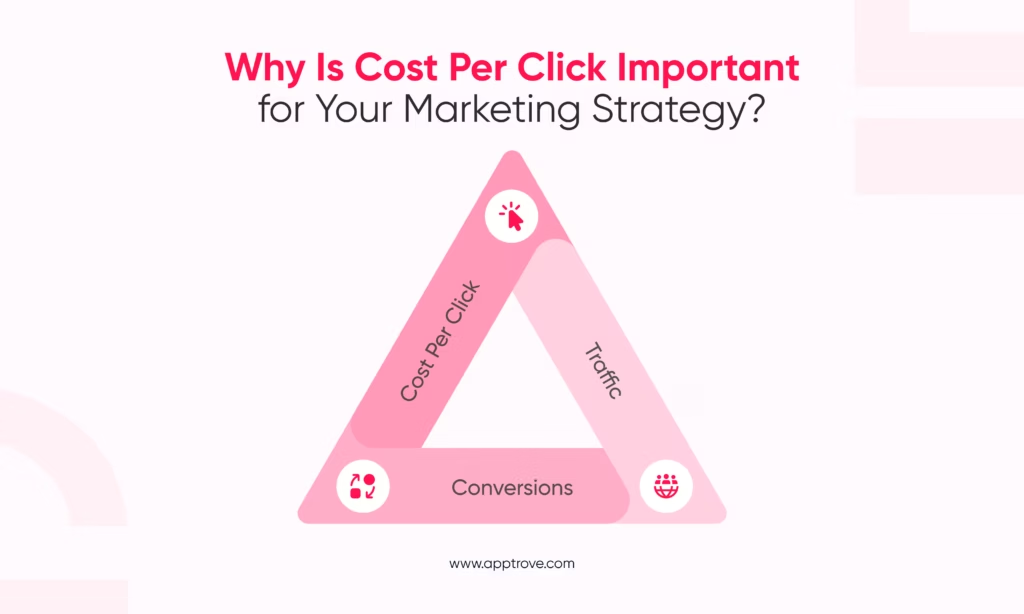
The Cost Per Click (CPC) of your ad serves an important purpose by helping determine how successful your advertising budget has been spent, as well as measuring how productive your marketing campaigns have been in terms of generating traffic that is interested in your products or services. The CPC is more than just a dollar figure; it is a powerful performance tool that gives you insight into how your ad campaign is generating the right kind of traffic.
From a budget perspective, CPC gives you a tool to manage how much of your marketing budget you have invested in each consumer interaction with your product or service. By using CPC as a benchmark, marketers can manage how much money they allocate to each ad campaign based on the type of traffic they are providing to the business. In addition, a lower CPC can be a strong indication that an ad has been placed appropriately and that the traffic generated by the ad is of high-quality, allowing a marketer to maximise their reach with minimal cost.
CPC is a good tool for measurable performance online because it gives you a clear method to track user engagement levels. You can use CPC to compare various campaigns, different channels, and the effectiveness of creative by allowing you to know whether or not your efforts are successful. You will be utilising actual user behaviour, so instead of only tracking impressions, you can now gather more useful insights.
CPC is also important for ROI measurement because it links the cost of a click to the number of clicks, which will convert into actual conversions sometime in the future. Therefore, CPC can be used as a basic number to determine whether a campaign will be profitable.
- Lower CPC gives you more potential for growing your campaigns.
- Higher quality clicks have a higher probability of converting into actual conversions.
- A good CPC will lead to a higher rate of return on investment for your advertising dollars.
As you can see, CPC is a critical part of successfully optimising costs, traffic, and outcomes, therefore allowing you to maximise results based on how you use optimally paid search advertising to create strong relationships with your customers.
Which Factors Affect the Cost Per Click of CPC Ads?
The cost you pay to receive clicks on your ad is variable. Costs will vary depending on multiple factors that indicate how competitive, relevant, and well-optimised your campaigns are; knowing these variables will allow you to be more proactive in controlling costs rather than being reactive due to unpredictable increases in your costs per click.
A major driver of cost per click is competition for keywords, as more advertisers competing for the same set of keywords leads to increased costs. Many times, costs increase due to the number of competitors within a particular industry or recent trends and events, with the number of businesses trying to attract the same audience increasing relative to the number of clicks available.
Ad quality and relevance are also crucial for success. The platforms that you are advertising on will be putting more weight on ads that closely match users’ intent when ranking ads. Therefore, if your ad copy, creative and landing page experience are all strong, it is likely that you will rank higher and have a lower cost-per-click (CPC) as a result. On the other hand, if you have an unoptimized ad, it may drive up your costs without improving your performance.
The other key factor you must consider is your target audience. High-value segments (such as people with very clear purchase intent) generally cost a lot more to reach than low-value segments. Conversely, larger audiences typically provide lower CPCs, but will likely not produce as many conversions.
Finally, both industry trends and seasonal factors will also impact your CPC. For example, during peak shopping seasons (such as Christmas) or the peak of your major advertising campaigns, you may see a higher CPC due to increased competition among advertisers on all platforms.
What Is The Impact Of Ad Quality Score On Cost Per Click?
The ad networks use quality indicators to determine the quality of your advertisements based on these criteria: relevance, expected click-through rate, and the experience when landing on the page. If your quality score is higher, it can:
- Decrease your CPC
- Improve the placement of your advertisement
- Increase the efficiency of your campaign
In short, if your ad has a good quality score, it will also cost you less money.
How Does The Targeting Of Your Audience Affect The Cost-Per-Click (CPC)?
The more specific and valuable your target audience is, the more competitive it is to access them. CPC rates will differ based on:
- Demographic and interest-based targeting
- Behaviour-based intent-signals
- Geographic targeting
Although highly targeted campaigns may produce superior results for advertisers, they also tend to be significantly more costly than untargeted or less-targeted campaigns. Finding a balance between precision-targeting versus cost-effectiveness, so that your CPC meets your overall performance objectives, is critical.
Ways to Lower Your Cost Per Click without Sacrificing Performance
Improving campaign performance doesn’t just happen overnight by cutting costs or changing your approach; it happens when you have a strong focus on improving the way that your campaigns connect to their target market while creating value for the business. Once you begin optimising for results rather than quick fixes, you will see a decrease in your cost per click as well as an improvement in the overall quality of your traffic and conversions.
The key to lowering your cpc is to create alignment between your messaging and targeting, and then use the data insights that you have to allow your ads to gain better engagement (more clicks) at less expense. By doing so, instead of focusing solely on obtaining cheaper clicks, you will also be working toward obtaining higher-value clicks that provide a greater return on investment (ROI) for your company.
How Can You Improve Your CPC Advertising Efforts?
Improving your CPC will not be achieved by simply lowering the amount you spend; instead, you’ll have to continuously work on how your campaigns operate:
- Improve the quality of your ad copy. Create ads that are written well, clearly communicate your intended message(s), and contain intent-based language that speaks directly to what the user wants.
- Refine who you’re targeting. Rather than targeting a broad audience and hoping for some of them to engage with you, identify and target those audiences that are most likely to engage with you.
- Utilise A/B testing. Test out different creative and copy combinations/revisions, different headlines, and try different ad formats to determine which will yield the highest CTRs.
- Smartly optimise your landing pages. Once a user has clicked on your ad, they should be offered a great experience while visiting the site.
As your ads become increasingly relevant and engaging, the various ad networks will continue to reward you with new and/or improved ad placements at lower CPCs.
How Can Data and Attribution Reduce CPC?
Without suitable measurements, you are merely taking a guess at what will work; therefore, data creates an intelligent approach to your decision-making for CPC.
Once you obtain accurate attribution and analytic tools (Apptrove), you can:
- Determine high-quality clicks by campaign and channel
- Look at user experiences after they have clicked the initial click
- Remove wasted spend from poor-performing channels
- Continuously optimise based on real data about performance
Combining robust insight with continuous optimisation will lead to lower CPC without having to force it.
Limitations of Cost-per-click (CPC) Metrics in Performance Marketing
Cost-per-click (CPC) is a useful and widely used metric, but when used by itself, you typically will not get the complete picture of the success of your advertising campaign. CPC measurements will give you the amount spent per click, but not whether the clicks resulted in an actual outcome that you were trying to achieve.
A significant limitation of using CPC as a measure of performance is that just because you have generated website clicks, it does not mean that these users will actually convert (take the desired action) on your website. You could have low costs for clicks and generate very high traffic to your website, but if those users do not complete the desired action (such as completing a signup or making a purchase), then your advertising campaign is not meeting your expectations. Therefore, CPC results should always be considered along with deeper performance indicators (such as conversion rate, return on ad spend, etc.) to accurately measure campaign success.
Another thing that you should be aware of is the potential risk of click fraud. If someone clicks on your ads either unintentionally or invalidly, this can lead to increased costs with no benefit to you. If your campaign doesn’t monitor for invalid clicks, your campaign performance, overall return on investment and budget allocation strategy could be easily misallocated due to invalid clicks and/or the absence of valid clicks.
Knowing what to do about such risks is key to preserving the integrity of your advertising data, and having a fraud detection tool like Mobile Fraud Detection will help with this issue.
In addition, CPC may be misleading when applied without consideration of other data points and performance measures. On the one hand, you might think a low CPC puts you in a winning position; however, if those low CPC clicks come from users who are not serious about purchasing from you, you could be negatively impacted in your overall performance in terms of sales and overall revenue. Conversely, if you pay a slightly higher CPC, but capture higher-quality traffic that is more likely to convert into customers, you will be better off than if you had conducted your campaign using a lower CPC.
Ultimately, the best use of CPC is when combined with other measurement strategies that monitor and evaluate what happens after the click.
How CPC Is Changing in Today’s Digital Advertising
CPC has changed from being a static measure of advertising costs into an evolving metric aligning with the way that digital advertising itself has changed. Automation, privacy rules, and more advanced targeting have led to changes in how you think about CPC compared to just a few years ago.
One of the major changes in CPC has been the rise of automated/AI-driven bidding. Advertising platforms are now using machine-learning algorithms to evaluate bids in response to user activity, intent signals, and prior performance on an ongoing basis. As a result, CPC rates are becoming more influenced by machine-learning algorithms which are measuring performance, not just click activity. According to Statista, AI-based media buying is becoming part of every company’s media buying strategy, and an increasing number of advertisers depend on the automated optimisation of their digital spend.
CPC is undergoing transformation as a result of privacy initiatives. For example, data restrictions and the amount of individual-level tracking available mean that marketers are focusing more on utilising aggregate insights and probabilistic approaches when measuring performance. As a result, establishing reliable measurement frameworks is critical due to less accurate attribution of conversions for clicks.
Furthermore, there is a clear trend toward targeting consumers based on their intent rather than just on their demographics or broad audience categories. As companies’ focus is now on obtaining consumer data in real-time through the use of search history, app usage, and contextual factors, we are seeing improvements in the quality of clicks, even though the CPC may change due to these factors.
With changes to CPC from cost only to more contextual and intent-based measurements, combined with intelligent optimisation for driving better results in a more complex digital ecosystem, it will become harder to establish a traditional measure of success for your program.
Final Thoughts: Why Knowing Your CPC is Important to Your Growth
Cost Per Click (CPC) tells us how much it costs to run an ad, but also shows us how effective our marketing triggers are in achieving true user engagement. You’ve already seen from the previous sections how using CPC helps you measure the relationship between how much money you spend on ads and the amount of revenue generated.
Our objective isn’t necessarily going after the lowest CPC; we’re actually looking for smarter use of our advertising expenses. Focusing on relevance/coherence, targeting/audience, and optimising through data will create a more authentic experience for potential customers; therefore, generating a higher rate of conversion through analytics. This transition away from “cheaper clicks” to “better clicks” is the foundation for sustainable growth in the long term.
Your understanding of CPC (cost-per-click) directly affects your overall campaign success as digital advertising continues to grow more competitive and emphasises data. By being strategic and focused on the way that you interpret your CPC campaign, you can improve your control over expense, performance and outcome.
If you’re looking for more than just basic metrics of performance and would like to truly understand what is responsible for driving performance, then it may be time for you to move towards a more structured, insight-based approach to measure how deeper attribution and smarter analyses will assist you with the next phase of growth within your company. Please reach out to us if you would like assistance in achieving this.
FAQs
1. What is a good Cost Per Click Matrix?
Cost-Per-Click or “CPC” has many variables: the industry, competition and the type of targeting you use to reach your audience. Therefore, each industry has a different target CPC; while you can look at benchmarks, it may not matter since every target CPC is dependent on your conversion rates and positive return on ad spend goals.
2. Why does Cost Per Click fluctuate over time?
Cost-per-click changes occur as a result of fluctuations in demand from seasonality, increases in the number of advertisers competing for clicks, and algorithm adjustments on the specific platform. It is also affected by the current market trends at that time, as well as any adjustments made to an individual advertiser’s campaign.
3. What is an effective way for beginners to improve their Cost Per Click results?
Cost Per Click can be improved by refining audience targeting, testing several ad creatives, and consistently tracking your performance data. Incremental, data-based changes will yield tremendous cost savings and increased overall effectiveness.
4. When should you give Priority to CPC?
Cost per Click should be considered first when determining returns or calculating return on investment in early-stage campaigns focused on generating traffic and awareness. For example, once CPC is analysed, it provides insight into how much engagement customers are exhibiting before measuring deeper metrics such as conversion rate and return on investment.
5. The Impact of User Intent on Cost-per-Click (CPC) Performance?
The effect of user intent on CPC performance is substantial; higher intent users tend to have higher CPCs. However, because of their higher propensity to convert, they represent more valuable clicks than lower-intent users and therefore can help improve overall campaign performance, despite the fact that they may cost more at the time of initial purchase.
from Apptrove https://apptrove.com/what-is-cost-per-click-cpc/
via Apptrove


Comments
Post a Comment