Mobile Measurement Partner (MMP): A Guide to Measuring Mobile in a Privacy-Focused World
MMP is the Backbone of Mobile Growth
Mobile growth today is far different from what it was just a couple of years ago. As a mobile app marketer, you aren’t managing one or two channels anymore; now, you are measuring installs from multiple networks, tracking in-app behavior on different devices, analyzing retention statistics, monitoring campaign performance, and adhering to ever-changing privacy regulations to determine how you can collect user data in the future. Campaign tracking has now changed from a simple task into an extremely complex and data-driven process.
This shift is also visible in advertising investment. DataReportal’s Digital 2025 report states that mobile accounted for 65.3% of global digital ad investment in 2024, up from 52.7% in 2019, showing how central mobile has become to modern marketing strategies.
This increased complexity is exactly why understanding what is MMP has become so important in modern app marketing. A Mobile Measurement Partner (MMP) acts as a centralized measurement system that helps you attribute installs, track user journeys, analyze campaign performance, and maintain data accuracy across multiple channels and devices.
In the absence of a single reliable measurement system, your data will be spread out across multiple dashboards, multiple analytic platforms, multiple advertising platforms, and multiple reporting systems. One reporting system may show installs, another will show engagement, while a third reporting system will show attribution or fraud prevention. As these data sets become distinct and are not reconciled, confusion will develop regarding performance, budget allocation, and user quality. Instead of making result-oriented decisions, you will be left to spend your time reconciling disparate sets of data.
What’s an MMP and Why Should We Care About Mobile Attribution?
A Few Facts About The Role of a Mobile Measurement Partner
Mobile marketing is getting easier to analyze as we increase our focus on data. To continue growing in the future, it will be important to know where your users came from and what they do after downloading your app. An MMP (Mobile Measurement Partner) will help provide critical information.
The MMP provides a centralized view of how users are discovering, downloading, and interacting with your app based on their mobile marketing efforts through various channels, ads, and devices.
The MMP is a bridge between your advertising platform(s) and your mobile app analytics.
When a user clicks on one of your ads, watches a video of an advertisement, or engages with a promotion before downloading your app, the MMP identifies which ad, video, or promotion was responsible for that download. An MMP also collects and analyzes other application-related event data, such as registration and purchasing events, subscription events, session events, and retention events. This information provides insight into where your app downloads originated, and which groups of people continue to support your application over the long-term.
The visibility of modern mobile growth is propped up by the rise of mobile app use and ad spending (based on recent statistics published by DataReportal & Statista). Because of the ongoing rise in both mobile app activity and ad budget each year, it is now increasingly important to accurately measure the individual performance of campaigns. With marketers managing sales from multiple channels, including social media, website, OEM apps, influencers, and programmatic, understanding the performance of a campaign is nearly impossible without mobile attribution.
A Measurement Platform (MMP) provides a single unified measurement system to tie the media source(s) of traffic directly to app events, resulting in accurate and meaningful reporting. Rather than being limited to a few isolated metrics that do not give you a true picture of how users interact with your brand throughout the entire process, MMPs allow you to have a much more complete perspective of the total user experience.
The Functionality of Mobile Attribution Technology
Essentially, mobile attribution determines the marketing interaction that caused a user to download and/or complete a conversion event on your mobile application.
Click attribution and view-through attribution are two of the most widely used attribution models in mobile marketing. With click attribution, if a user clicks on your advertisement and installs your app shortly thereafter, then the MMP would attribute that install back to the campaign/source of that click. With view-through attribution, if a user views your ad but does not click on it at first and installs the app later on in an established attribution window, then the view-through impression could still be credited for the app install.
Mobile deep links greatly enhance mobile attribution accuracy and the user experience on mobile apps. Rather than sending users to a generic landing page after clicking on an ad or downloading an app, deep links will send users directly to relevant in-app content, creating a more seamless user experience during the onboarding process and increasing conversions.
When an app is installed, the MMP will continue to track and report any post-install events associated with the app, including purchase, signup, subscription, engagement with features, retention, and other relevant data. Tracking and reporting this information allows marketers to not only measure the volume of app installs resulting from their marketing but also provides insights into the quality of those marketing-driven app installs.
How Mobile Attribution Influences All of Your Growth Goals
As an app marketer, mobile attribution has an effect on almost every decision you make about your marketing campaigns. When you don’t have reliable attribution data available to guide your budget decisions, then your choices become less educated and more guess-based. This may lead you to continue investing in campaigns that drive installs,s but not in ways that create users who stay as paying customers.
Through the use of a quality MMP, you are able to gain the ability to allocate your budget towards those channels, campaigns, and creative pieces,s as well as specific audiences that provide the highest return on your investment. This allows you to create a much better user acquisition plan by identifying where you are able to acquire high-quality users as opposed to only measuring the number of users that you can acquire.
Mobile attribution is even more valuable when evaluating your ROAS due to the fact that it can connect your ad spend to your actual business results. Rather than just measuring the number of installs, you can also measure things like how many purchases were made, how many users retained their accounts, subscription activity, and customer lifetime value more accurately.
Attribution is critical in providing you with the ability to see a higher level of retention. It allows you to measure which acquisition methods you are using to gain users who continue to engage with your app long-term. In a world where privacy is at the forefront of all data decisions and where the efficiency of our growth is more important than the raw number of mobile app installs, this level of visibility into all aspects of your growth will be necessary for your overall success.
The Evolution of Mobile Measurement Partner (MMP) in Privacy-First Industry
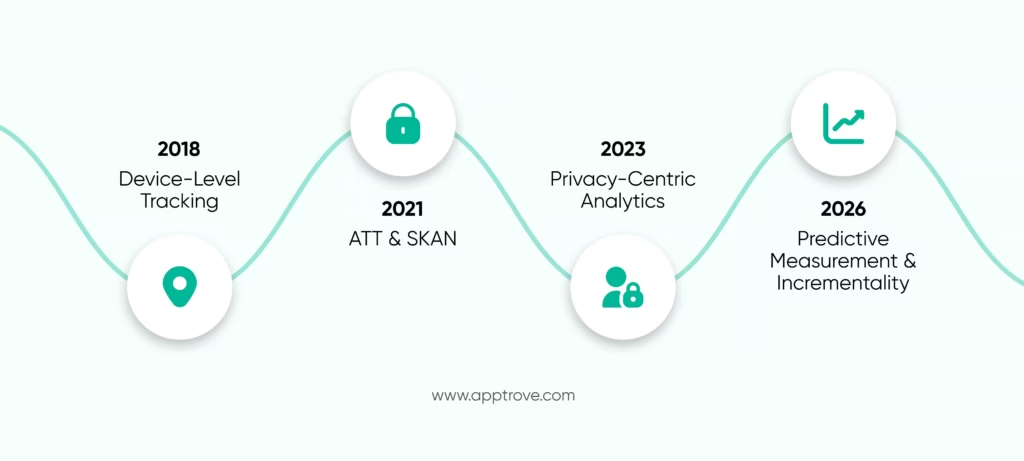
The mobile marketing industry is seeing a major shift. App marketers relied heavily on using device-specific identifiers and detailed user tracking in order to accurately measure the performance of their campaigns. Although this provided advertisers with a way to optimize installs and learn about user behavior, Increased concerns over digital privacy have drastically changed how mobile measurement now operates.
Because of this, the role of an MMP has evolved well past traditional attribution.
A modern MMP today needs to balance providing an accurate measurement and being compliant with the principles of privacy, user trust, and rapidly evolving platform policy. This new reality is redefining the landscape of how we will use mobile attribution going forward and forcing marketers to rethink how they will analyze their future growth.
Moving Away From Traditional Tracking
Mobile measurement experienced a significant change when Apple updated its IDFA. The introduction of App Tracking Transparency (ATT) enabled users to have increased control over whether or not they wanted their data tracked by an app. The outcome is a decrease in access to deterministic, user-specific data and a change in how attribution signals can be gathered.
Additionally, privacy requirements for consent have become easier to enforce in the digital ecosystem. Privacy regulations and platform policies now emphasize the importance of being transparent, getting users’ permission, and using data responsibly when conducting their activities. Previously, marketers had unrestricted access to tracking users; however, they are now faced with significant limitations on how much information they can access about the user journey.
The use of cookies to measure campaigns and target audiences has also been limited due to the move by both browsers and mobile environments to limit the use of third-party tracking methods. Consequently, cookies have been used to report on campaign performance and target specific user groups, but these limitations are creating further issues for measuring ad performance across platforms.
Android is moving toward becoming a privacy-focused operating system. With the evolution of Android privacy frameworks, advertisers will be forced to prepare for less tracking of individual devices and the need for reporting models based on aggregate data. These factors combined will create an urgency to develop privacy-compliant infrastructure for measuring ads.
How Privacy-First Measurement is Changing the Functionality of MMPs
As traditional methods of tracking are becoming harder to access, new MMPs (or Multi-channel Marketing Platforms) are being built on a methodology of privacy-first measurement.
In addition to relying on user-level identifiers, current methods are increasingly relying on aggregated reporting and modeled insights to evaluate the effectiveness of campaigns while following user consent and platform privacy guidelines.
Another key feature is consent-safe analytics. Rather than viewing compliance with privacy requirements as an obstacle, new mobile attribution platforms have integrated privacy-safe collection of data directly into their measurement methodologies.
Another key function of new MMPs is SKAdNetwork (SKAN) support. SKAN provides aggregated attribution signals to help marketers interpret post-backs, categorize conversion values, and simplify reporting for multiple marketing channels through one set of metrics.
Marketers are also increasingly focusing on predictive modeling. Because there is less complete visibility to program metrics, marketers now rely on modeled insights to predict retention behaviors, lifetime value, and campaign quality.
Modern MMP Solutions Evolve with Privacy Challenges
Modern MMPs are adapting to the changing landscape by embracing several key measurement trends, including an increased focus on:
1. First Party Data: The rise of privacy regulations and more restrictive data sharing practices has made first-party data more valuable than ever before; brands will be able to build stronger relationships with their customers while also having greater control over the accuracy of their measurements. Marketers will rely less on third-party identifiers to measure and will rely more on user interactions inside their own ecosystem with their own customer base, who are providing explicit consent for the collection and use of their personal information to measure the effectiveness of their ads.
2. Cohort Analysis: Marketers are utilizing the trend of cohort analysis as a key component of mobile attribution reporting; rather than only focusing on user-level attribution, marketers are now looking at aggregate behavior by grouping users and analyzing the resulting behavior/use patterns of these groups to better understand individuals’ engagement, retention, and monetization.
3. Incrementality Measurement: Marketers have shown interest in developing incrementality measurement methodologies to provide additional insights about the true effectiveness of their marketing campaigns. Rather than just determining which ad campaign should receive credit for generating an app install, marketers will begin asking questions about the true incremental impact on user behavior resulting from their ad campaigns (i.e., whether the user would have installed the app without seeing any ad for it).
4. Event Prioritization: Due to possible restrictions on the number of measurable signals for analytics purposes, marketers will need to be very judicious about which of the conversion events they want to use to optimize their training/semi-automated model and for long-term growth.
Main Features to Consider With a New MMP
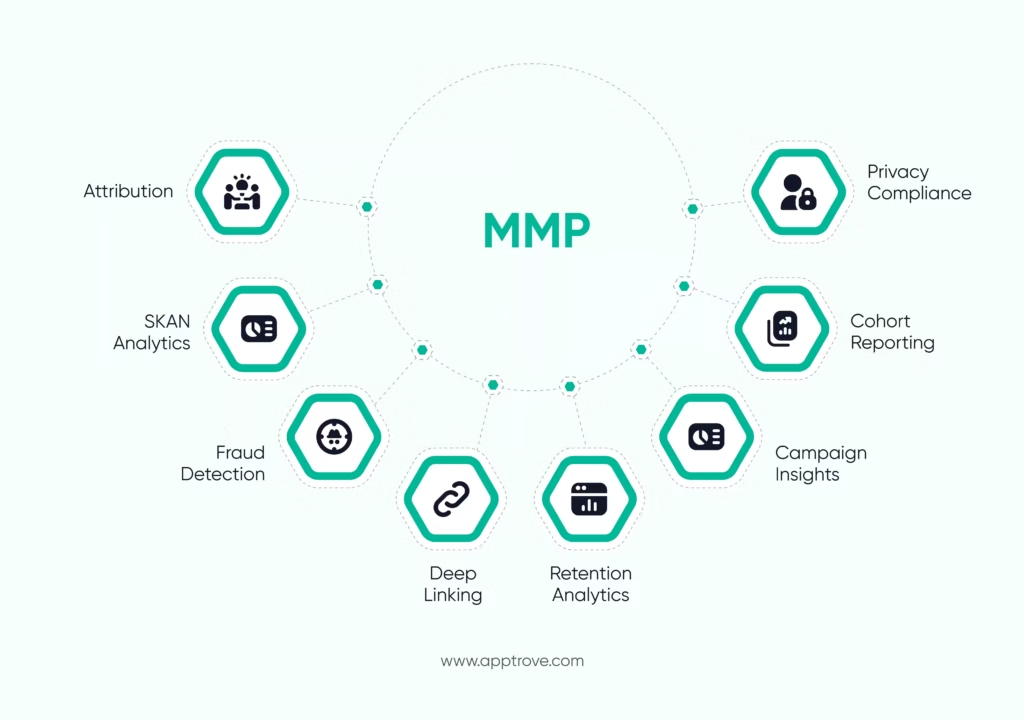
Selecting your MMP today is not solely about installing attribution. With more mobile ecosystems shifting towards privacy-focused methods, along with increasing costs for customer acquisition, your measurement infrastructure should provide much more than basic campaign tracking. A cutting-edge Mobile Measurement Partner will provide you with insights into user behavior, enhance your marketing efficiency, safeguard your campaigns, and adapt to new privacy regulations.
The best mobile measurement partners provide comprehensive mobile growth ecosystems containing attribution, analytics, anti-fraud capabilities, retention measurements, and privacy-compliant reporting in a single, cohesive platform.
Mobile Attribution and Campaign Measurement
Every MMP has two main functions: mobile attribution and campaign measurement. Mobile attribution is especially important because it will allow you to derive where your users have come from and what specific campaigns are driving meaningful growth for your company.
Real-time attribution is one of the most vital elements of MMPs today since it offers an understanding of how many installs you receive as a result of your campaigns, as well as how much in-app activity occurs because of those campaigns. By offering a real-time view into campaign performance, you may quickly analyze and optimize budgets and creative strategies without waiting several days for fragmented and/or delayed reports.
An MMP’s multi-touch visibility capability helps you evaluate the different touch points a user has had with your app over the user journey. Users do not convert after only one interaction; for instance, they may first learn about your app through a video advertisement, then revisit by means of social media, and finally download via a search engine campaign. As such, it is critical for an MMP to help you evaluate each user’s journey and understand how each touchpoint affects the conversion.
While install tracking is still a necessary function of MMPs, the total number of installs received is not the only value MMPs give to retail or brand marketers. Event measurement gives additional visibility into what users do after downloading your app. For instance, the number of users who register, subscribe, purchase, exhibit retention behavior, and engage with your app will help distinguish between users who were attracted to your app via a campaign that generated high-quality users versus campaigns that led to low-quality traffic being generated.
Mobile Fraud Prevention and Fraud Detection
As mobile advertising continues to expand, so does the sophistication of fraud. If you do not have any fraud protection on your marketing budget, it is very easy to waste money on unqualified traffic and improperly attributed clicks.
A reputable MMP will utilize solid fraud verification and fraud prevention features to protect both campaign performance and data integrity.
The most common type of mobile ad fraud is click spamming. In this case, fraudsters will create many fake clicks in order to receive attribution credit for organic installs (or installs that are not the product of any paid expenditure). SDK spoofing is another prevalent type of mobile ad fraud. This method uses fraudulent install or event signals to impersonate legitimate users and create a history of their interaction with your app.
Attributing installs can also lead to inaccurate attribution because it allows a company to capture installs that should have been recorded as conversions prior to the install being completed. Similarly, using bots or emulators to create fake installs damages your campaign performance metrics while also not providing any value to your actual users.
By identifying suspicious activity and filtering out fraudulent activity in real time, an MMP will allow you to have insight into your report that reflects legitimate performance instead of erroneous traffic.
Deep Linking & Seamless User Journey
Your app’s experience will be enhanced by utilizing a solid MMP for user movement through your app.
Through deep links, users can go straight to the relevant in-app location rather than returning to a generic home or welcome screen. By doing this, onboarding journeys happen more easily, and the friction in acquiring new users is lessened.
When a user clicks on an ad with deferred deep links, if they choose to install your app after engaging with the ad, they can still be taken to the desired in-app location after downloading the app. This creates a more personalized and seamless experience for users and allows for more fluid transitions from marketing message to landing page.
The usability of your app as a result of eliminating the friction associated with onboarding will allow users to fulfill their earlier intent (where to find the content, product, and/or offer they originally targeted). Thus, with more users vying for attention, the reduction of friction within the onboarding process of your app is a significant driver of retention and engagement.
Retention Analytics and Cohort Reporting
To achieve mobile growth in today’s world, it requires understanding long-term user quality and not only the volume of users you have acquired.
Using cohort reporting can help you analyze groups of users with similar behaviors, install times, acquisition channels, and/or sources of acquisition,n such as campaigns. Cohort Reporting enables you to gain insights into how different user cohorts engage with your app throughout time instead of just looking at total installs.
Retention analytics enables you to track the number of times users return after the initial install. If a large number of users have been installed, but have a high amount of churn, this is not a positive metric to measure mobile growth.
A good MMP can also help you get insights into lifetime value (LTV), which connects your acquisition spending to long-term revenue generation, allowing you to see which campaigns yield users that are more likely to purchase, subscribe, or maintain a user for an extended period of time.
Privacy Safe Reporting and SKAN Analytics
SKAN analytics is one of the most significant trends unfolding as privacy frameworks rapidly evolve, thus providing modern MMPs with an impactful feature set.
Marketers encounter difficulties interpreting campaign performance due to limited aggregate attribution signals that Apple is providing via the SKAdNetwork (rather than low-level user-level detail), but strong MMPs can decode the SKAN data into practical reporting formats that streamline the postback’s overall interpretation.
Conversion value management is another critical capability that allows marketers to assess which user event will be measured across privacy-compliant standards of measurement.
With modern MMPs, marketers have a way to work within the confines of limited visibility and delayed reporting through the MMP’s ability to combine aggregated insights and predictive analytics to develop structured reporting structures, making privacy-first mobile attribution significantly easier to action and execute against, as marketing begins developing long-term growth strategies.
The Role of an MMP in Bettering User Acquisition Decision Making
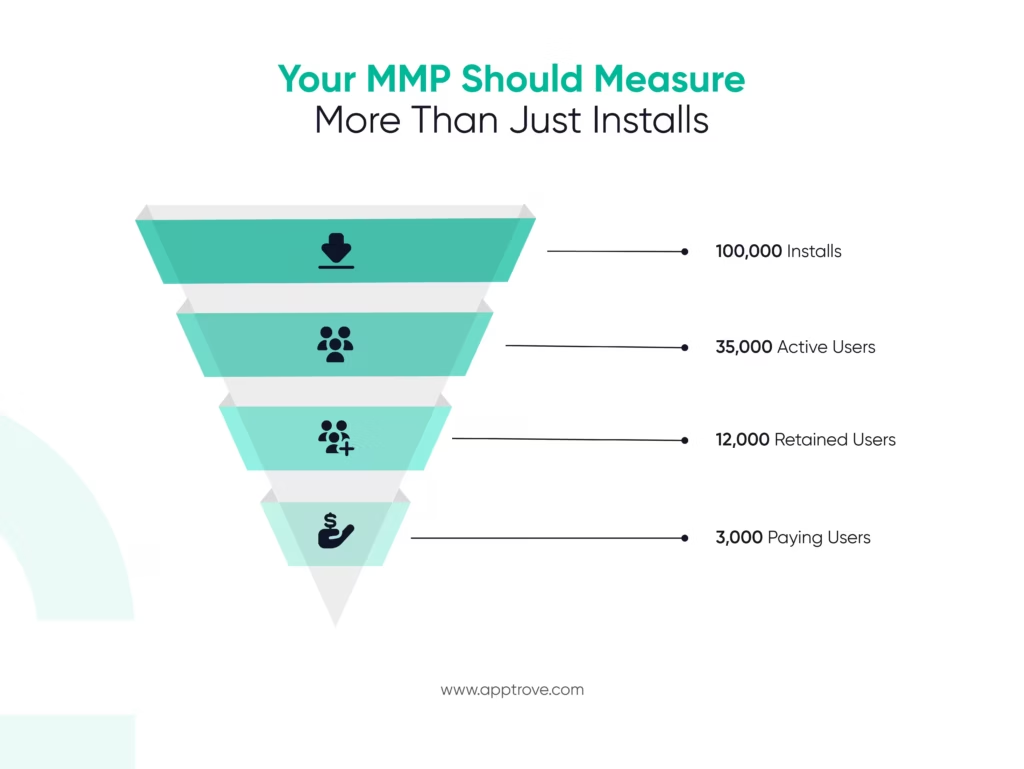
Over the last few years, user acquisition has become significantly more competitive, expensive, and data-driven than ever before. Multi-network advertising campaign success (e.g, creating installs) does not mean your campaigns will result in overall growth of your user base; to be successful, you must analyze the performance of each of your acquisitions by how many engaged users generate revenue over a long period of time.
This is why having access to a modern mobile measurement partner (MMP) is important when making good decisions around your user acquisition strategy.
An MMP not only focuses on top-level performance numbers – instead, it also helps connect user acquisition activity and actual business results. By allowing you to more easily see the economic performance of your acquisitions, an MMP improves the efficiency and sustainability of your user acquisition strategy through its analysis of your overall performance, including campaign quality, your behavioral data, and how each acquisition performs beyond the installation.
Understanding What Types Of Campaigns Drive Growth
One major challenge in mobile advertising is attribution ambiguity. Without accurate attribution, it’s hard to ascertain what campaigns actually contribute to installs, and which media sources are merely claiming credit for installs that could have occurred naturally.
An MMP improves the situation by providing attribution data from multiple media sources in one location. Instead of having to randomly compare disconnected reports from various ad networks, you’ll have a singular view of your campaign data in one measurement system.
This visibility allows you to evaluate your media sources more accurately and, instead of just optimizing to maximize install count, you can identify which sources of traffic ultimately bring about higher engagement, greater retention, and/or more valuable customers.
Creative analysis will also be far more effective. Using mobile attribution to analyze how different types of creative, messaging, formats, or audience segments affect post-install user behavior will provide you with a wealth of information regarding which creatives will get the most installs, but may not be the most revenue-generating or retaining. An MMP reveals additional performance insights.
Enhancing Your ROAS Through Improved Mobile Attribution Analytics
The increase in acquisition costs has forced many app marketers to put a greater emphasis on improving their ROAS. Your MMP allows you to derive insight from your budget allocation in order to invest in channels that will yield the greatest lifetime value.
Using attribution data, you can also gain a clearer picture of which audience segments, creative materials, and acquisition channels are providing the best engagement (i.e., players who stay on the app longer) and monetization (i.e., players who spend money) results.
Mobile attribution is also beneficial because it eliminates wasted ad spend. Some of your campaigns may have performed well based solely on install counts, but could result in low retention or poor conversion quality post-install. Using post-install event data to attribute ad spend allows your MMP to support robust decision-making while preventing inefficient scaling and creating a more efficient acquisition model over time.
In an increasingly competitive app ecosystem, marketers are focusing more on retention, engagement, and lifetime value metrics than on raw installs. Think with Google reported that when its Google Search app teams optimized campaigns around users likely to complete a meaningful in-app action — a “first search” — instead of targeting one-and-done downloaders, they saw a 40%+ relative uplift in retention. This shows why modern app growth depends not just on acquiring users, but on attracting users who continue to engage and generate long-term value.
The Importance of Retention vs Install Numbers
Many people focus on install numbers and view it as growth; however, it’s really about retention, which is what determines if your install/acquisition strategy will be sustainable. You can run a crazy amount of installs through tons of advertising campaigns to get people to install it, but it doesn’t give you real long-term value, because those users will stop using it within a few days of installing it. That’s why MMP’s today focus much more heavily on install quality rather than just the number of installs.
Retention analytics will allow you to see which campaigns bring in users who will continue to use your app for a longer period of time. When users continue to engage with an app over time, it provides evidence of better product-market fit, healthier monetization opportunities, and more sustainable growth trends.
Expanding the analysis of attribution by linking these insights together, it will allow for revenue-focused measurement. Instead of optimizing campaigns for just installs, start optimizing your campaigns for meaningful business outcomes.
Navigating Privacy-First Attribution with MMP and iOS Measurement
The rapid evolution of privacy regulations has created challenges for mobile marketers when measuring app performance on iOS devices, as they can no longer rely solely on user-level data to measure the success of campaigns, the user journey, and conversion behavior. Instead, many companies have adopted new forms of measurement focused on user consent and aggregated reporting for a more privacy-conscious approach.
As such, having a modern Mobile Measurement Partner (MMP) has become increasingly important for mobile marketers in order to accurately and systematically interpret the results of their iOS campaigns.
While most MMPs still provide basic attribution tracking, mobile measurement partners provide additional services such as providing structure to fragmented measurement data, analyzing campaign trends, assisting in identifying high-value users, and supporting mobile marketers in making optimization decisions within increasingly privacy-compliant ecosystems. Additionally, marketers are transitioning from granular mobile app performance measurement to more intelligent analytical methods of analyzing mobile app performance, looking for patterns, segments (or cohorts), and modeling mobile app performance.
Why Has Measurement Changed the Mobile Attribution Process on iOS Devices?
Advertisers have historically utilized deterministic measures of attribution that furnish advertisers with extensive knowledge of install and in-app activity, as well as user behavior. Advertisers have relied heavily upon real-time insights at the user level to optimize their campaigns.
However, recent changes to privacy-focused platforms have fundamentally altered this paradigm.
Modern iOS Measurement systems rely on aggregated reporting-based models rather than allowing access to individual user-level activities. These systems improve user privacy and transparency but provide marketers with less granular data than before.
Changes to the delayed reporting structure have also impacted the manner in which marketers optimize their campaigns; instead of receiving near-instant pricing feedback from their campaigns, marketers are left analyzing how their campaigns performed using broader timeframes and generalized trends in user behavior. This creates a challenge for real-time decisions to be made regarding the success or failure of acquisition campaigns.
With visibility of users becoming increasingly restricted, marketers will need to rely more frequently on properly structured analytic engines that provide better organization and understanding of incomplete datasets.
Challenges faced by Marketers regarding Privacy-First Attribution
The granule of the data you deal with today is much less than you have been used to when measuring an iOS App on the Internet; for example, Growth Teams that used to rely heavily on finely detailed user-level insights must now rely, principally, on some more limited behavior signals and broader aggregate frameworks of attribution.
The delay in performance data will also impact your ability to make timely decisions on budget, creative testing, and optimizing the audience of your marketing campaigns.
As marketers, we must now determine what user interactions are the most valuable for purposes of reporting and optimization, because attributions based on privacy-safe attributions will usually prioritize a limited number of measurable events.
Due to the impact of these restrictions, marketers may experience uncertainty about the quality of new customers acquired, retention forecasting, and overall long-term efficiency of their marketing campaigns, especially for those that have been scaled to significant sizes.
MMP Platforms Make Tracking iOS Easier
An effective MMP addresses these issues by providing marketers with simpler performance insights by transforming disconnected attribution signals.
A central dashboard provides marketers with a single interface to report on their campaign analytics, attribution trends, retention metrics, and conversion activity as opposed to using disparate sources of data.
Furthermore, the conversion mappings are more systematically defined. Instead of measuring every conceivable event, MMPs can define and prioritize the most significant events that relate to business growth objectives and user engagement strategies.
As a result, the ability to predict insights within a privacy-centric analytics model is becoming very important. As a result of reduced access to 100% visibility, most contemporary MMPs employ behavioral forecasting and modeled trends to derive estimates of the quality of campaigns and the long-term value of users.
By helping marketers assess how users have interacted with one another over time, cohort analysis also helps clarify the measurement by allowing marketers to evaluate aggregated behavior for the users within the defined group over time. In addition to relying exclusively on action attribution paths for any individual, it gives broad insight into user engagement, retention, and revenue generation across multiple sources of acquisition.
In conclusion, modern iOS measurement has transformed the way marketers consider attribution. Rather than depending exclusively on detailed tracking for their efforts to drive mobile growth, marketers are moving toward more intelligent analyses of measurement data through the use of privacy-compliant reporting and adaptive frameworks for measurement.
Mistakes Made by Common Brands When Choosing an MMP
Selecting the correct MMP is one of the most significant decisions for an app-centric company; however, many companies still evaluate mobile measurement platforms based on short-term and incomplete criteria. Since a Mobile Measurement Partner ultimately impacts attribution accuracy, campaign optimization, retention analysis, and overall reporting clarity, the choice of the wrong solution will severely limit long-term growth potential.
With the mobile ecosystem’s increasing emphasis on privacy and data, brands need to evaluate their MMP platforms on more than simply outward features and install reports.
Vanity Metric vs Business Metrics
One of the most common errors that brands make is concentrating primarily on vanity metrics rather than measuring the real outcome of their marketing spend.
The number of installs appears impressive on your campaign report; however, installs alone cannot tell you anything about the quality of that user, the potential long-term growth of that user, or the likelihood of that user becoming a customer. Just because a campaign has a lot of installs doesn’t mean they are going to continue to use your application after that first install… However, there are other metrics that help prove users from campaigns with fewer installed apps are typically retained longer, engaged more with the application, and have much higher monetization than users who are converted through campaigns focusing on only installs.
We see the same situation with ROAS analysis; there are many marketers using the short-term return metrics without taking into consideration how engaged a user is after they’ve installed an application. When users install an app and don’t use it for long or never transition to becoming an active paying customer, it is hard to have an efficient campaign over time.
Using an excellent MMP to help develop metrics for lifetime value, engagement patterns, revenue contribution, and retention instead of only developing metrics to measure installation should be your priority.
Failing to Consider Privacy & Compliance Readiness
A second common mistake is ignoring privacy & compliance capabilities when evaluating measurement platforms.
As mobile attribution changes rapidly as a result of changes in privacy mandates, platform rules, and consent requirements, companies using an obsolete method for measuring growth will find it more difficult to measure their growth as the restrictions on tracking increase across the mobile ecosystem.
Companies must evaluate their privacy readiness! The mobile measurement provider you select should provide safe measurement methods for consent, aggregated reporting frameworks, and analytics methodologies that will continue to meet the needs of the rapidly changing measurement landscape due to growth initiatives in response to the same initiatives across the industry.
You also want a long-term solution to your operating challenges with future changes in privacy. Selecting a mobile attribution solution that can adjust to changes in privacy will help minimize disruption to your operations while ensuring continued measurement stability for your company over time.
Ignoring Reporting Flexibility and Data Transparency
A number of brands fail to adequately recognize how critical data transparency is for making good business decisions.
Without visibility into the attribution logic, reporting structure, and analytics for campaigns, it is impossible for companies to confidently make decisions regarding growth. Because of this, it is essential that a good MMP provides a high degree of flexibility with respect to reporting access rather than limiting access to vital information.
Part of this process is defining how brands can own their data and what they want to do with it, including having more control over the way private data will be utilized, stored, analysed, and shared through internal systems.
Both custom dashboards and access to raw data are important since individual departments typically have different reporting needs. For example, the needs of the marketing department and the needs of the product, retention,n and growth teams will be very different when it comes to reporting, and a flexible MMP should allow for all of these types of workflows.
Thinking of a Mobile Measurement Partner Only As An Attribution Tool
One common misconception about mobile measurement is that it is only a way to attribute installs.
While that is one of the pieces of value measurement offers, there are many other things that measurement can do beyond basic attribution. Today, mobile measurement has developed into a more complete and comprehensive infrastructure for growth through fraud protection, cohort analysis, retention measurement, campaign optimization, privacy-safe analytics, deep linking, and user journey analysis.
Brands that see MMPs as strictly reporting tools will be missing out on the strategic insights that MMPs provide around acquisition performance and business growth over time, providing you with a holistic view of how users interact with your app throughout the user lifecycle.
MMP Platforms And The Future Of Mobile Measurement
Mobile measurement is moving into a period of new definitions and expectations of what marketers will track and attribute to their customers. Due to changes in privacy circumscriptions and the continued increase in the cost of customer acquisition, we will see the movement from traditional measurement methods to more intelligent, sustainable ways to measure growth. This will lead to a change in how businesses view MMPs and how MMPs help to define long-term marketing strategies.
In the future of mobile attribution, we will see fewer isolated campaign-based measures, as all mobile measurement will focus on understanding business impact, user quality, and long-term engagement patterns.
Transitioning from Attribution to Incrementality
For years now, mobile attribution has primarily focused on figuring out which campaign should get the credit for an install (“I know that user’s name and this was my campaign”) or conversion (“This user converted, from which was my campaign”). In comparison, while attribution will still be a vital aspect of mobile measurement, marketers are starting to ask a much higher, more valuable question: “Did that campaign actually influence user behavior or would that conversion have happened through organic means anyway?”
The switch towards incrementality will become one of the most vital developments in mobile measurement today.
Incrementality is used to help marketers determine the true impact that their advertising efforts have on their overall growth, as it measures whether or not a campaign has created an additional lift in business over and above what would have been there if only existing demand were taken into consideration. So, brands are now more focused on optimizing for those campaigns that generate true business growth, as opposed to simply optimizing for attributed installs.
This is important because traditional attribution models sometimes overstate channels that are only capturing users who were already going to convert (e.g., direct traffic) while providing an inaccurate representation of how much of a contribution that marketing activity actually makes to creating real or sustainable growth in a business. Incrementality provides marketers with more accurate data to support making more informed and smarter decisions about their overall marketing budgets and reducing recycled or wasted ad spends.
As competition via the mobile app ecosystem continues to grow, marketers will increasingly require a type of measurement system that focuses on measuring actual business outcomes of their marketing beyond traditional attribution alone.
AI, Predictive Analytics & Smarter Measurement
Artificial intelligence (AI) and predictive analytics are transforming the future of mobile measurement.
As marketers continue to lose access to more detailed user-level data, they are increasingly relying on predictive models and behavioral analysis to anticipate changes in performance. Many new mobile measurement platforms take advantage of the insights generated by AI to not only forecast future user behavior but also estimate the likelihood of retaining that user and highlight which user groups to focus on when acquiring customers.
Predictive lifetime value (PLTV) modeling is particularly beneficial for marketers because it provides insight into the potential value of a user throughout the acquisition cycle. Rather than waiting several weeks or months to determine whether a campaign was effective, growth teams can now use forecasts of user engagement and revenue to make quicker decisions about optimizing campaigns.
Automated optimization will also see a rise in usage among mobile attribution ecosystems. Modern measurement solutions enable marketers to utilize real-time analytics to identify poor-performing campaigns, enhance their audience targeting, and improve their acquisition strategies.
This change results in quicker decisions with less complicated reporting processes.
The Future of Mobile Attribution is Based on First-Party Data
Targeting users through tracking methods that rely on external identifiers is becoming an outdated approach to growing your app business as the privacy-first ecosystem evolves.
One of the most important pieces of modern app business is the value of first-party data – data collected through interactions inside your app ecosystem, where brands have greater control over how measurement insights are collected and analyzed, resulting in improved data resilience when using first-party data vs. third-party data.
As privacy becomes the primary concern of users when it comes to how their data is used, consent-first strategies will be increasingly important for sustainable mobile growth. Users are becoming increasingly aware that they want to know what data you collect from them, and platforms are increasingly focused on providing privacy-conscious user experiences.
Brands that implement a trustworthy measurement practice will strengthen their long-term relationships with users and create a future of mobile attribution that combines strong performance measurement technology with a user-first approach driven by measurement ecosystems focused on building user trust and privacy.
Conclusion on MMP’s Role in Long-term Growth of App Marketing
With app growth no longer solely reliant on app installs, user acquisition becoming increasingly competitive, and privacy concerns developing over time, businesses need more in-depth reporting concerning how users are engaging with their applications at every point in time. Due to the above situations, your choice of an MMP has now become one of the primary keys to successful app marketing today.
By working with a trusted Mobile Measurement Partner (MMP) you can achieve more than just fragmented reports and basic attribution, they will allow you to understand campaign effectiveness, user quality, how users have retained your application(s), and their growth patterns over the long run, as well as allowing for adaptation to a mobile market where privacy-first measurement methodologies are becoming normal instead of optional.
The way mobile attribution evolves will rely on maintaining equilibrium; balancing performance vs privacy, automation vs transparency, and the growth of the acquisition channel with long-term retention. By putting smarter measurement infrastructures into place now, brands will be in a position to confidently inform themselves as the holistic marketplace matures into one that is more focused on transparency around data.
Additionally, modern measurement systems are not just about measuring marketing activity, but they also represent understanding how well a marketing strategy contributes to sustainable growth, increased user engagement, and improved overall user experience.
And Platforms like Apptrove help businesses to simplify mobile measurement by providing privacy-compliant analytic tools, offering visibility into attribution, and delivering growth-centric reporting systems to support growing applications.
from Apptrove https://apptrove.com/mmp-mobile-measurement-partner-guide/
via Apptrove


Comments
Post a Comment