Dynamic Customer Segmentation: The Future of Smarter Customer Targeting
Customer preferences are always changing, and they often make their decisions to purchase in a moment. Someone who is looking at a particular product today may or may not be interested in making a purchase tomorrow or may have lost interest altogether by the end of the week. This constant change in behaviour is one of the reasons why businesses have moved towards using dynamic customer segmentation.
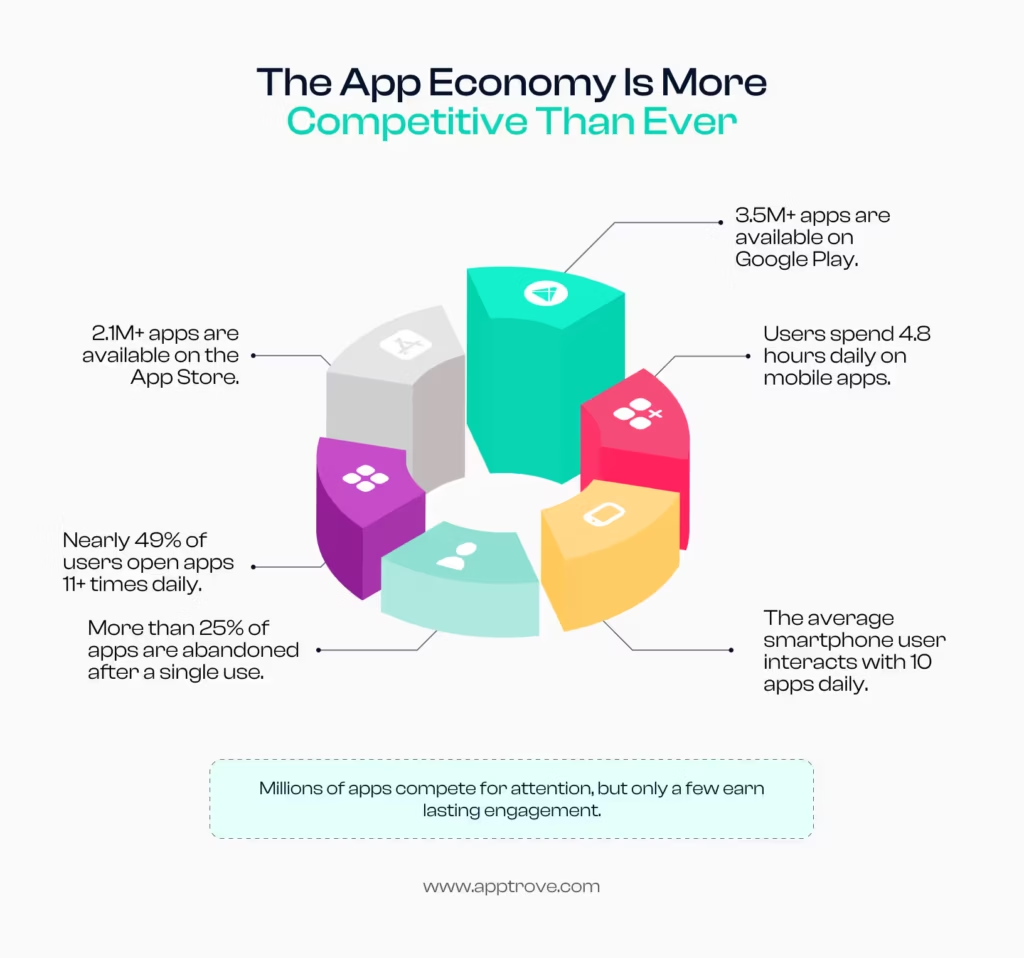
Rather than placing customers into fixed groups and keeping them there indefinitely, brands are now gathering real-time data to create dynamic customer segments that are based on customer behavior. This provides businesses with information regarding customer intent, allows for more targeted messaging, and improves conversions. In fact, approximately 80% of businesses that use segmentation have seen an increase in sales, while businesses that use personalized marketing campaigns have increased their revenue by 40%.
Because of these facts, dynamic customer segmentation has become one of the most effective methods of marketing in the 21st century.
What Is Dynamic Customer Segmentation?
When marketers think to themselves, “What is dynamic customer segmentation?” they are looking at the definition of how customers will be grouped into different segments that change routinely according to how they are behaving at any moment, based on recent activity, likes, and behaviour. The difference between groups created based on this model and groups created with fixed attributes, like age and location, is that groups created under this model will have their groups/factors updated frequently based on new information.
The simplest way to think about dynamic customer segmentation is that it allows the organization to learn about the customer as that customer behaves in the marketplace in real-time.
Let’s see an example of this, if a customer visits your website’s ‘pricing’ page repeatedly on a website, opens emails that contain promotional materials, and then adds an item to their online shopping cart, they can be automatically assigned to the high-intent category of customers that should receive special attention from the marketing department by sending them appropriate communications immediately after each of those events occurs.
Therefore, you can see why knowing what is dynamic customer segmentation will enable you to sell faster and more efficiently because you have accurate, real-time information about your customers.
What is dynamic customer segmentation all about? It is all about taking the hit or miss approach out of marketing by replacing the guess “who” the customer is, with a form of real-time customer intelligence.
Static Segmentation vs Dynamic Segmentation
Using static demographic segmentation to develop brand strategies based on age, gender, geography, or income has limitations and will not accomplish developing meaningful customer relationships.
For example, a 28-year-old customer in Gurgaon and a 28-year-old customer in Mumbai will likely have entirely different interests, behaviours, and shopping patterns. Traditional static demographic segmentation will not provide clarity to a brand regarding the behaviour of similar-aged customers who happen to live in different cities.
Dynamic customer segmentation provides additional power than traditional demographic segmentation because it does not focus solely on who a customer is but also on how customers interact with your products and services. Dynamic customer segmentation employs dynamic real-time data to help brands better understand how customers are browsing, which products they are interacting with, their purchase history, and their engagement levels with their brand.
Due to the additional insight that dynamic customer segmentation provides, strategists will have much better success in creating customer journeys that matter and respond in real-time to what customers do and not rely on previous assumptions based on what they have done. The shift from traditional static segmentation to dynamic segmentation is one of many reasons why businesses are adopting dynamic segmentation marketing strategies across a variety of industries and markets.
Dynamic customer segmentation is critical in today’s marketing environment because customers demand to be known and do not want to receive email, ads, or recommendations that do not speak to them as an individual or that are not relevant to them. This is the value of implementing dynamic customer segmentation into an organisation’s marketing strategy.
Why Dynamic Customer Segmentation Matters
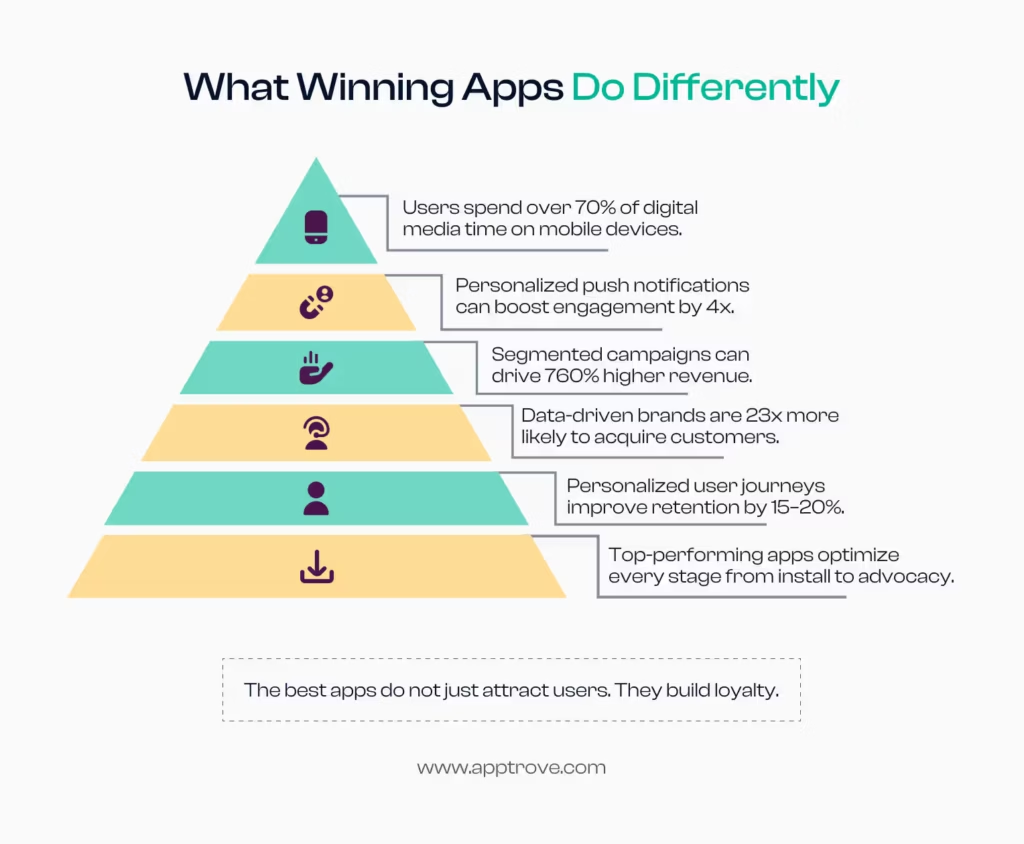
Companies that utilise dynamic customer segmentation live behaviour data will be able to develop highly relevant customer journeys by ensuring that their planned campaigns are directed to the proper groups of customers rather than delivering the same message to all customers regardless of the context of the communication or at what stage in the customer relationship.
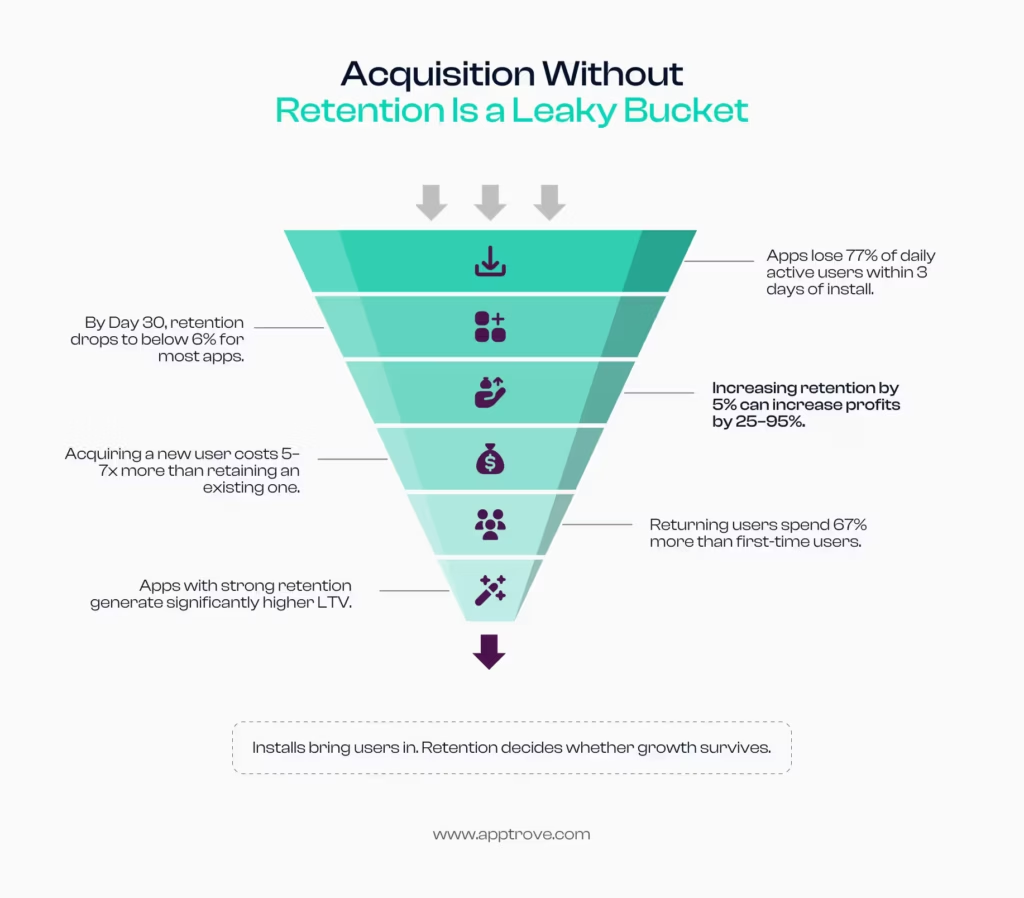
For example, a frequent buyer may receive loyalty rewards, while a customer showing churn signals may receive retention-focused messaging. This level of personalization increases engagement significantly. Studies show personalized emails generate six times higher transaction rates compared to generic campaigns.
This is one of the biggest reasons businesses are investing heavily in dynamic segmentation marketing.
How Dynamic Customer Segmentation Works
Dynamic customer segmentation involves an elaborate methodology but is not difficult to conceptualize.
The initial step of this process requires the acquisition of data. In order to accomplish gathering this data, businesses will pull information from websites, mobile applications, customer relationship management (CRM), email campaigns, customer service communications, and purchase history data. Each of the aforementioned types of interactions is creating context for a business.
Following data acquisition, businesses create segmentation rules or regulations for assigning customers/consumers to specific segments. If a customer visits a product more than three times, does not take any additional action after two weeks elapse, and/or abandons an online checkout, the customer could potentially be added to a product segment.
The real benefit associated with dynamic customer segmentation is that businesses do not have to spend their valuable time reassigning customers or consumers based on behaving differently than other individuals within the same segment. With each changing customer behavior there is an automatic assignment to the next segment once the customer’s behaviour has changed.
This is the main reason dynamic customer segmentation is an asset for businesses that operate in areas where consumer behaviour is changing at a rapid pace.
Dynamic Segmentation Marketing is the preferred segmentation methodology employed by e-commerce businesses, SaaS companies, financial technology providers, and developers of mobile applications.
Businesses utilise many different dynamic segmentation strategies to group customers and consumers:
Common Types of Dynamic Segments
Behavioural Segmentation
In this segmentation model, the focus is on customer/consumer actions. This involves tracking customers/consumers while browsing and buying. The final purpose of utilizing behavioural segmentation is to create repeat customers or potential customers that generate the same or comparable levels of revenue.
Lifecycle Segmentation
Lifecycle segmentation is building a group of customers/consumers according to an individual’s “journey.” The various groupings include new customers, active customers, loyal customers and customers that are at risk of churning at any given point in time.
Value-based segmentation groups users based on business value. High-value customers, frequent spenders, and loyal buyers often receive more personalized treatment.
Intent-based segmentation identifies customers who show strong buying signals. These segments are extremely valuable because they help brands prioritize high-conversion opportunities.
This is where dynamic segmentation marketing delivers impressive results.
Benefits of Dynamic Segmentation Marketing
The greatest benefit of dynamic customer segmentation is that it allows customers to receive the right message at the right time, which leads to a natural increase in engagement and conversions.
In addition to improving engagement and conversion rates, one of the major benefits of utilizing dynamic segmentation is customer retention. It costs 5-7 times more to acquire a new customer than to keep one. With dynamic customer segmentation, brands can identify customers with a risk of churning early on, allowing them to take action before losing those customers.
Dynamic customer segmentation also increases marketing efficiency. Businesses can spend less money on irrelevant campaigns and direct their budgets toward high-value opportunities. This is why dynamic customer segmentation has become essential for brands that are focused on growth. In today’s environment of increased competition, dynamic customer segmentation is no longer an optional strategy, but a core component of smarter customer targeting.
An example of the value potential of dynamic customer segmentation would be a scenario where an e-commerce company sells sneakers. A customer visits pages containing running shoes multiple times over the course of three days, comparing products, reading reviews, and adding items to their cart, but not finalizing their purchase.
The customer’s actions are analyzed using dynamic customer segmentation as they occur, and once the customer completes the series of activities listed above, they are placed into a high-intent cart abandonment segment. The e-commerce company can now target this customer through personalized reminder emails, limited-time offers, or retargeting ads. This level of accuracy in targeting ultimately creates a greater opportunity for conversions. This is the true power of dynamic customer segmentation in action.
Challenges in Dynamic Customer Segmentation
While dynamic customer segmentation can be robust, it can also face a number of roadblocks.
For instance, very poor data quality may lead to diminished results. When a company uses data for customer segmentation, the information must be accurate, complete, and up-to-date. Another roadblock to advanced customer segmentation will be the complexity of the necessary technology. High-end segmentation usually requires the use of an enterprise-level infrastructure and a great deal of automation. Using data in an ethical and compliant manner while maintaining customer trust is very important when implementing any type of advanced segmentation strategy.
The Advantages of Dynamic Customer Segmentation Outweigh the Disadvantages
The future of marketing will continue to evolve in the direction of being increasingly predictive, data-driven, and intelligent.
AI and machine learning have begun to radically alter how we are able to implement dynamic customer segmentation. Instead of only reacting to what customers do, data-driven systems are now able to anticipate how people will behave in the future.
For example, through the insights generated from advanced segmentation, companies will be able to identify which customers are very likely to make a purchase, which customers may be at risk of churning, and which customers may require some form of development or nurturing, much sooner than may have previously been possible.
Thus, the predictive view offered by dynamic segmentation will greatly increase the value of dynamic customer segmentation for businesses that invest in this capability early.
To Wrap It Up
Tremendous changes are happening around customer expectations every day. Therefore, traditional segmentation methods and ways of thinking about customers will no longer be good enough.
Marketers will need to find new, smarter ways of segmenting and understanding customers, predicting their behaviour, and delivering better and more important customer experiences. Dynamic customer segmentation will provide you with the means to cultivate and grow your relationship with customers through the transformation of raw data into insights that you can leverage to create more personalized messages and improve your ability to retain customers.
FAQs
1. What is dynamic customer segmentation?
Dynamic customer segmentation is the grouping of customers together based on behaviors on a continual basis such as real time interactions with companies, current interests, and previously held preferences.
2. Why is dynamic customer segmentation important?
Dynamic customer segmentation enables companies to provide personalized messaging, increase engagement and ultimately improve conversion rates.
3. How does dynamic customer segmentation work?
Dynamic customer segmentation is accomplished by gathering real-time customer data (transactions and activities) and automatically updating customer segments as the customer’s behaviours change.
4. Which industries benefit most from dynamic customer segmentation?
Some industries seeing the biggest advantage to utilizing dynamic customer segmentation are eCommerce, SaaS, Fintech, and mobile app companies.
5. Is dynamic customer segmentation better than static segmentation?
Dynamic customer segmentation clearly outperforms traditional segmentation approaches by utilizing up-to-date, real-time information and adapting to a customer’s real-time behaviors instead of being based on static (historical) information.
from Apptrove https://apptrove.com/dynamic-customer-segmentation-the-future-of-targeting/
via Apptrove


Comments
Post a Comment