Real-Time Bidding
What is Real-Time Bidding?
Real-time bidding is how ads for products you have recently searched for show up on other websites in milliseconds after you make the search using computer software. It is one of the most significant advances in modern digital advertising and occurs via an automated auctioning process where advertisers purchase and sell ad impressions (the people who see the ad) by placing bids on them. Therefore, they can do this faster than the time it takes to show an advertisement on a website. For example, when you type a URL into your browser, the webpage should appear on your computer screen almost instantaneously.
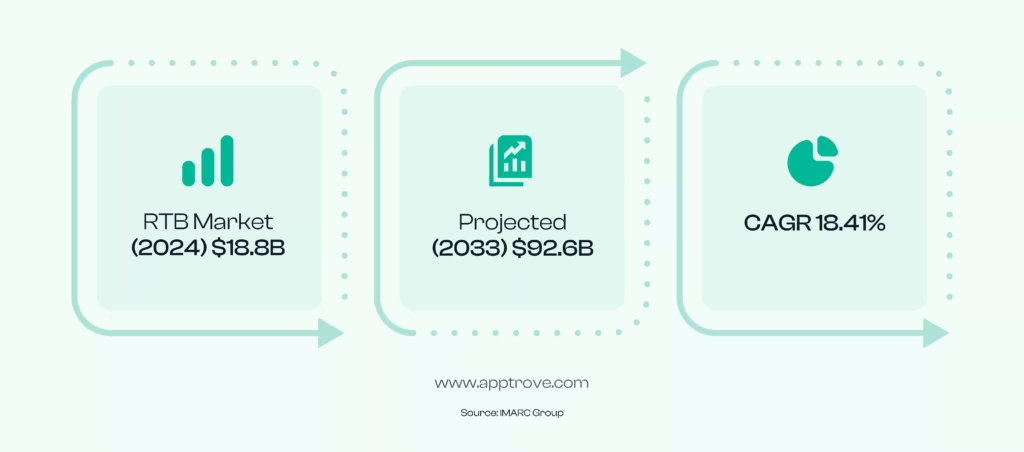
The world of real-time bidding is now so huge that the International Market Research Association (IMARC) Group reports that the total value of the global real-time bidding market will grow from USD 18.8 billion in 2024 to USD 92.6 billion in 2033 (CAGR of 18.41%), meaning it is not only a buzzword—it is the backbone of programmatic digital advertising.
It’s essential for brand managers, performance marketers, or developers who work in the world of advertising technology to understand what real-time bidding is. Platforms like Apptrove are creating platforms that will assist you in understanding the real-time bidding market, as well as allow you to measure and optimise the ways that you purchase impressions. The purpose of this glossary is to define terms in easy-to-understand language, in a clear manner, and without excessive jargon.
What Is Real-Time Bidding and How Does It Work?
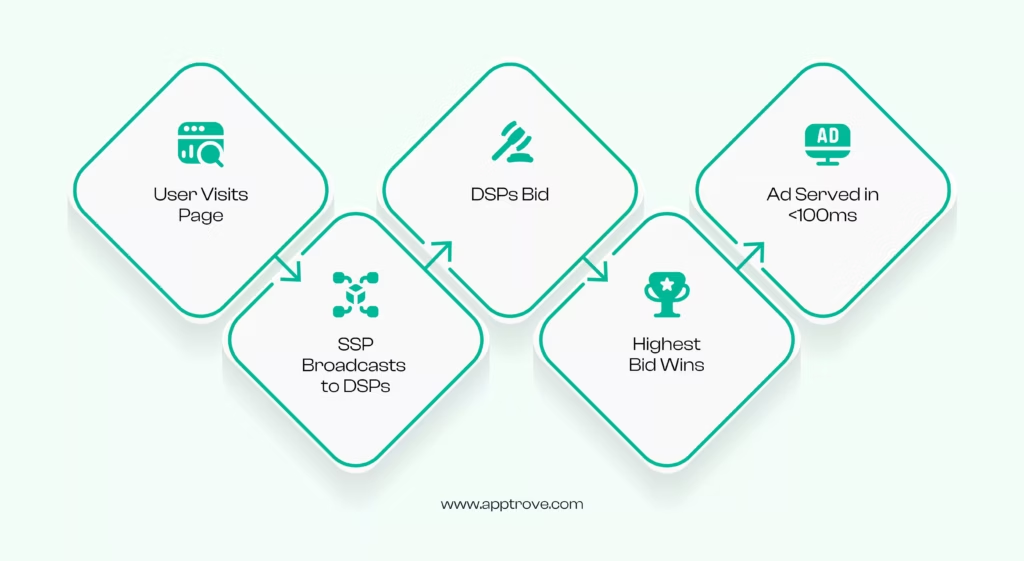
Simply put, real-time bidding (RTB) is an automated auction that takes place every time someone views a website or opens an app and sees an ad slot. This auction happens behind the scenes, with multiple layers of technology operating together seamlessly for the observer.
As soon as a user accesses a page or app, the publisher’s Supply-Side Platform (SSP) sends a request to purchase the advertising space, which contains anonymous information about the viewer and the ad format. The SSP sends this request out to many different Demand-Side Platforms (DSPs) at the same time. Each DSP uses its own algorithms to evaluate how much that impression is worth to its advertiser clients.
Bids are placed in real time by each DSP. In addition, the highest bidder wins the auction and has their ad displayed to the user (within approximately 100 milliseconds). Therefore, the user receives an advertisement that is relevant to them, the advertiser gets a targeted placement, and the publisher earns a profit from the inventory they sell. It is a win-win solution for everyone involved in the transaction process when everything is working properly.
The efficiency of Real-Time Bidding (RTB) makes it a very compelling method for advertisers to purchase media. By removing the need for extended manual negotiations between buyers/sellers, advertisers can now transact with multiple publishers quickly, efficiently, and at scale based on data science and real-time analytics. Daily, rummaging through billions of display impressions using RTB technology and programmatic advertising has become commonplace across all major media channels.
The Function of Demand-Side Platforms (DSPs) in relation to Supply Side Platforms (SSPs)
For an advertiser, DSPs are automated purchasing agents that represent them in their purchasing activity, allowing them to connect with a variety of ad exchanges and Lists of Supply Side Platforms (SSPs) in order to make bids on impressions based on the advertiser’s predefined criteria. This includes attributes such as audience demographics, device types, and behavioural signals. A DSP uses an algorithm to determine how much an advertiser should be willing to pay for an impression.
Whereas, on the flip side of the programmatic advertising ecosystem, an SSP represents the publishers and manages all their available ad placements on their digital properties, e.g., websites, applications & Connected TV. An SSP’s primary responsibility is to maximise revenue from inventory by ensuring that inventory is shown to the largest possible number of prospective buyers so that they can create competitive bidding.
Overall, DSPs and SSPs are the two key elements to the programmatic ecosystem and could not exist without each other.
What Is an Ad Exchange and Why Does It Matter?
Ad exchanges are digital trade markets that connect Demand Side Platforms (DSP) with Supply Side Platforms (SSP). Imagine a stock exchange but for buying and selling ad space! Publishers submit their inventory to the ad exchange; advertisers place bids for the available ads; then, once the auction is completed, the ad exchange connects both parties to complete the transaction in milliseconds. Ad exchanges are neutral entities that enable real-time bidding at scale by performing the auction mechanics and ensuring both parties have access to fair and transparent pricing.
Why Is It Important That You Understand Programmatic Advertising?
Programmatic advertising has changed fundamentally how brands connect to their consumers. Brands no longer purchase blocks of impressions based on general demographic assumptions; rather, they purchase each impression targeted at a specific consumer at precisely the time the consumer is most likely to be receptive to the message.
This is an important change for businesses because it affects their return on advertising investment (ROAS). Every amount invested will yield impressions that have been determined to be most relevant. The business is paying to be viewed by consumers interested in the advertising, not paying to have consumers see their advertisements who have no interest.
According to the Business Research Company, the real-time bidding market is expected to grow from 16.81 billion to 21.11 billion between 2024 and 2025 (a 25.6% increase in a single year). A booming programmatic market is being driven by two primary factors: improving sophistication of programmatic real-time bidding algorithms powered by AI technology and enormous growth in app-based advertising on mobile devices. By delivering more inventory, smarter bidding, and additional audience data, programmatic advertising is being delivered, contributed to through real-time bidding.
Differences Between Direct Buying and Real-Time Bidding (“RTB”)
When purchasing advertising using a direct buy, there is an agreement between the advertiser and the publisher (one-to-one relationship). This includes negotiating an agreed-upon price, reserving space (inventory) for specific timeframes (fixed), and paying for the inventory based on a flat cost per mile (CPM) regardless of how successful the campaign is. While predictable, these types of arrangements can lack flexibility and/or precision.
With RTB, the advertiser sets bidding parameters (e.g., target audience, maximum price willing to pay, frequency limit, geographic area) and then allows an algorithm to process the audience data. The advertiser only pays for impressions that meet the specified targeting parameters. The advertiser has lower predictability with respect to total inventory for their campaigns, but significantly higher efficiency with regard to costs associated with impressions bought and accuracy in targeting the desired audience. Programmatic bidding allows performance-oriented marketers to achieve a measurable competitive advantage over all advertising impressions.
What Kinds Of RTB Auctions Are There?
There are many different types of Real-time Bidding (RTB) auctions. As the RTB ecosystem continues to develop, we now see many different auction types that serve the needs of advertisers, publishers, and intermediaries. Knowing which type of auction is best for your campaigns will help you make better programmatic bidding decisions.
- Open Auction (Open RTB): The most widely used type of RTB auction. An accredited Demand Side Platform (DSP) can participate in an open auction. Bids in open auctions are made by agencies that want to use your inventory. An open auction is democratic and efficient; however, open auctions expose you to ad fraud unless you manage the auction effectively.
- Private Marketplace (PMP): A Private Marketplace (PMP) auction is an invitation-only auction between premium publishers and select child DSPs. The inventory provided by a DSP will typically be its highest-priced CPMs. For a premium publisher to invite an advertiser to a PMP, they must give the advertiser the ability to review the space before proceeding with the bid.
- Preferred Deal: Preferred deal auctions are considered a hybrid auction type. A publisher sells inventory to a single advertiser at a fixed price before the inventory goes into an open auction. In preferred deal auctions, an advertiser has the first right of refusal.
- Programmatic Guaranteed (PG): Although the use of PG is new, the programmatic guaranteed model is a way of combining the predictability of a direct transaction at a predetermined CPM with the operational efficiency of programmatic bidding.
The auction type you choose will fall somewhere along the open-to-exclusive continuum. Your selection should depend upon your campaign objectives, budget, and level of control desired over the outcome of your RTB auction.
What is the Process for Bidding Programmatically via an Open Auction?
In the past, the method used for programmatic bidding in an open auction was a second-price auction; however, most of the exchanges have transitioned to first-price auctions. A second-price auction means that the winning bidder will only have to pay one cent more than the second-highest bid; this incentivises all bidders to bid their actual value. Conversely, first-price auctions necessitate that DSPs employ more intelligent bid shading strategies so that they do not overpay when submitting their bids. Understanding which type of auction format your desired exchange utilises will influence your max bids.
What is a Private Marketplace (PMP)?
A private marketplace is a way for advertisers to bid on real-time inventory through a closed auction process. Premium publishers (i.e., established news sites, large volume traffic lifestyle apps, and brand-safe content networks) provide a select group with the opportunity to bid in an exclusive manner on their inventory. Advertisers have access to premium inventory that might not otherwise be found on the open market, while publishers have more control over who runs ads in association with their content. If brand safety and viewability are key priorities of an advertiser’s campaign, then PMPs should be strongly considered.
Reasons for the Effectiveness of RTB for Mobile Ads
Mobile app advertising has become a rapidly growing area of real-time bidding for many good reasons. There are many more user signals available on a smartphone than on a PC: GPS location, app usage, in-app activity, type of device, connection speed and time of day. Thus, the combination of all of these signals provides marketers with unique and highly-targeted opportunities to reach their audience through this channel, versus being able to do the same with any other medium.
With RTB, mobile app marketers have the ability to reach their target customers at the time of greatest intent. For example, after a customer has browsed a travel application (an example of in-app activity), the advertiser could then use RTB to get the customer to purchase that flight. Alternatively, after a customer has recently made an in-app purchase of clothing, the marketer could follow up with a limited-time clothing offer through programmatic ad targeting based on behaviour.
Mobile real-time bidding (RTB) can be used effectively in retargeting to reach out to users who have already engaged with your app or website. The bid request contains the device identifier and some characteristics about the user, which allows your Demand-Side Platform (DSP) to identify a user that hasn’t engaged with you lately and serve them a personal retargeting creative at the right time.
By using rich audience demographics, having the ability to make real-time decisions, and delivering a mobile-first creative format of interstitials, rewarded video, and native ads, today, real-time bidding (RTB) is the engine driving most of the successful user acquisition campaigns across all channels.
What Are The Metrics That Tells You How Well Your Real-Time Bidding Campaigns Performed?
You can think of measuring your Real-Time Bidding (RTB) campaign performance as driving without headlights; you won’t be able to see where you are going. Knowing about the following metrics will give you insight into your campaigns:
- Win Rate (RW): This is the percentage of times that your demand side platform (DSP) has won an auction. If your RW is low, then it could indicate that either your bids are conservative or that the way you are targeting is very limited.
- Effective Cost Per 1,000 Impressions (eCPM): This is a measure of how much you are actually paying (after supply chain fees are taken into consideration) for every 1,000 impressions (referred to as a “Mille”). It serves as an initial benchmark to judge the overall efficiency of your campaign.
- Click-Through Rate (CTR): This is a measure of how often users click on your served ad in relation to how many times they viewed your served ad. Measuring the CTR will help determine if the creative of your ad resonates with the intended target audience.
- Conversion Rate (CR) and Cost Per Acquisition (CPA): What percentage of users executed the desired action (e.g. install, purchase, sign up). What was the cost of each of the actions?
- Viewability (V): How many times has your ad actually been seen? Standardly, an ad is considered viewable if at least 50% of it is in view for greater than or equal to 1 second.
To measure the above across large, complex, multi-channel RTB campaigns, you will need an effective measurement and attribution layer to provide you with the data that supports the above metrics. For App Campaigns, it is critical that your partner can accurately match installs and Post-Install Events back to the correct RTB Impression.
The Future of Digital Advertising Will Continue to Be Defining and Constantly Changing
Digital advertising has been transformed by real-time bidding. The old-school way of buying ads took a while, was not data-driven, and had no way of putting the ad up for bid at the speed of light. At the same time, there were limitations on what data was available and how bids could be accepted. In the current digital marketplace, real-time bidding enables advertisers to buy impressions in a variety of ways so that they receive impressions they are interested in seeing without being concerned if they are bidding for the same user multiple times.
As programmatic advertising continues to grow, marketers who know the ins and outs of measuring success with programmatic advertising will continue to see higher ROI than marketers who don’t understand how to effectively measure success with programmatic advertising. Brands that build better data measurement structures today will be the ones who succeed tomorrow. Are you Ready to Continue Your Growth With Programmatic Advertising? If you are looking for a comprehensive solution to establish greater efficiency for your entire advertising strategy, Apptrove is the perfect solution. Our technology leverages attributes and deep link tracking to provide real-time campaign reporting, allowing you to take full advantage of every impression your ads are generating. Contact our team today and learn more about how Apptrove can help you develop a successful programmatic advertising plan.
FAQs
Q1. What is the difference between first-price and second-price auctions in RTB?
In a first-price auction, the winning bidder pays their exact bid. In a second-price auction, they pay just above the second-highest bid. Most ad exchanges now use first-price auctions, requiring smarter bid-shading strategies from DSPs.
Q2. Why is ad fraud a concern in real-time bidding, and how is it addressed?
The speed and automated nature of RTB creates a significant risk of fake traffic due to bots. Third-party verification tools can help reduce invalid traffic and other types of fraud, in addition pre-bid filtering methods and private marketplaces can reduce the risk of low quality inventories on the RTB platform.
Q3. How does cookie deprecation affect RTB targeting?
As third party cookies go away RTB targeting will change to a first party data targeting strategy that uses contextual clues and legal identifiers. Advertisers with their own data ecosystem will still have the ability to precisely target their audiences, those without will lose the capability to segment their audiences accurately.
Q4. When does programmatic bidding become less cost-effective than direct deals?
Programmatic bidding can become expensive when demand for specific audience segments is high, driving CPMs up. For campaigns needing predictable reach against premium, brand-safe audiences, direct deals often offer better inventory certainty.
Q5. How does real-time bidding interact with mobile attribution?
When an RTB auction leads to a served ad and a user installs an app, mobile attribution maps that install back to the winning impression — ensuring advertisers optimise bids toward audiences that actually convert.
from Apptrove https://apptrove.com/real-time-bidding/
via Apptrove


Comments
Post a Comment