Data Discrepancies: Why Your App Numbers Don’t Match Up
Open two dashboards for the same campaign. Look at the install numbers. Analyze the install volumes. The figures would always be different. This is not a mistake. This is one of the fundamental characteristics of mobile marketing. Industry statistics state that the gap between the platforms is normally between 10-15%. However, once the figure reaches 20%, something is wrong. One can see in Google’s developer documentation that a different attribution window and different reporting methods would lead to discrepancies in the statistics but would not be the consequence of a certain glitch. Thus, if your Mobile Measurement Platform provides 9,800 installs while Google Ads indicates 11,200 for the same period of time, just calm down.
This guide breaks down why data discrepancies happen, how fraud makes them worse, and what you can actually do to close the gap.
What Are Data Discrepancies?
A data discrepancy is easy to comprehend. It means when two different sources show different figures or values about the same campaign at the same time. You could usually see this in mobile marketing as one account shows 5,000 installs and another one shows 6,800 installs, although it’s the same campaign and the same week. Nonetheless, this does not necessarily mean that a problem exists because people should understand that this discrepancy is not the error, but a result of different data collection.
Once you understand this, the mismatch stops feeling odd. It starts looking like something you can actually manage. If you’re new to the term, our glossary has plain-English definitions for mobile marketing terms.
Why Data Discrepancies Happen in Mobile Marketing? The Reasons
There is not only one cause. There are many, and most of them stack on top of each other.
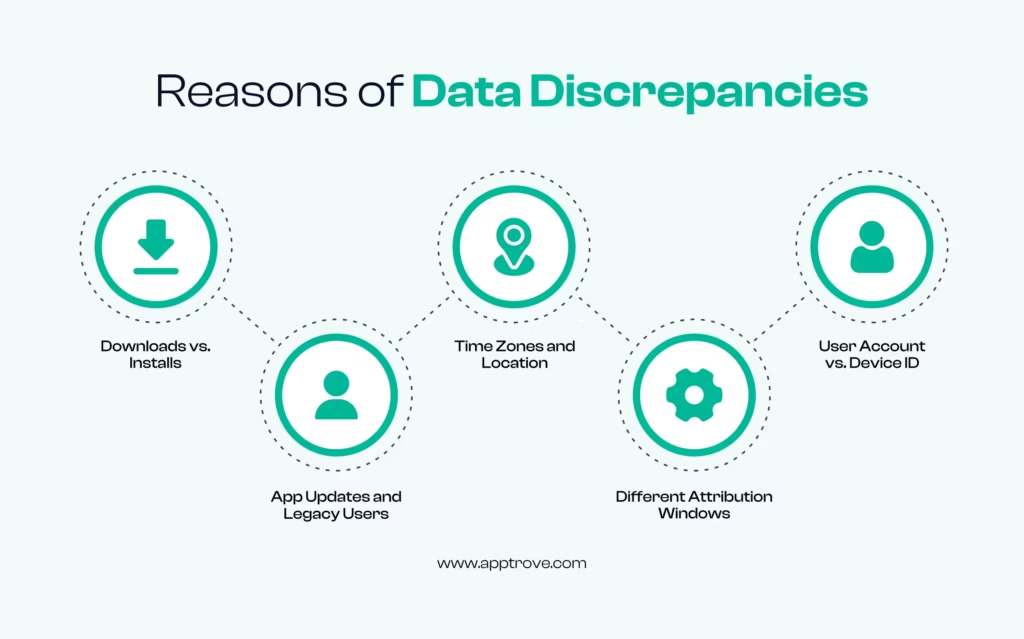
Downloads vs. Installs
A download occurs when a user clicks on the ‘Get’ button in the App Store or ‘Install’ button in the Play Store. However, an installation is recorded only when the application is opened for the first time from this application. The download/installation gap is one of the reasons for the reporting discrepancy. Download counts the number of downloads, while attribution partners take into account the number of installations. There is no right or wrong party in this issue; they are just comparing apples and oranges.
For example, if there was a big holiday marketing campaign carried out for a game app and there were 40,000 downloads during that week by the App Store, while the mobile measurement partner showed only 33,000 installations. In this case, both the Android and the iOS markets made no mistakes. Roughly, 7,000 users simply did not open the application after the download, and so the tools failed to register them. Read more about the process of install tracking.
User Account vs. Device ID
Both Apple and Google measure installs through user accounts, while mobile attribution shows the installation number through device identifiers.
If there is a person who has both an iPhone and an iPad, the mobile measurement tool tracks the installations through the IMEI number of the device, identifying it as two installs of the same user.
Time Zones and Location
To determine a user’s location, Apple and Google utilize the information collected from the user’s app store account. Currently, most attribution tech relies on the IP address of the user for logging the location at the time of installation.
Consider a user who has a UK app store account and is travelling from the UK to Spain. They will still be identified as “UK” on the app store’s dashboard while showing up as “Spain” on your attribution dashboards. When this trend is replicated for a lot of users, there can arise situations where the figures for different regions differ widely from each other. The same case applies in the case of time zone differences, where Google Ads uses Pacific time usually, while MMPs rely on Coordinated Universal Time (UTC), a standard explained in more detail on the official UTC reference page.
App Updates and Legacy Users
Adding an attribution SDK to a live app results in an interesting phenomenon where every existing user who updates the app gets classified as a “new” install according to the attribution partner because it is the first time the SDK has captured information about that user. However, this is not the case as far as the app stores of the devices are concerned, as they do not recognize it as a new install and just logs it as an update. This phenomenon leads to a sudden spike in the data which eventually recedes in a couple of weeks.
Different Attribution Windows
This one is important and often not given enough focus. For Google Ads, the default window is 30 days. For Meta, the window will depend on the type of event that takes place. Usually, MMPs consider a 7-day click window as a standard option.
When looking at the same example, let’s say a user clicks on the ad on day 3 but installs the app on day 10. Depending on the attribution model being used, one platform may recognize the event while another one does not. Different meaning for the same click and installation event. That’s a textbook example of data discrepancies born entirely from configuration, not fraud or error.
More specifically, SKAdNetwork and AdAttributionKit add one more layer to this for iOS. Apple does its attribution through aggregated delayed information because of privacy. So, if you compare that to say Meta or Google reporting in almost real time, there will always be a gap.
Can Mobile Ad Fraud Cause Data Discrepancies: The Types
Investment fraud goes beyond mere number manipulation. It ultimately results in loss of money in your marketing campaign.
SDK Spoofing
SDK spoofing refers to the process whereby false install events are created even when a user does not interact with an app.
Click Injection
Click injection involves an occurrence where a fraudster notices an actual download takes place and then mimics a click just before a user opens the app to claim the organic install.
Device Farms
This is another tangible example of mobile ad fraud is a situation where device farms use farmed devices to reach the desired result while impostors initiate fake installations.
Click Spamming
Click spamming is a situation where fraudsters bombard the system with numerous clicks in an attempt to get credit for an actual install event.
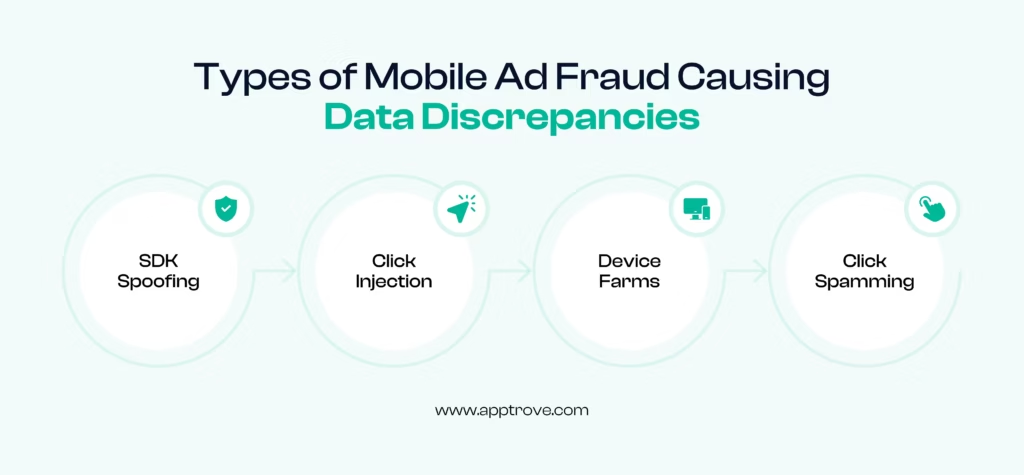
Every one of these fraud types adds noise to your reporting. And noise means more data discrepancies between your ad platform, your mobile attribution partner, and reality. Industry bodies like the Mobile Marketing Association publish fraud benchmarks every year, and the trend holds steady: fraud rises whenever ad budgets rise.
A strong fraud prevention layer inside your mobile attribution stack catches most of this before it ever touches your reports. That’s a core reason marketers pick a serious MMP over spreadsheets and guesswork.
How Do You Fix Data Discrepancies Across Platforms?
You won’t get every number to match perfectly. That’s not realistic, and honestly, it’s not the goal. The goal is understanding the gap and knowing when it’s normal versus when it’s a problem.
- Compare installs to installs, not downloads to installs. Make sure you compare installs versus installs, not downloads versus installs. This is the most common mistake when reporting on mobile stats.
- Match your attribution windows across platforms wherever you can. So for example, if Google Ads uses 30 days for attribution and your MMP has a default attribution of 7, you will need to synchronize them before you compare anything.
- Make sure to standardize your time zone across all of your platforms in relation to logging, etc. You can pick UTC or your local time zone.
- Be careful of spikes that occur in the data from the moment the SDK is integrated. Try to wait a few weeks after launching something new to check your data more accurately.
- Make sure to run fraud protection tools on a regular basis as well. If you see in the data any sudden spikes or falls regarding installs coming from some specific geographies or device types, it is important to check it as soon as possible.
- Centralize your data in one dashboard. Switching between five different login screens is where small data discrepancies turn into big, expensive mistakes.
- Document what “normal” looks like for your app. Once your team agrees on an acceptable range, panicking over a routine gap gets a lot less common.
None of this eliminates data discrepancies completely. It just keeps them small, explainable, and easy to defend when someone on your team asks why the numbers look off.
Why an MMP Like Apptrove Makes This Easier
This is what an MMP (mobile measurement partner) is supposed to do. Apptrove makes sure that your advertising channels and campaign statistics match and always have the same attribution. You don’t have to manually extract all of your Google Ads, Meta, app store data every week; you can just get all your data in one go.
Data discrepancies won’t vanish. There is no way that an MMP can promise anything like that. If any MMP does that, you need to be skeptical. However, by having the right MMP, the gap has become easy to justify and predictable rather than being a mystery.
Conclusion
Data discrepancies are part of the job, not a sign you’re doing something wrong. Download and install are two different processes. Device IDs are not the same as user accounts. Different apps have different definitions of what an attribution window is.
The solution is not to try and achieve consistency between all the platforms involved. It’s all about understanding the reasons for the difference and ensuring that it stays within an acceptable level. Once you know what’s normal, data discrepancies stop being a headache and start being just another number you check on a Monday morning.
FAQs
What does the term data discrepancy mean when it comes to mobile marketing?
A data discrepancy in mobile marketing is when the number of installs reported from the two sources is different for that particular campaign and for that given period. The cause is due to the fact that the reporting system of each source is different.
What degree of data discrepancy is considered to be normal?
Most marketers believe that a difference between 10% and 15% is acceptable. When the difference is over 20%, chances are there are some issues connected with configuration or fraud.
Why are the figures of mobile measurement and Google Ads never the same?
One reason behind the difference in both reporting systems is due to a different attribution window. Google Ads usually uses a 30-day period of 30 days, while MMPs usually have a window of 7 days.
Is data discrepancy connected with ad fraud?
Yes, ad fraud techniques, such as SDK spoofing and click injection, can contribute to data discrepancies as they lead to an increase in numbers. A good MMP with detection of fraud will catch most of such cases.
Will a data difference indicate problems with a campaign?
No, a data discrepancy does not mean that the campaign is bad. It means that both systems had reported different results according to their own attribution methods and the way they define installs.
How does an MMP like Apptrove help reduce data discrepancies?
Apptrove sets the rules for attribution, aligns time zones and windows, and makes sure there are no fraudulent installs or clicks, so the difference between your ad platforms and your real data is minimal and plausible.
Should I try to make every dashboard match exactly?
Perfect matches across advertising platforms are almost never observed. Instead of worrying about matching your data perfectly, concentrate on keeping the variation reasonable and explainable.
from Apptrove https://apptrove.com/data-discrepancies-why-your-app-numbers-dont-match/
via Apptrove


Comments
Post a Comment