Location-Based Marketing: Reaching Customers at the Right Place and Time
Have you heard that more than 80% of consumers are more inclined to do business with a brand that can provide customised experiences and one of the most compelling forces that lead to this trend is the use of location-based personalisation?
Research indicates that location-based campaigns have the potential to increase the levels of engagement by as much as 2x or even 20x when compared to non-location-sensitive campaigns.
That’s exactly why location-based marketing is no longer optional – it’s essential.
Location-based marketing has evolved beyond just sending a message based on geography to understanding a user’s current location, next steps, and whether that interaction has value. Most location-driven campaigns will be successful, or at a minimum, unsuccessful; however, this is where true value is achieved and lost in location-based marketing.
To have truly impactful location-based campaigns, you need the ability to track user journey across multiple channels, associate location-based signals with behaviour inside mobile applications, and measure campaign success beyond surface-level engagement metrics. These capabilities separate basic location targeting from high-performing location strategies that are backed by solid data. Now, where do you get the solid data? You’ll get to know by the end of this.
What Is Location-Based Marketing?
Location-based marketing is a marketing strategy that allows you to target users based on their real-time or historical geographic location. You do not send them the generic messages, but rather really relevant and contextual messages when the users are somewhere in particular, or have been there at some point.
You can trigger:
- Push notifications
- In-app messages
- Ads
- SMS or emails
… depending on the location of your users, where they have been, and where they will go in future.
This will help you make your marketing purposeful, timely and personal, and not pushy.
How Location-Based Marketing Works
At its core, location-based marketing relies on location data collected from mobile devices and apps. The following are the steps involved in the process:
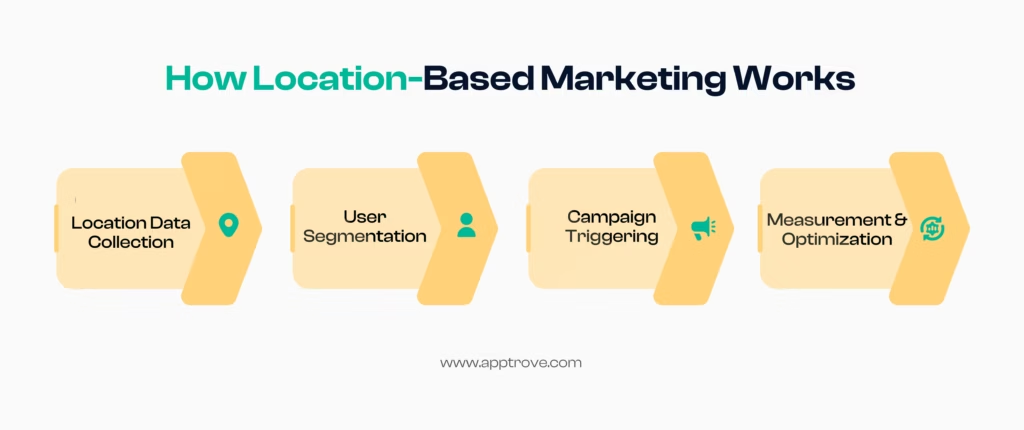
1. Location Data Collection
Location data of users on your app or platform is collected by:
- GPS
- Wi-Fi
- Bluetooth beacons
- IP addresses
This data is only collected when users grant permission.
2. User Segmentation
You segment users based on:
- Current location
- Places of frequent visits
- Proximity to a particular location
- Past location behavior
This is where geolocation marketing plays a crucial role in refining your audience.
3. Campaign Triggering
Campaigns are activated automatically once the conditions are met, e.g., a user enters, leaves, or remains within a certain geographical area.
4. Measurement & Optimization
You also follow the engagement, conversions, footfall, and revenue to improve future campaigns.
Types of Location-Based Marketing Techniques
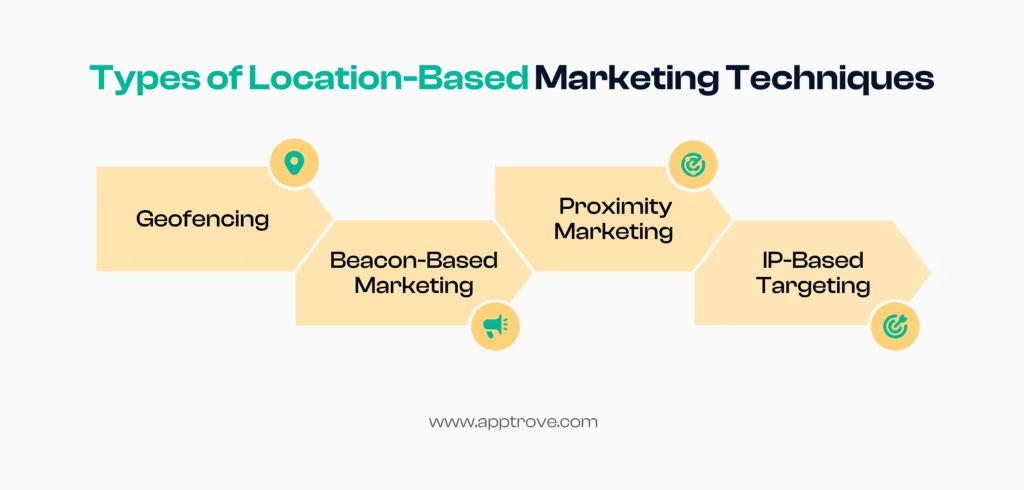
1. Geofencing: Geofencing develops an imaginary fence within a physical space. Customers are sent a message or advertisement when they enter or leave that space.
Example: You can send out a notification of a discount when a user enters a mall or is within 500 meters of your shop.
2. Beacon-Based Marketing: Beacons are devices that utilize Bluetooth to transmit extremely accurate messages within the store or facilities.
Example: Sending supermarket aisle-specific offers.
3. Proximity Marketing: The strategy will be aimed at users keeping in mind their proximity to a particular place of location, but it will not have any boundaries.
4. IP-Based Targeting: IP-based targeting is used to deliver relevant content on desktop and web campaigns and is approximated to locate the location of user.
Location-Based Marketing vs Geolocation Marketing
Although the two interchangeability occurs, there is a thin line between the two.
Geolocation marketing focuses primarily on identifying where a user is and targeting them accordingly.
Location-based marketing, on the other hand, is broader — it includes geolocation, behavioral triggers, contextual messaging, and real-time engagement. Think of geolocation marketing as a subset of location-based marketing.
Why Location-Based Marketing Matters in 2025 and Beyond
You are vying in an overcrowded online landscape. Here’s why location-based marketing gives you an edge:
1. Hyper-Personalization at Scale: You are no longer guessing what the users want; you are responding to where they are and what they are doing.
2. Higher Engagement Rates: Location-based messaging seems to be too personal and will result in a higher open rate, number of clicks, and conversions.
3. Better Customer Experience: Users receive information that is actually useful at that time instead of irrelevant advertisements.
4. Smarter Ad Spend: By targeting users in high-intent locations, you reduce wasted impressions and improve ROI — especially in location-based advertising campaigns.
Top Use Cases of Location-Based Marketing
Retail & E-commerce
- In-store offers
- Cart abandonment reminders near stores
- Product availability alerts
Food & Beverage
- Lunch-time promotions
- Nearby restaurant deals
- Loyalty rewards triggered by visits
Travel & Hospitality
- Hotel upsells during stays
- Airport or destination-based recommendations
- Local experience promotions
Fintech & Banking
- ATM or branch-based messaging
- Location-aware fraud alerts
- Contextual financial offers
Gaming & Entertainment
- Event-based promotions
- Geo-exclusive rewards
- Location-triggered challenges
Location-Based Advertising: A Powerful Growth Channel
Location-based advertising allows you to serve ads to users based on where they are or have been. This works across:
- Mobile apps
- Programmatic platforms
- Connected TV
- Digital out-of-home (DOOH)
When combined with location-based marketing, advertising becomes far more effective because it aligns intent, context, and timing.
Benefits of Location-Based Marketing for Your Business
- Increased foot traffic
- Higher conversion rates
- Improved customer retention
- Stronger brand recall
- Better attribution and measurement
When implemented correctly, location-based marketing bridges the gap between online engagement and offline action.
Challenges of Location-Based Marketing (And How to Solve Them)
Privacy Concerns
Consumers are becoming wary of the use of data. Openness and approval is not a bargain.
Data Accuracy
Poor location information can destroy the success of the campaigns. Reliable sources of data and validation.
Over-Messaging
The number of notifications may result in the uninstallation of apps. Frequency capping is key.
Attribution Complexity
To monitor offline conversions, there are sophisticated attribution tools and models needed.
Best Practices
- Always prioritize user consent
- Deliver real value, not spam
- Apply behavioural and contextual overlay.
- Continuously test, measure, and improve.
- Make campaigns correspond to user intent.
Conclusion
In order to maximise the opportunity for utilising location-based marketing, it is important to have both location information as well as a clear understanding of how to use this information. By combining the use of location information with a mobile analytics platform like Apptrove, the ability to quantify and scale marketing based on the potential of location-based marketing becomes a reality. As a result, marketers are able to deploy marketing campaigns that reach their target audience at the appropriate locations and times, while also providing measurable results that clearly indicate how successful those campaigns were.
FAQs
How does location-based marketing work in mobile apps?
Location-based marketing in mobile apps works by collecting user location data (with consent) and triggering personalized messages, offers, or ads when users enter, exit, or stay within specific geographic areas. These interactions are then measured to understand engagement and conversions.
Is location-based marketing the same as geolocation marketing?
Not exactly. Geolocation marketing focuses mainly on identifying where a user is, while location-based marketing combines location with behavior, context, and timing to deliver more meaningful and personalized experiences.
What kind of data is used for location-based marketing?
Location-based marketing uses GPS data, Wi-Fi signals, Bluetooth beacons, and IP addresses. This data is often enriched with behavioral and contextual insights to improve targeting accuracy.
Does location-based marketing improve customer engagement?
Yes. Because messages are delivered based on real-world context, users are more likely to engage. Location-aware campaigns typically see higher open rates, better click-through rates, and stronger conversion performance.
How can businesses measure the success of location-based marketing campaigns?
Success can be measured using metrics like engagement rates, footfall attribution, conversion rates, retention, and ROI. Advanced measurement platforms help link location-driven interactions to actual business outcomes.
from Apptrove https://apptrove.com/location-based-marketing/
via Apptrove


Comments
Post a Comment