Marketing Apps in Asia: How to Win the World’s Fastest-Growing Mobile Market
When we talk about marketing apps in Asia, the Asia-Pacific region already accounts for about a third of worldwide mobile app revenue, whereas the application downloads of this part of the world are projected to signify around 70% of global downloads by 2030, led by China, India, and Indonesia. Therefore, if you’re promoting mobile apps in Asia or about to do so, there are vast opportunities as well as some risks associated with simply taking the Western book of practices and applying it to the region where it doesn’t fit at all.
This guide cuts to the chase by getting to the execution part without focusing on the process of market size estimation: in other words, what tier to choose, how to localize properly, what channels to use, how to perform well in ASO for asian markets, and how to evaluate the effectiveness. If you need information that is more basic than that, we elaborated on the data and trend analysis in our State of App Marketing in Asia report; this article presents the continuation of the latter.
Why Is Asia the Biggest Opportunity for App Marketers Right Now?
Today, marketing apps in Asia is a must for any team that wants to have a global presence. Based on studies by Fortune Business Insights, Asia-Pacific controlled around 70% of the global mobile app market value, as well as data from Neontri predicting that app download numbers in the region will increase from the current 167 billion to almost 245 billion by the end of the decade.
The number sounds great, but it actually represents a real challenge for companies willing to market their apps in the region. In fact, when it comes to marketing apps in Asia, it means marketing them in dozens of languages, across several app store ecosystems (not only Google Play and the App Store), and the phenomenon of different user behaviors from ultra-mature markets (such as Japan) to extremely young ones (like Indonesia and Vietnam) within one region. Therefore, one of the biggest reasons of unsuccessful results of global user acquisition budgets in the region is the fact that many companies use the same app marketing strategy for Asia.
The 5-Step Playbook for Marketing Apps in Asia
This is the practical core of the guide, and it mirrors the infographic below step for step.
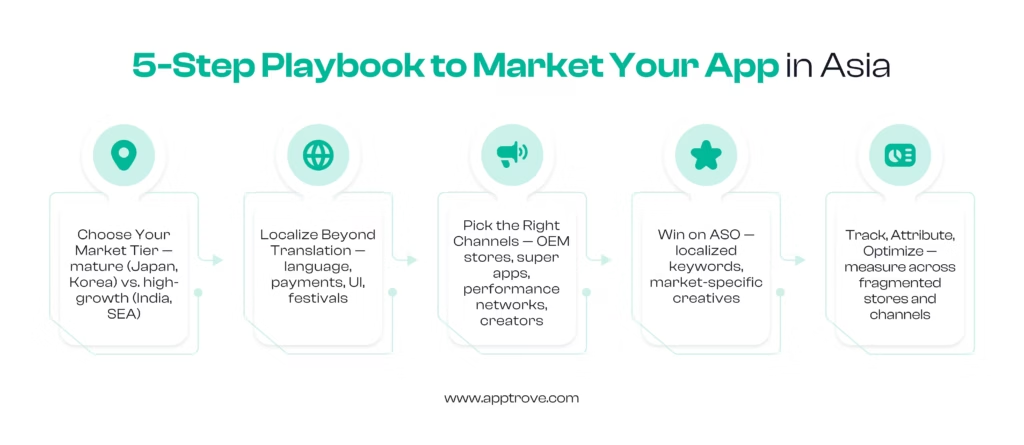
Step 1: Choose Your Market Tier Before You Choose Your Budget
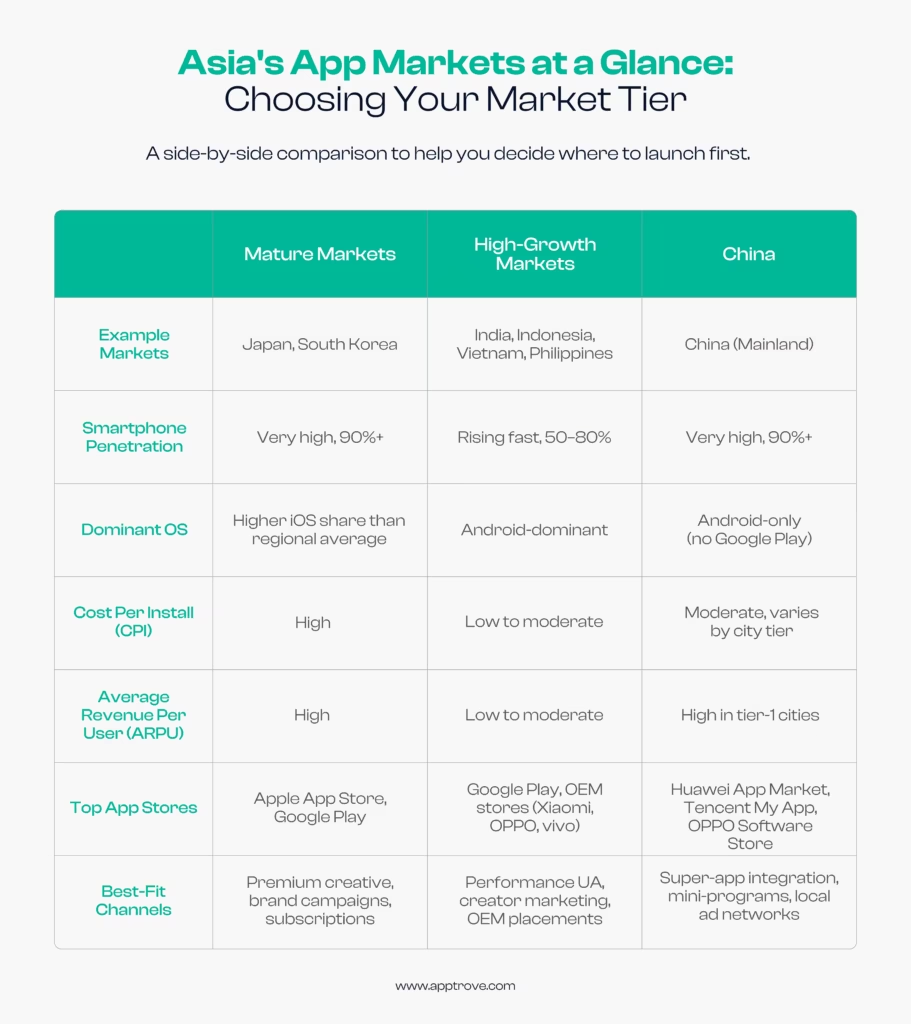
Not all Asian markets behave in the same way, so the first real decision when marketing apps in Asia is determining which tier you will be playing in.
- Mature markets (Japan and South Korea): High smartphone penetration of users who expect high-quality innovative design, higher CPIs, but also good retention rates and higher user lifetime value.
- High-growth markets India, Indonesia, Vietnam, and the Philippines): Lower CPI, more price-sensitive users, potential for fast scaling, but lower margins per user and much more localization effort.
- China: Almost its own ecosystem with no Google Play, popular domestic app stores dominating the market, and the growing usage of super-apps as the distribution channel.
The decision about which tier you are going to work within is going to shape everything else related to the project, for instance, creative approach and combination of channels, as well as the definition of success for the project.
Step 2: Localize Beyond Translation
Marketing applications across Asia commonly fail at this point because of confusion between translation and localization. True localization means:
- Language and script, Chinese characters, Japanese kana, Thai script, and others each affect layout, spacing, and readability in ways a straight text swap won’t fix.
- Payment preferences, including digital wallets and the like, are more convenient than using debit and credit cards in countries such as China, Vietnam, and Indonesia.
- Cultural calendars, during special days and holidays including but not limited to the Lunar New Year, Ramadan, Diwali, Golden Week, and Singles Day, produce different patterns of revenue and advertisement in place of normal campaigns.
- Payroll schedules employed in the region dictate wage payments, hence the best times for finance and other types of applications.
Depending on the Asian market into which the company ventures into a neighboring territory, e.g., providing financial services in a neighboring country such as moving from China to India, the company must adapt its operations; for more detail about how it is done and how the Chinese market fits into the Indian one, refer to our article on how Chinese lending apps are entering India.
Step 3: Pick the Channels That Actually Work in Each Market
The reason a channel mix that works in the United States does not work for app promotion in Asia is that the distribution environment is fundamentally different. When it comes to app user acquisition, Asia typically combines several of the elements listed below instead of relying on just one:
1. Performance networks: Meta, Google App Campaigns, and TikTok are all essential components of paid ad strategies, along with strongly established local ad networks in each region.
2. OEM app stores and pre-installations: Xiaomi, OPPO, vivo, and Samsung operate their own app stores and on-device positions, where competition is less fierce than on Google Play.
3. Super Apps: China and most of Southeast Asia super apps are apps that integrate messaging, payment systems, and mini apps in one platform and represent a real distribution channel and not just a UX pattern trend; for how this affects the acquisition strategy, please refer to our complete analysis of super apps and their impact on mobile marketing.
4. Influencer and creator marketing: regional celebrities on YouTube, TikTok, Instagram, and Bilibili perform better than traditional ads since they bring a cultural context that no brand account can provide.
Most marketers in Asia successfully apply three or four approaches from the above list.
Step 4: Win on App Store Optimization (ASO)
Search-driven discovery is enormous across Asia, which makes ASO a growth lever rather than a checklist item. Good ASO for Asian markets comes down to two things above all:
- Localized keyword research; direct translation of your existing keyword set misses local search intent; users in Japan, Vietnam, Thailand, and Korea often search using different phrasing and semantic patterns than a literal translation would produce.
- Market-specific creative; icon style, screenshots, and store video previews that work in Japan (minimal, restrained) often underperform in Southeast Asia (bright, information-dense), and vice versa.
Ratings, review volume, and update frequency also carry more trust weight in Asia than in many Western markets, since they double as social proof in markets where community trust signals heavily influence conversion.
Step 5: Track, Attribute, and Optimize Every Market Separately
Marketing apps across the fragmented app stores, OEM channels, and super-app placements of Asia does indeed make the process of attribution much more challenging than in single-storefront markets and this is precisely why having a mobile measurement partner (MMP) is crucial for the success of campaigns.
Here is how Apptrove’s solutions help tackle this issue:
Cross-store attribution: Apptrove makes it possible to attribute installs back to their source not only through Google Play but also from other stores, super-app placements, and performance networks, so you do not have to rely on the data from one source.
Unilinks: Apptrove allows for effective advertising campaign user tracking experience from various sources and makes them land on their needed in-app experiences.
Fraud prevention: Since Asian markets have low CPIs and a high volume of incentivized traffic, fraud is a major problem. Apptrove has multiple layers of fraud protection, including bot prevention technology that allows for getting rid of bot installs and low-quality traffic.
Retention and cohort tracking: since greater differences exist between mature and growing Asian markets, it is necessary and helpful to analyze the retention rate by market and cohort, rather than just one number.
Set this up before scaling spend, not after; retrofitting attribution once budgets are already live in five markets is far more painful than building it in from day one.
Final Thoughts
In Asia, marketing applications reward those teams that view Asia as composed of various markets, quick ones, instead of one big opportunity. Select a market level, localize your localization, select the channels based on local media availability, do well at ASO, and analyze each market independently. By doing this, Asia can become the fastest-growing continent within your business instead of the biggest headache during meetings with your board members.
Are you ready to discover the actual success of your campaigns in Asia? Apptrove offers app marketers cross-part for apps, deep linking services, and fraud protection, specifically designed for environments like Asia. Start your free trial!
FAQs
1. What’s the biggest difference between marketing apps in Asia versus the US or Europe?
Fragmentation. If you’re figuring out how to market apps in Asia for the first time, expect to deal with multiple app stores (not just Google Play and the App Store), dozens of languages, and hugely different user behavior between mature markets like Japan and high-growth markets like India or Indonesia.
2. Which Asian market should app marketers start with?
It depends on the goal. India and Indonesia offer scale and lower CPIs for teams prioritizing growth, while Japan and South Korea suit teams targeting higher ARPU and premium positioning. Most successful expansions pick one market tier first rather than launching everywhere at once.
3. Do I need a different app store strategy for China?
Yes. Google Play is unavailable in China, so distribution runs through local app stores and OEM channels, and super-app integration often matters more than traditional store optimization.
4. How important is localization when marketing apps in Asia?
Extremely, it’s consistently the difference between a campaign that scales and one that stalls. Language, script, payment methods, and cultural timing all directly affect conversion, not just brand perception.
5. What’s the best way to measure app marketing performance across multiple Asian markets?
Track each market separately rather than blending results, and use a mobile measurement partner that can attribute installs across fragmented app stores and channels; otherwise, a strong-performing market can get masked by a weak one in a single combined report.
6. Is paid or organic more effective for marketing apps in Asia?
Most successful teams run both together. ASO and organic discovery are unusually strong across Asia because of search-driven behavior, while paid UA fills gaps and accelerates growth in specific high-intent windows like festivals and paydays.
from Apptrove https://apptrove.com/marketing-apps-in-asia/
via Apptrove


Comments
Post a Comment