User Acceptance Testing
What is User Acceptance Testing?
Even if a product successfully passes all the technical checks, it can still fail in real-world use. The buttons may work successfully, the code may be immaculate, and the full feature set may function exactly as expected by the developer. But when real users engage with the product, it is not unusual for unpredicted problems to arise. For example, the checkout procedure may seem complicated, a valuable feature may be hard to access, or a given technological workflow may be effective, yet it may require twice as much time as users anticipated. This is where User Acceptance Testing comes into play.
This is a process that occurs after the product is tested solely from technical perspectives and evaluates it from both user and business points of view. The question asked at the User Acceptance Testing stage is not, “Is the software functioning correctly?” but rather “Is the software capable of performing the necessary functions needed by the users and business?”
What Is User Acceptance Testing?
User Acceptance Testing is a process in which end-users or business representatives examine a particular product, tool, application, system, or function to determine whether it fulfils specific functional and user needs. Typically, the activity takes place at the end of the software development cycle, which means the activities of development preceded it, as well as multiple tests. The goal does not merely consist of identifying bugs; more importantly, an evaluation should reveal whether the developed product has a purpose.
To illustrate, this is the ultimate test. Developers have no problem checking whether a payment button is functioning; for quality assurance specialists, it is vital to think of resolving some serious functional problems, but it is important for users to ask themselves if customers can perform their transactions easily and successfully.
Reasons for the Need for User Acceptance Testing
Finally, software is created for people who have to use it. If people cannot work with it successfully, achieving technical perfection does not mean that much. Acceptance testing helps to recognize usability problems, unresolved requirements, incorrect business logic, as well as all gaps that exist between what was required and what has been produced. It also lowers the risks associated with it.
How Does User Acceptance Testing Work?
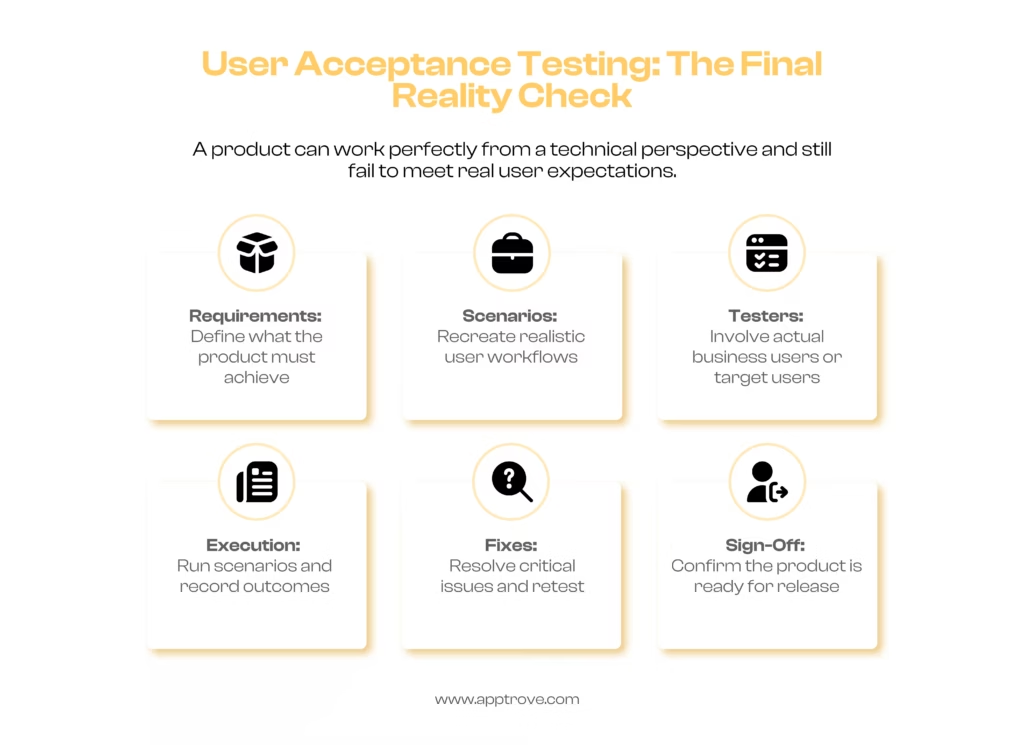
The procedure is usually organized in a certain order. The very first step is to determine what the system should be able to do, prepare test scenarios, recruit testers, implement these scenarios, record the results, fix important things, and eventually decide whether the product is ready for delivery. The exact pattern of implementation may differ from company to company, but the principle remains the same: check the functionality of the product against real-world expectations before introducing it to the public.
Set Up Acceptance Criteria
Before testing, the development team should clarify the meaning of the term “acceptable.” Acceptance criteria must be clear about the conditions that qualify a specific feature, some functionality in general, or a whole product to be defined as accepted. For instance, when it comes to an e-commerce application, acceptance criteria may state that a customer can add an item to a cart, enter data for shipment, choose a method of payment, finish the order, and get confirmation.
Create Test Scenarios
The next step is designing real-world scenarios in line with the expected user experience.
Rather than checking whether buttons operate correctly, the testers must test full processes. For instance, for online banking software testing, the checking process may include logging in, checking the balance, making a transfer, getting the confirmation, etc. The more realistic the scenarios, the better the testing results.
Choose the Appropriate Testers
For the testing to be effective, it is necessary to choose the right testers. The testers should know the business process or belong to the target user group. Depending on the particular case, the tester may be any of the following: employee, business stakeholder, customer, product manager, or indeed any other group of people.
Types of User Acceptance Testing
Not all jobs conduct acceptance testing in the same manner. Different types of acceptance testing can be employed based on the nature of the product, business, audience, and purpose. The best type of acceptance testing is chosen based on the goals of the organization.
Business Acceptance Testing
Business acceptance testing looks at whether the software meets the business requirements. The tests assess whether the workflows, rules, calculations, reports, and processes are implemented correctly. For instance, an insurance software system may need to compute insurance premiums based on certain rules.
Alpha Testing
Alpha testing is performed in a controlled environment before the launch of a product. The team may include employees or some selected testers who will use the product and identify issues that other testing procedures might not have found, including defects in the product.
Beta Testing
Beta testing is the term used to refer to the availability of the new product for a limited number of users before its final release for public use. Thereby, one can see how regular users will act outside the boundaries of the controlled environment of internal testing. There is a chance that beta users may encounter unwanted usability problems and device-specific bugs as well as situations that developers did not foresee.
Contract acceptance testing
It is the type of testing that allows determining whether the newly delivered product meets requirements that were defined in the contract or agreement. In particular, it is relevant to cases when the software was developed by a third-party company for the customer. Contract acceptance testing will reveal whether the functionality, requirements and deliverables agreed upon were achieved by the tested product.
Regulatory acceptance testing
This is of the essence for those industries that need to comply with strict regulatory requirements. In this case, acceptance testing should show whether the product meets the pertinent regulations and rules.
User Acceptance Testing vs. Software Testing
There is a connection between these two notions, but there is also a significant discrepancy between them. Software testing is primarily about confirming that the software works correctly as per technical and functional specifications. This area encompasses such types of testing as unit testing, integration testing, system testing, performance testing, security testing, etc. UAT, on the contrary, pays special attention to the satisfaction of business and end-user needs by the product.
For instance, consider a scenario when a food delivery application has no issues with the checkout process. Every API functions well, payments are successful, and orders are recorded properly. However, users cannot figure out what delivery options are available. While the technical side of this feature passes the tests, from the users’ point of view, there is a problem. Acceptance testing can identify such situations.
User Acceptance Testing vs. Quality Assurance
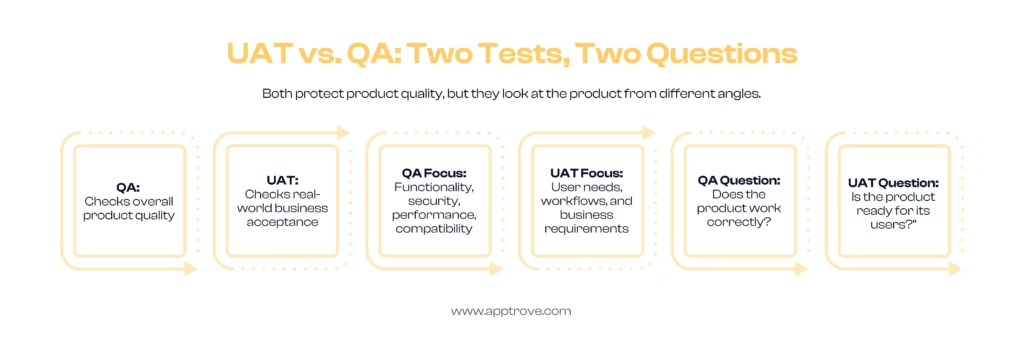
Quality assurance refers to the different procedures and processes of ensuring that quality is being maintained in development-related activities and processes. Acceptance testing is one of the processes within quality assurance.
Quality assurance can involve testing technical aspects such as functionality, security, performance, compatibility, and reliability. In contrast, acceptance testing deals with whether or not the product has become suitable for use by both users and businesses. To put it simply, QA asks, “Does the product meet the necessary quality factors?” and acceptance testing asks, “Is this product ready for use by the users and businesses for whom it was created?” Therefore, both are equally important perspectives.
Benefits of Acceptance Testing
The acceptance process can greatly benefit organizations when it comes to validating a product prior to its launch and making sure that technology completion does not get confused with business readiness.
Reduces Launch Risk
If you launch software without validation against real-world expectations, you might face a risky situation. Acceptance testing gives one more level before a launch to help a company identify serious issues while they can still be fixed relatively easily. Moreover, it is easier to find a strong workflow problem during acceptance testing than when thousands of users have already dealt with it.
Checks Business Requirements
Business requirements could change during the process of software development or be interpreted differently by technical and business teams. Acceptance testing provides an opportunity to check whether the final product meets business specifications successfully and closes the gap between the required and actual implementation.
Enhances User Experience
Users do not care why a particular problem happened. They just use the product. Acceptance testing takes that into account and helps to identify problems that may not have been discovered through technical testing. Even though a feature works according to the technological parameters, it can still be complicated and not make sense from the user perspective.
Builds Stakeholder Confidence
When stakeholders take part in acceptance testing and verify that the important processes work as expected, they become more confident in the product. This confidence is especially significant in the periods right before a critical launch, migration, or changes in the system.
Difficulties in User Acceptance Testing
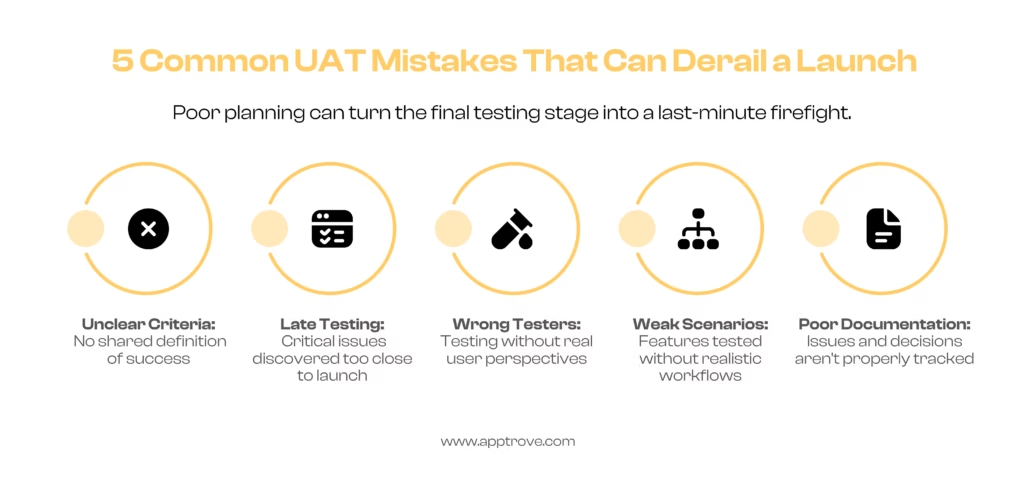
Acceptance testing can turn out to be hard if the integration is poorly organized. Unclear business requirements, time limitations, wrong audience selection, and incomplete scenarios may serve as stumbling blocks. All of this can affect the effectiveness of the whole process.
Undefined Acceptance Criteria
In case the teams cannot come to an agreement about what success actually is, the testers may understand the business objectives differently. Clear, quantifiable acceptance criteria eliminate such misunderstandings and ensure that all team members share the same vision of success.
Late Testing
Acceptance testing is usually conducted at the end of the software life cycle, which gives a false impression that it can be regarded as something minor. It is necessary to keep in mind that if any usability or workflow issues are detected shortly before the release, the time might not be enough to fix them. That is why it is advisable to involve the business users.
Wrong Test Participants
While a developer may comprehend how a feature functions, they cannot necessarily understand the thoughts and behaviors of the person who will actually use it. This is why selecting testers who can walk in the shoes of the user is so important. The closer the tester’s experience is to that of the ultimate user, the better their input will be.
Incomplete testing scenarios
When validating only isolated features, some problems may be left uncovered as they only manifest when several features are used in conjunction. End-to-end realistic scenarios provide a more thorough assessment since they replicate the way users navigate the solution.
Best practices of user acceptance testing.
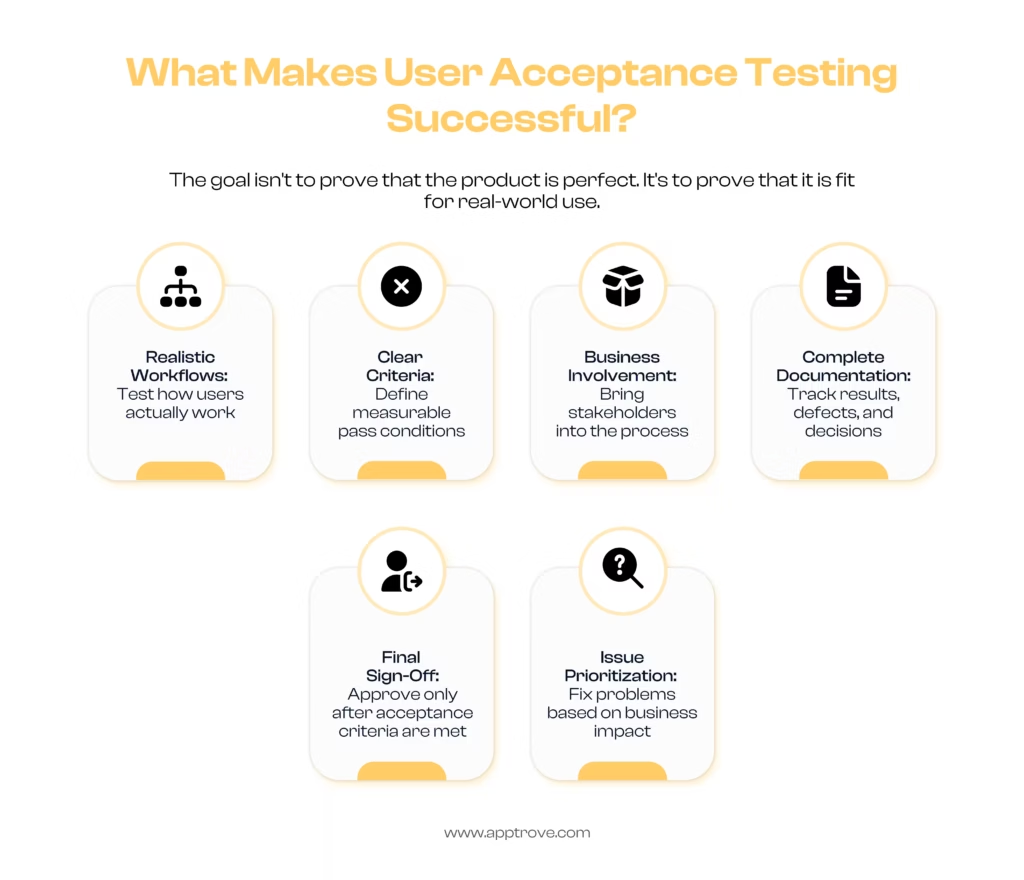
It is possible to enhance acceptance testing effectiveness significantly by applying a few simple principles. Teams should start by defining measurable acceptance criteria and afterwards create scenarios based on real user flows instead of some detached functions. It is also important that testers as closely as possible resemble the final audience; business stakeholders should also remain involved in the process from start to finish.
Test Realistic Workflows
Don’t just test features in a vacuum. Instead, mimic the user journeys that will actually happen. If you’re testing an e-commerce platform, you need to test the whole journey from product discovery to the checkout process and then to product order. On the other hand, if you’re testing a business application, you’ll have to create all the processes that the employees use in their daily working schedule.
Define Success Clearly
For every scenario, there should be a clear expected outcome. Testers should know exactly what pass and fail mean. This takes the guesswork out of testing and simplifies the analysis of results.
Involve Business Users from the Start
Business Users shouldn’t come to know about testing only when the process is ending. Their involvement well before the testing will help to identify the missing requirements when they are still cheap to fix. The technical teams need to collaborate with the business users from the very beginning to understand how the product will be used in real life.
Prioritize Critical Issues
Every issue should be treated differently. For example, a simple graphic discrepancy shouldn’t be treated the same as a failed payment. Usually, teams separate issues according to severity and impact on business, consumers, and risk of release.
What Comes Next After User Acceptance Testing?
When the testing is finished, results must be studied. Generally, teams check unsuccessful cases, defects, requirements, and readiness. In case there are unresolved crucial issues, the product may return to the development stage to be fixed and tested yet again. Otherwise, if all acceptance criteria are met, stakeholders can grant the product their approval for launch.
What Does ‘UAT Sign-Off’ Mean?
UAT sign-off is witnessed when it has been proved that a product or a feature meets the pre-agreed acceptance criteria and is ready to be deployed. It doesn’t mean that everything works perfectly, as almost all software has some minor faults. It’s the confirmation that known issues are taken into account and that the problem has been addressed.
Conclusion
The success of a product comes from more than just its operational capabilities. The real secrets of its success lie in its operability for target users. This is what the concept of User Acceptance Testing is all about. The process of User Acceptance Testing ensures that technical development can be in line with actual expectations so that companies can check the completeness of the requirements, test a variety of working scenarios, identify usability issues and be more confident when launching the product.
Good acceptance testing of a product does not merely exist for the users to appreciate the end product. User Acceptance Testing asks users to be truthful, to put the product under stress and find out the inconsistencies between assumptions and facts. This is useful! Finding a fault before the product is launched is a completely different thing from discovering a problem after the product has already been used by many customers.
FAQs
1. What is the main purpose of User Acceptance Testing?
The main purpose is to determine whether a product meets business requirements and is suitable for its intended users before it is released. It provides a final opportunity to validate the product from a real-world business and user perspective.
2. Who performs User Acceptance Testing?
It can be performed by business users, subject-matter experts, customers, product stakeholders, or other representatives of the intended audience. The most important factor is that the testers understand the workflows and expectations the product is designed to support.
3. When is User Acceptance Testing performed?
It is generally conducted after major development and functional testing have been completed and before the final production release. However, involving business users earlier in the development process can make the final acceptance stage much more effective.
4. Is User Acceptance Testing the same as QA testing?
No. QA is a broader quality discipline, while acceptance testing specifically evaluates whether the product satisfies user and business expectations. QA can cover technical areas such as performance, security, functionality, and compatibility, whereas acceptance testing focuses on practical readiness.
5. Can User Acceptance Testing find bugs?
Yes. It can uncover functional defects, workflow problems, usability issues, requirement gaps, and other problems that affect real-world use. However, its primary purpose is not simply to find technical bugs; it is to determine whether the product is fit for its intended purpose.
from Apptrove https://apptrove.com/what-is-user-acceptance-testing-apptrove-glossary-2/
via Apptrove


Comments
Post a Comment