What is TRP (Target Rating Points)?
To sum it up, advertising is a numbers game, but not every number depicts the proper story. Advertising reaching one million people may seem wonderful, but this may not seem so nice if this number consists mostly of people who do not belong to the target audience of the ad. This is where Target Rating Points come in handy.
Target Rating Points, or TRP for short, is a tool that helps those who advertise understand how well they reached their target audience. Instead of asking, “How many people saw our ad?” as one would expect, TRP provides another question which is much more interesting: “How much of our audience has been reached in this advertisement and how often?”
For this reason, Target Rating Points is very useful in television advertising, media planning, and audience measuring. TRPs allow marketers to evaluate the reach of advertising, its frequency, and overall media effectiveness, thus making comparisons of ads easier
What Are Target Rating Points?
Target Rating Points (TRPs) represent the method by which advertising impressions are measured in the target audience. This, however, means that we express in numeric values both the reach and frequency together in a way to indicate how many times the target audience was exposed to the advertisement.
To illustrate this idea, let us imagine that a company wants to communicate with young people living in cities aged 18-34. It is undoubtedly important to reach the maximum number of people possible, but only some of them will belong to the target audience, which diminishes the effect of their outreach. Therefore, we see that Target Rating Points computes for the target audience only.
We can conclude that the advertising campaign can be well-rated in general but at the same time have a low target rating.
How Are TRPs Calculated?
In simple terms, within a traditional framework, the calculation would look like this:
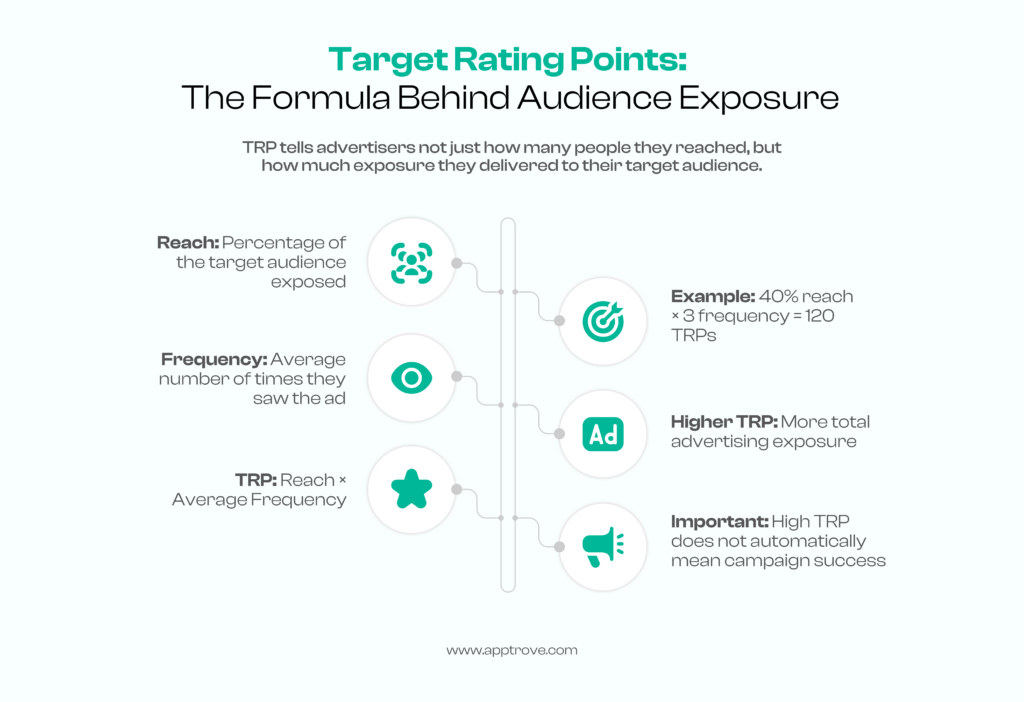
TRP = Target Audience Rating × Frequency
Another expression of the same idea is:
TRP = Reach (%) × Average Frequency
Thus, if the advertising campaign reaches 40% of the target audience and they see the advertisement, on average, three times, the total TRPs will amount to
40 × 3 = 120
If we say that, we cannot imply that 120% of people
Why Are Target Rating Points Important?
Promotional funds are not usually boundless. Enterprises need to ascertain whether their investment gets to targeted consumers and that those people get their message often enough to recollect it.
This is where Target Rating Points come in.
An advertisement that reaches 70% of its target market may create product awareness, while another advertisement that reaches 50% of the target market several times may create a better frequency. There is no automatic winner; the correct figure depends on the objective of the campaign.
Understanding Audience Exposure
TRPs help marketers evaluate exposure for the defined audience, which makes it more useful than simply establishing the number of advertisements.
For example, a sportswear brand that targets the younger generation should prefer this sector over targeting older people who are less likely to purchase their products.
Target Rating Points puts emphasis on marketing to the selected audience.
Comparing Media Plans
Media planners can use the TRP figures to evaluate various programming methods, channels, time, and format of advertisement.
A particular television program might attract a large overall audience but deliver relatively weak advertising exposure to the target audience. It’s possible that a specific advertisement can have a low audience figure but can still be efficient when targeting the audience.
TRP demonstrates the opportunity to distinguish one advertisement from another.
Budgets and Advertising
Availing the media purchasing services marks the beginning of a company’s journey filled with numerous trade-offs. Advertising agencies face a dilemma regarding whether to purchase additional spots for advertisements on high-rating shows.
The solution lies with the help of the TRP metric.
Target Rating Points and GRPs
Target Rating Points and GRP belong to the same advertising field. However, the results of these metrics differ based on the case under consideration.
What Are Gross Rating Points?
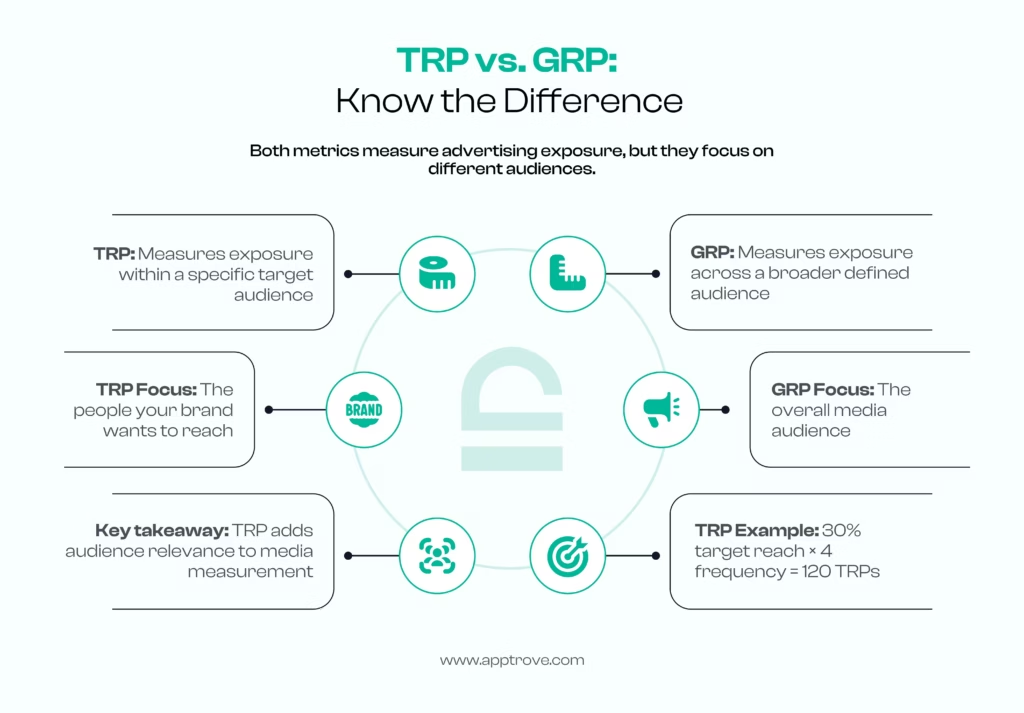
GRP measures advertisement exposure through the overall audience.
In the scenario when the advertisement has a reach of 30% and an average frequency of 4 exposures per ad, the GRPs of the ad campaign would amount to 120.
TRP and GRP
The essential difference lies in the fact that Target Rating Points measure advertisement exposure for a particular target audience.
Think of it this way:
GRP = What is the total amount of ad impressions we delivered to the target audience?
TRP = What is the amount of impressions we delivered to the audience we want?
In targeted campaigns, this differentiation is very significant.
Target Rating Points and Reach
The term “reach” refers to the portion of a target market that is exposed to a message, at least once. TRP, on the other hand, considers reach and increases it with repetition.
Consider two marketing initiatives, A and B, where A has a reach of 70% of the target market with a one-time exposure, and B has a reach that is smaller, 40% but reaches them five times.
Campaign A relies on reach, while campaign B utilizes frequency.
This is the reason why TRPs should be looked at together with reach. High TRP indicates effective reach use. So, it is advisable to find the right frequency.
How do Target Rating Points work in media planning?
During the early phases of creating a marketing campaign, TRPs play a crucial role because media planners check how many of their target audience members could receive promotional messages via specific combinations of channels, programs, and slots.
Selecting the right audience
The initial step is defining the target audience.
The definition can be based on several parameters, such as age or gender, location, interests, buying habits, and demographic and other behavioural factors.
With clearer definitions, the effectiveness of measurements made at the target level greatly increases.
Selecting media
After defining the audience, planners can figure out which media types ensure that this audience receives the advertisement.
For instance, a brand that manufactures beauty products may pay more attention to those broadcasting channels with high concentrations of its target demographic group instead of relying on the programs with the largest audiences.
Balancing Reach and Frequency
The successful campaign involves balancing the need for reaching enough number of people and the frequency of exposing these individuals to the message.
Reaching too many people can lead to the situation when clients forget about the product too soon, whereas exposing the messages too often may not achieve expected results.
What Is a Good Target Rating Point Level?
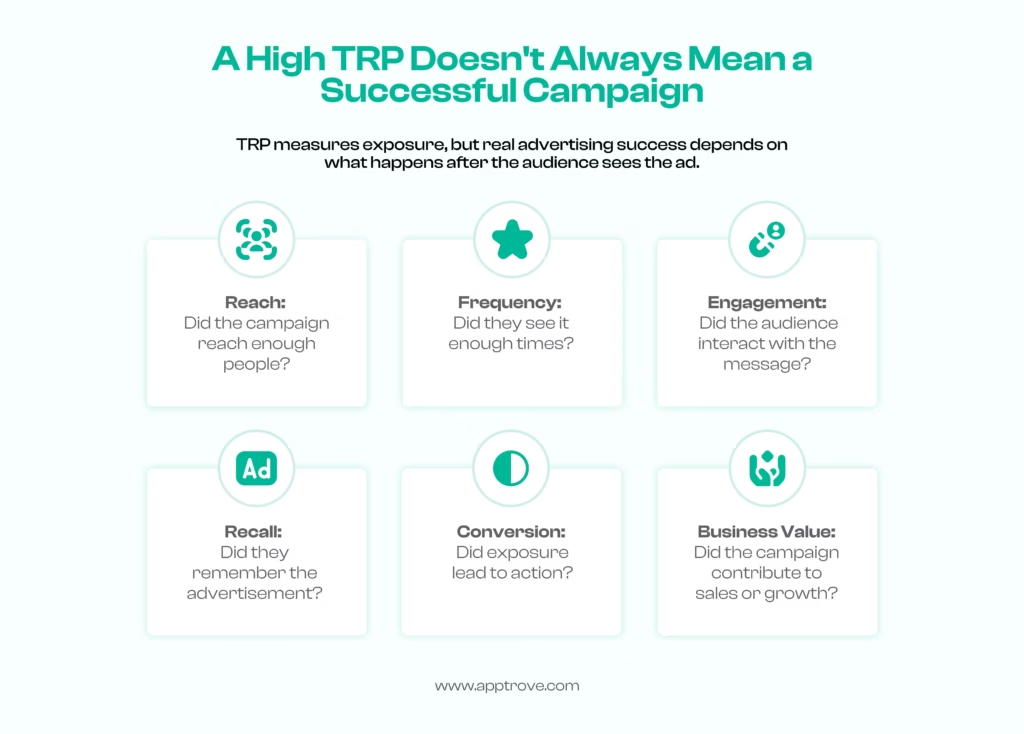
There is no single TRP score that determines a successful campaign. The optimal value may vary depending on the length of the campaign, the target audience, the sector, the goal of the advertisement, competition in the market, available funds, media environment, and the wish for repetition of the advertisement. The launch of a new product may require stronger advertising exposure than the brand in the state of the brand’s existence. A competitive segment might need advertising strength much more than businesses in sectors with little to no competing companies. The question is not whether TRP is high but whether TRP fits the purpose of the campaign and the nature of the target audience.
Disadvantages of TRP
Even though TRP is useful in defending marketing strategies, it still cannot be viewed as the only way of measuring advertisement efficiency. TRPs Do Not Guarantee Engagement
High TRP can exist in a campaign that does not deliver any engagement with the audience. The same advertisement may be viewed an unlimited number of times and still be ignored by the public. TRP counts impressions only, not whether the viewer appreciated the advertisement, remembered the message, stated visiting the website or downloading the app, or even buying something.
Measurement Accuracy Matters
Audience measurement techniques and data accuracy affect TRP. If the measurement system cannot accurately estimate the audience, then the resulting TRP results cannot indicate campaign success.
In the modern world, the advertising industry has drastically changed concerning the development of digital television, internet television, social networks, and programmatic advertising systems. Nonetheless, the main question about whether the TRP is “Does the campaign reach the correct audience in the necessary amount of time to enable the campaign to be effective?”
In fact, the question is important because
Modern marketers use a combination of both traditional audience measurement methods and digital ones.
Instead of just evaluating the TRP, they also look at impressions, video completion rates, clicks, conversions, engagement, attribution, and other data.
In short, this makes it easier to evaluate the campaign’s effectiveness. Also, digital advertising allows measuring advertising success in more detail than television. Most likely, marketers may see the number of impressions delivered to the audience and observe audience behavior after seeing the Ad.
Nevertheless, it is necessary to understand that TRP and digital advertising measurement should not be considered as opposing each other. Target Rating Points are useful for understanding audience exposure and media weight, while digital metrics can provide deeper insights into engagement and downstream actions.
Target Rating Points vs. Impressions
Impressions are the total count of advertising instances. TRP gauges the advertising exposure within its intended audience.
For example, consider a campaign generating one million impressions; this number alone does not convey how many members of the intended audience saw these impressions.
Whereas Target Rating Points gives information related to the audience. Thus, it helps marketers understand whether their advertising expenditure is reaching the desired audience.
Conclusion
Using Target Rating Points gives marketers insight into audience engagement based on advertising visibility. Instead of considering raw impression figures or the total number of individuals exposed to advertisements, a TRP shows how accessible advertisements were to certain audiences. Its key benefit lies in the context it gives.
In a media world that is inundated with a barrage of messages from various sources, it is critical to understand how many people have seen your ad, how often they have seen it, and whether the exposure has been adequate to achieve your goal.
FAQs
1. What do the letters TRP stand for?
The acronym TRP refers to the target rating points.
2. What difference do TRP and GRP have?
TRP analyzes a particular target audience, while GRP calculates the weight of the advertisement for a large number of people.
3. Can TRP be over 100?
Yes, TRP can reach over 100 due to repetitions of exposure. For example, 50% of the target audience reached with 4 exposures equals the number 200 in terms of TRP.
4. Does a high TRP mean an advertisement was successful?
This is not necessarily true. Even though high TRPs reflect high levels of exposure to the target audiences, they do not offer reassurance of customer engagement, brand awareness, purchases, or conversions.
5. Why is frequency so significant in computing TRP?
The term “frequency” indicates the number of contacts experienced by a member of the target audience with the advertisement and reveals to marketers the extent of the reach of the promotional effort.
6. Are TRPs still relevant in the realm of digital advertising?
Yes, but the main idea of the terminology still has its relevance as advertisers need audience measurements applicable to TV, streaming video, and the web. But in order to measure the success of a digital advertising campaign, other metrics are usually employed apart from TRP.
from Apptrove https://apptrove.com/what-are-target-rating-points-apptrove-glossary/
via Apptrove


Comments
Post a Comment