Word of Mouth Marketing: How to Build It Into App Growth
Word of mouth advertising is an unpaid promotion that comes from a friend’s word, a user’s review, or a user’s shared link, not something that a business spends money to advertise. This is effective because people tend to have more trust in what they hear from fellow consumers than what they get from brands; many studies in the industry agree on the fact that a personal recommendation is trusted much more than any other paid advertising. More specifically, for app promoters, word-of-mouth marketing is crucial compared to other industries. There are three notions affected by it in terms of mobile applications: app store rating, installation choices, and retention rate of the installed app. This guide aims to provide a breakdown of the meaning of the term, its differentiating features for mobile applications, possible ways of stimulating it, and the ways to measure it.
What Is Word of Mouth Marketing?
At its most fundamental level, this sort of promotion counts as any organic conversation, review, share, or recommendation that tells someone about your product without you paying for it specifically. It’s the most ancient form of promotion, and it does better than most modern types as it offers something advertising cannot: credibility from a third party.
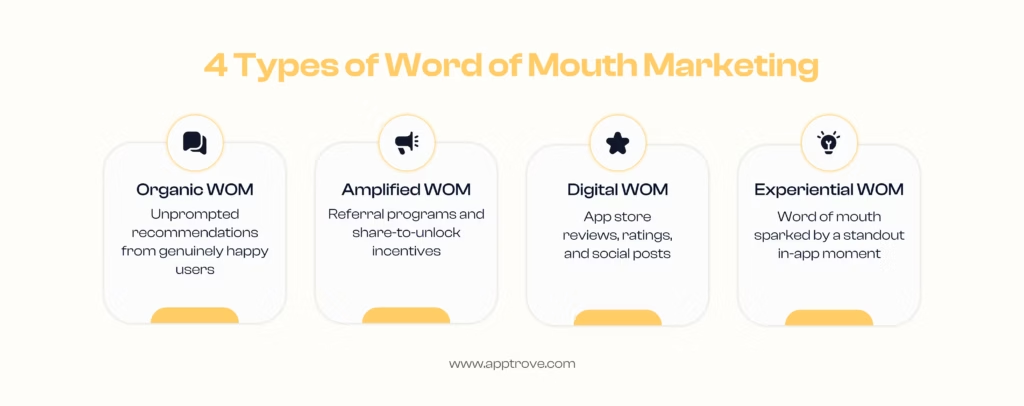
Generally speaking, organic promotion (or advocacy, as it is sometimes called) can be classified into the following four types:
1. Organic advocacy: A user genuinely likes your promotional tool and tells someone about it without you asking them to do so.
2. Amplified advocacy: A brand gives people a reason and a means to talk, for instance, through referral programs or unlockable functions.
3. Digital reviews & UGC: Reviews in the app store, ratings, social media posts, and whatever else any user is likely to see before they download your app.
4. Experiential moments: When people recommend a product because they experienced a moment of something great stemming from the product experience in terms of onboarding flow, some functionality, or even support interaction.
Most companies tend to use only one of these types of organic promotion. The ones that grow fastest treat all four as a system rather than a single referral widget bolted onto a settings menu.
Why Does This Kind of Organic Growth Matter More for Apps?
The costs associated with acquiring paid users have gradually risen across both Android and iOS platforms. The changes brought forth by privacy implementation, including App Tracking Transparency, Privacy Sandbox, and SKAdNetwork, also mean that targeted marketing isn’t as accurate as it used to be. The advantage of organic recommendations is that it neatly resolves both issues. We can say it is mostly free and is also very precise, because people recommend apps to those similar to them.
The gap of trust behind this practice is well known. Numerous studies by Nielsen’s Global Trust in Advertising have shown that customers tend to view recommendations made by their acquaintances as the most trustworthy form of marketing. Keller Fay Group has conducted different research according to which peer influence actually accounts for a significant amount of consumers’ decisions. In its turn, McKinsey’s research has found that the influence of opinionators is much stronger than that of conventional advertising.
In terms of an app, it presents itself in a very specific way:
- App store visibility. App store search ranking is determined by ratings, reviews, and the history of installs, amongst other things. Thus, consistent organic reviews are a clear SEO signal for the app store.
- Lower CAC on your best-fit users. The cost of acquiring customers is lower because referred users often come with the context of why the app is good, so the foreseen onboarding challenges and the likelihood of dropping off decrease in comparison to a cold install.
It doesn’t mean paid acquisition will go away, but rather that it needs to be structured in a way similar to paid campaigns and not treated as an accidental bonus.
How Can You Encourage More Word of Mouth Marketing?
Even if you can’t compel individuals to talk about your goods and services, you can eliminate the barrier that prevents them from acting on that instinct to share. Indeed, most of the successful strategies in this area are simply a way of minimizing the friction between the message and the person receiving it.
1. Build a referral program people don’t have to think hard about. The greatest inhibiting factor for most referral programs is not the low value of the reward itself; it is friction. If sharing entails copying a generic link, explaining the app’s purpose, and hoping the friend will find the right destination, most people won’t bother doing that. A branded link that takes users to the app’s page on the correct store eliminates all the issues related to the need to explain anything: one link is able to differentiate between those who already have the app and select the correct store where the recipient should open it.
2. Ask for reviews at the right moment, not the first moment. The problem with requesting a review immediately after the user installs the app is that they have not had adequate time to appreciate what they got in the app itself and to formulate any thoughts as regards how they feel about it. It is much more reasonable to wait until the user completes an action that implies satisfaction: an order or a milestone.
3. Give people something specific to talk about. “Recommend our app” is vague. “Here’s an invite code that gets you both a free month” is specific and repeatable. Specificity is what turns a vague positive impression into an actual shared link, and it’s one of the clearest differences between referral marketing and word of mouth marketing left entirely to chance.
4. Make the in-app experience itself shareable. Progress screens, results, streaks, and personalized outputs are naturally screenshot-and-share material if you design them that way. This is where experiential and digital advocacy start to overlap; a genuinely well-designed moment does the referral program’s job for free.
5. Close the loop with the people who already refer. A small number of users typically drive a disproportionate share of referrals. Track who they are, thank them, and consider a tiered incentive; this turns a handful of enthusiastic users into an ongoing acquisition channel rather than a one-time spike.
How Do You Measure Word of Mouth Marketing for Your App?
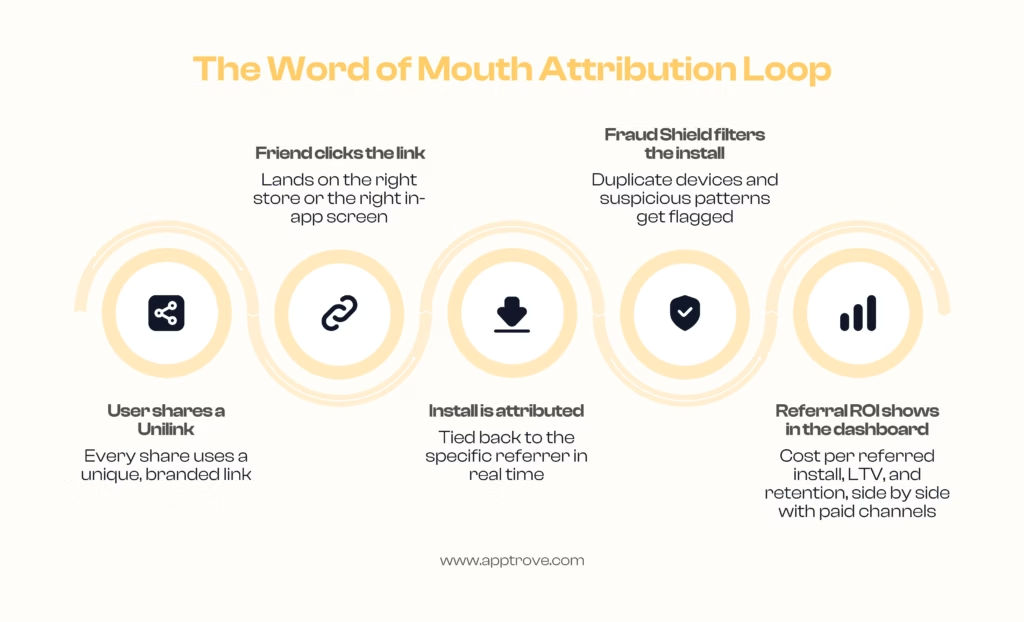
It’s the perplexing part, not the recommendation itself, but afterward the attribution process. When it comes to face-to-face communication, it is one point that one can’t keep track of, and it is okay; one would not need to track down everything that’s been said at dinner. However, you would need to know about those referrals, which can be tracked by means of a link, sharing and invitation code. This is also the part that makes the difference between vague ‘organic growth’ and actual channels with the help of which one can measure the outcomes.
Below are some steps for all of those who want to succeed in measuring word of mouth marketing for mobile apps:
1. Use unique, branded referral links for every user: To track every new install of an application and attribute it to the person who referred it, those who coordinate an affiliate program should avoid the use of any common link and, instead, rely on unique links/Unilinks for each person participating in the program. It is useful for tracking at what level of referral a person is coming from.
2. Separate referral installs from other organic installs: This separation is needed because organic installations involve several different ways of reaching the application, not one of which can be counted as a referral.
3. Filter for fraud before you trust the numbers: Try to fraud-shield the program from applicants who would like to commit fraud so that the numbers you see are accurate.
4. Watch retention, not just install count: For referred users versus paid users. Referred users usually retain meaningfully better, and that’s the number that justifies investing further in organic advocacy specifically, rather than just counting it as a nice-to-have.
5. Report on it in real time: Real-time reporting lets you catch a referral spike (or a fraud spike) while a campaign is still live, instead of reconstructing what happened weeks later.
Common Mistakes That Quietly Kill Referral Growth
Certain problems appear again and again with companies that try this and experience poor results:
1. Treating the referral link as an afterthought. A generic, un-brand link that directs each user to the same store regardless of their location, device, or whether or not they have the app will definitely lose a lot of clicks prior to converting. The referral link must provide a positive product experience instead of just serving as a means for tracking users.
2. Over-rewarding low-intent shares. Heavy incentives tend to bring in leads who care less about the app. As a result, future retention rates for acquired customers are likely to be low, and the overall ROI for the app may become unfairly low compared to paid channels.
3. Ignoring the review funnel until ratings start slipping. Once the average rating drops, the app has to wait for a while before getting more positive reviews that could boost the rating.
4. Not separating signal from noise in attribution. By lumping referral installs into the category of “organic,” it becomes impossible to know if the referral campaign is making an impact or if unrelated organic growth is concealing a stagnant referral program.
5. Measuring installs but not downstream behavior. A surge in referred installs may be great on the dashboard, but if users drop out within a week, the program has not added any value and only transferred the cost of acquisition away from paid channels to free ones that do not improve quality.
Ultimately, the root cause is the same: referral marketing and review generation are treated as set-and-forget, rather than as an ongoing process that needs tracking, iterations, and reports.
FAQs
What is word of mouth marketing in simple terms?
An organic recommendation occurs when someone endorses/advocates for a product or service free of charge while communicating in conversation, writing a review, posting on social media, or sharing a link.
Is this kind of organic promotion still effective in 2026?
Indeed, organic advocacy should be seen as one of the most efficient channels in the current climate, especially because the costs of paid advertising are growing and privacy-related changes reduce ad targeting.
What’s the difference between referral marketing and word of mouth marketing?
The term “organic recommendation” is the general idea, while “referral marketing” refers to the method used to put this idea into practice. Thus, not every result of organic advocacy is a referral from a referral program.
How do you track word of mouth marketing for a mobile app?
Tracking unique branded links of every person sharing the information, recording installs received from specific referral links, avoiding invalid or duplicate installs, as well as comparing retention rates and lifetime value of referred users with those from other channels, is possible only if the latter are based on tracking link referrals.
What are good word of mouth marketing examples for apps?
Common examples include double-sided referral rewards (“you get a month free, they get a month free”), post-milestone review prompts, shareable in-app results or achievements, and community features that let users show off progress to people outside the app.
How long does it take to see results from a word of mouth marketing strategy?
Referral programs with a clear incentive can show measurable installs within weeks. Organic, unincentivized advocacy builds more slowly and compounds; it typically becomes a meaningful acquisition channel over several months, as satisfied users accumulate and app store reviews build up.
from Apptrove https://apptrove.com/word-of-mouth-marketing/
via Apptrove


Comments
Post a Comment