Data Collaboration Platform: Turning Fragmented Data Into Marketing Intelligence
Today’s marketing is not short of data; it is full of disparate data.
A smartphone app can produce countless data points throughout the user experience, including updates on shows, interactions, installations, signups, in-app transactions, subscriptions, retaining customers, and losing customers. When CRM databases, ad campaigns, attribution statistics, analytics sources, and partner datasets enter the situation, marketers will find themselves working in isolation on many facets of their consumers’ narrative.
That’s why a data-sharing platform helps bring the puzzle pieces together in a controlled environment where teams and organizations can conduct their business with the datasets without the need to move or disclose the initial data.
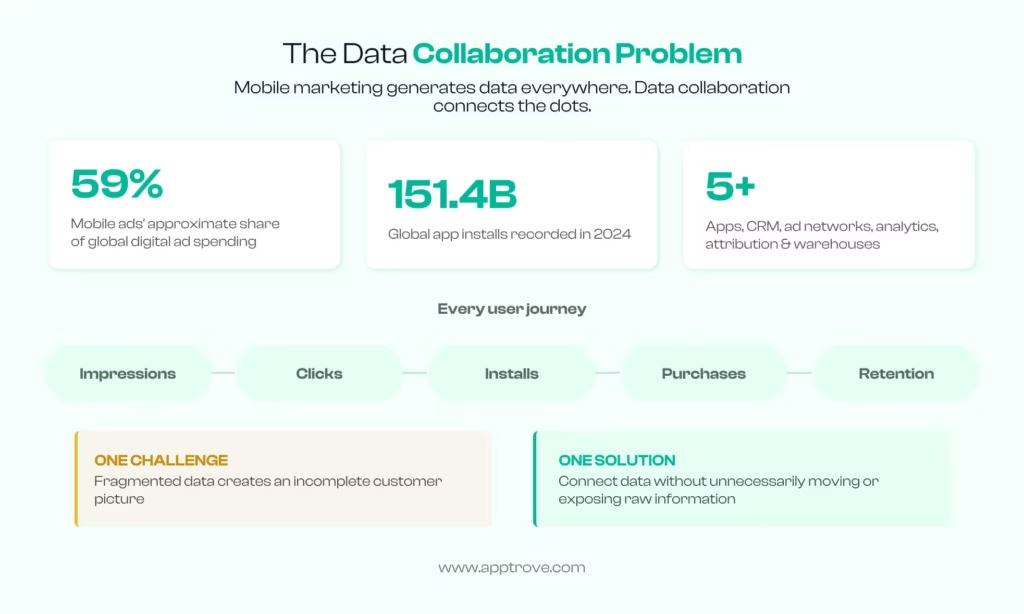
This becomes especially relevant in light of the growing privacy concerns related to mobile marketing. According to some reports, mobile ads accounted for approximately 59% of total digital ad spending globally, which indicates how heavily mobile marketing relies on data and analysis. This is vital for app marketing, where connecting the success of a campaign with downloads and later events helps to manage the budget.
What Is a Data Collaboration Platform?
A data collaboration platform refers to an environment that allows various groups, companies, or partners to use data jointly without losing control over data protection, access, and governance. Rather than sending spreadsheets, sending customer databases, or passing raw data from one system to another, companies can establish controlled access to data.
Let’s take a mobile marketing campaign as an example. An advertiser knows how many impressions and clicks the campaign earned, and how much money the advertiser spent. On the other hand, the app publisher has information on installations, registrations, purchases, subscriptions, and customer retention.
Combining the two eliminates the need to mistakenly believe a campaign brings valuable users.
A high number of installs per campaign may seem like a success, but if people uninstall apps in a week or don’t generate revenue, something is wrong with the acquisition strategy.
How Data Collaboration Platforms Work
Typically, the first step in any process is to create connections between various data sources like mobile applications, customer relationship management (CRM) systems, customer data platforms, ad networks, analytics tools, attribution platforms, and cloud data warehouses.
The platform will then serve as a way of putting together and regulating this information. The companies may use this in several ways depending on the technology used. As an example, this may include identity resolution, audience matching, data analysis, segmentation, and report generation based on different rules of access and privacy application.
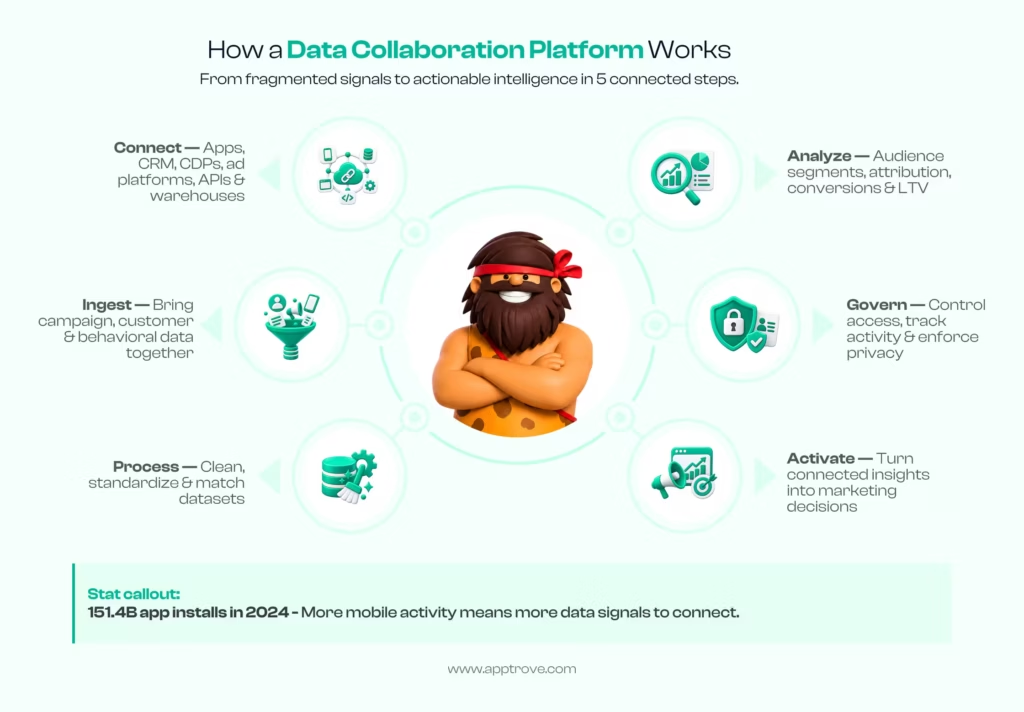
For mobile marketers, this may involve connecting first-party data with signals of attribution, information regarding campaigns, conversion events, different segments of customers, and lifetime value metrics. Instead of treating every dataset separately, the process allows marketers to develop a broader understanding of the customer journey.
Data Collaboration vs. Data Sharing
Traditional data sharing simply involves sending data from one user to another. After the data is transferred, controlling how that data is retained, shared or reused becomes more complicated.
Data collaboration offers a more sophisticated method of data exchange. Companies sharing data can manage who gets access to the data, what analyses can be performed and what results can be shared.
The best example of collaboration is the use of data clean rooms. These allow teams to share sensitive data while protecting the privacy of pristine datasets.
The difference can be summarized easily: data sharing sends data, while data collaboration creates an environment for data.
For mobile marketers, this difference is becoming crucial, as the need to attribute marketing campaigns increases along with privacy regulations shaping the ways customer data is utilized.
Why Do Businesses Need Data Collaboration Platforms?
Data can’t be isolated these days. For example, marketing professionals look at campaign data, the product team analyzes engagement metrics, the sales department tries to manage the CRM and finance department focuses on revenue. Each team has its own data source that contributes to decision-making, but it becomes ineffective when they don’t connect.
Data collaboration platforms enable companies to combine all available data into useful insights. Instead of accumulating isolated reports, teams can use governed data and interact with it while keeping all the rights.
Mobile marketers can see clear evidence of the importance of the issue. There are a number of marketing measurement elements like user acquisition, attribution, retention, and monetization. According to AppsFlyer’s State of Mobile 2025 report, 2024 saw the growth of global app installations to 151.4 billion, while the number of app remarketing conversions just gets higher and higher.
Breaking Down Data Silos
Data silos occur when information becomes confined to certain departments, platforms or organizations. While marketing might know which channel led to an install, product analytics will understand what the user did after that. However, neither of them gives full context of the situation.
Data collaboration allows these sources to connect with each other and makes it easier to analyze the correlation between acquisition and subsequent behavior. For example, marketers may analyze how much was spent on the campaign, what was the quality of installation and the purchase events that followed.
The result is a shift from channel reporting to customer intelligence.
Facilitating Cross-Department Collaboration
Data collaboration prevents obstacles from appearing between teams. Rather than asking for CSV exports and waiting for analysts to produce custom reports, those who are authorized can work with datasets that are governed.
For instance, the growth team can combine attribution with product analytics to find out where the most valuable users come from. CRM can then make use of this information to create suitable segments, while finance can get insights about revenue generated in relation to acquisition costs.
Thus, everyone uses connected information, and there is no continually competing truth.
Supporting Data-Driven Decisions
Improving decision-making abilities is the ultimate goal, rather than just increasing the availability of information.
Marketers can find trends hidden by separate data systems by simultaneously analyzing marketing, customer, and revenue information. This way, they can recognize which customer segments retain best, which campaigns are the most effective, and where acquiring customers has poor profitability.
In such a competitive field as marketing, this insight can make a significant difference between making effective bids in milliseconds and when dealing with conversions because of the information extracted.
How Does a Data Collaboration Platform Work?
A data collaboration platform enables a controlled layer between different sources of data and any entity that needs to make use of them, whether it be a person or a system. You can think of it as a conference room where data can convene: everyone can contribute their useful knowledge, but access to confidential information is regulated.
Such a model allows marketers to see data points collected during all stages of app development in one place. For instance, an attribution platform can allow tracking installs and sources of campaigns, an analytics system can make records of sessions and actions taken within the app, while CRM or CDP may hold customer profiles. A collaboration layer enables signals to work cooperatively instead of making marketers analyze them separately.
Data acquisition
The next stage is transferring all relevant data sources to the collaborative environment that may include mobile measurement tools, media buying platforms, CRM systems, CDPs, mobile analytics software, data warehouses, APIs, and in-house databases.
The use of channels and APIs may automate the process minimizing the need for manual CSV downloads. Data can be transferred via batch or real-time streaming pipelines if it is allowed.
Data Processing and Storage
In order for raw data to be useful, it must be cleansed and standardized. This includes changing different formats, fixing different kinds of discrepancies, arranging metadata, and getting datasets ready for analysis.
For instance, one type of data can receive a user ID while another type of data identifies a certain person with a different ID in its analytics system. Such discrepancies can be solved with the help of identity resolution or matching mechanisms.
Once the information is processed, it can be used in conjunction with the already available infrastructure rather than replace it all. Once data is processed, relevant authorized personnel will be able to access it. Access management will determine which datasets, attributes, queries, or outputs a particular user or partner can access.
Governance and Monitoring
Governance is the last layer. A proper data collaboration platform manages the use of data sets.
Entities can set access permissions, keep track of who accessed the data, ensure the audit trails, track the origin of data, and enforce the privacy regulations. As a result, companies mitigate the risk of unleashing an uncontrolled data flow. Thus, the entire process becomes automated with no data transfers and more data intelligence contributing to the work.
Key Features of a Data Collaboration Platform
An effective data collaboration platform is more than just a space for the storage of datasets. Its worth lies in its ability to integrate processes and apply security protocols, analytics, and process coordination for generating usable insights from data.
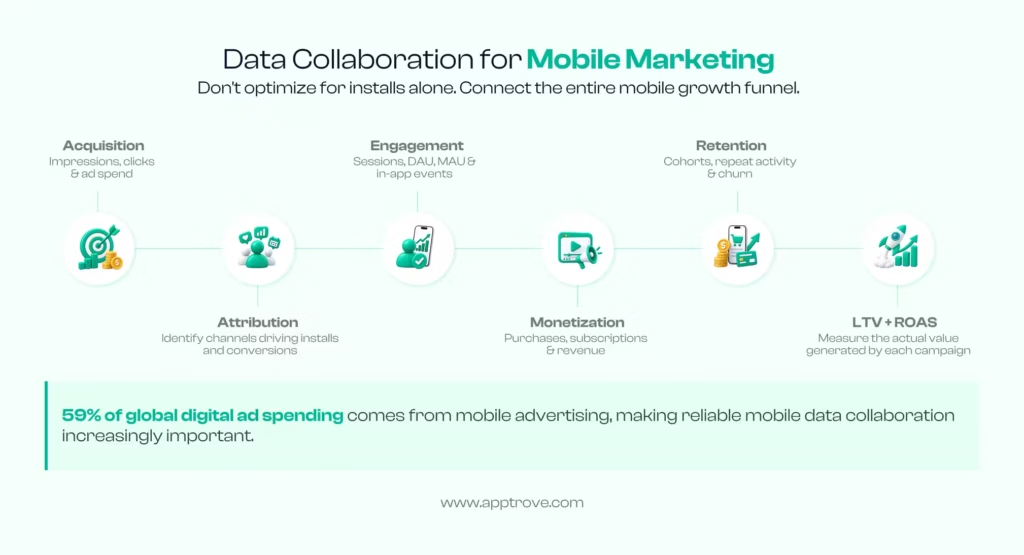
The importance of this capability is obvious when it comes to mobile marketing, where data on growth is spread throughout the entire customer journey from performing an ad impression to an installation, completing the first sale, reaching a customer’s repeat transaction and churn.
Data Integration
Integration forms a basis of successful collaboration. The platforms should be interconnected with data warehouses, CRM systems, CDP, advertising platforms, engines for analytical evaluations and APIs, and mobile attribution systems.
Robust integration capabilities permit marketers to unify the reports on spending on campaigns, impressions, clicks, installations, actions within the app, income, retention, and customer lifetime value without having to transfer information manually from one system to another constantly.
Access Control and Security
Not all users require access to all datasets. A good data collaboration platform thus includes granular access control based on users, roles, organizations, or particular datasets.
Elements like role-based access control, authentication, encryption, and permission management ensure that customer-sensitive information is kept safe, while enabling authorized teams to collaborate.
Data Cataloging and Governance
With the number of datasets ever-increasing, it is challenging to find and comprehend the relevant information. Data catalogues offer insights into the existing datasets, such as their source, form, ownership, and purpose.
Governance assists in establishing rules regarding data quality, retention, access, and compliance. This enables the teams to avoid the use of wrong information.
Analytics and Reporting
The collaboration contributes significant value when users can perform analytics independently of the technical teams. The presence of querying functions, dashboards, segmentation, and reporting allows stakeholders to identify trending patterns and measure the results.
For example, marketers are able to analyze the cost per install (CPI), conversion rates, retention, ROAS, and customer lifetime value figures across the acquisition channels and find out which campaigns generate profitable users.
Collaboration Tools
In conclusion, the platform should have tools that make working together possible. With shared working areas, limited access to the data set, automatic operations, and links to other business intelligence tools, the parties have the same rules in a shared data environment.
This combination ensures the transformation of the data collaboration platform from a simple means of data sharing into an effective tool for modern, privacy-oriented data collaboration.
Types of Data Collaboration Platforms
Different companies may have their own different practices when it comes to cooperation regarding data. For example, a mobile gaming company that shares its internal marketing data expects other things compared to a retailer that cooperates with an advertising agency. This is the reason why different versions of data collaboration platforms exist.
Internal Data Collaboration
The main purpose of internal data collaboration tools is to facilitate communication between internal teams. Marketing, product, sales, accounting, and data management departments collaborate using the same datasets, but their rights regarding access to data differ depending on their department.
For example, a team working in marketing can use data received from different sources such as marketing attribution, product statistics, and revenue reports to understand which ways of attracting users work the best.
External Data Collaboration
The term external collaboration refers to the collaboration between companies concerning their data. The relations could be established between advertisers, publishers, agencies, suppliers, technology companies, or partners.
The only prerequisite for it is access control. The companies must grasp the benefits of the shared data while refraining from sharing sensitive customer and proprietary information.
Cloud-Based Cooperation
Thanks to the emergence of cloud-based services, the cooperation of companies situated in different locations became easier.
The data is easily linked to cloud services, cloud warehouses, and analytical solutions, providing centralized governance. For those companies that have an enormous number of mobile events, cloud platforms can provide them with the capacity needed.
Data Clean Rooms
Data clean rooms are viewed as a safer type of collaboration. In data clean rooms, companies can compare different datasets, without having to make an identity of individuals who are part of those datasets. In mobile advertising, for example, a brand and its media partner can determine if they are targeting the same audience and how effective their advertising campaign was while still keeping their customers’ database secret.
These models differ in terms of their purpose. Internal systems are based on accessibility of data within the company, external ones are based on cooperation of companies, cloud-based systems are based on the principle of scalability, while clean rooms prioritize privacy.
How Data Collaboration Platforms Work
The difference between data collaboration platforms starts making sense only when data moves beyond mere dashboards to start influencing companies’ decisions. Companies are capable of utilizing collaborative data environments to connect the dots across departments, business partners and clients.
In mobile marketing, this is particularly powerful because the customer journey rarely sits inside one system. Acquisition, attribution, engagement, monetization, and retention data often exist across different platforms.
Marketing and Advertising
Marketing teams can leverage the power of campaign, audience, attribution, and conversion data to assess performance across campaigns and delve deeper than the mere metrics.
Marketers can utilize this information to determine the channels that yield users with a higher retention rate, higher purchase rate, and better LTV, instead of merely focusing on impressions, clicks, or installs. This allows more precise allocation of budgets and audience segmentation.
Sales and Customer Analytics
Data collaboration solutions can help to link CRM data with behavioral and transactional data. Sales teams can gain value from this data by discovering customer behaviors, uncovering profitable accounts, and tailoring communication.
When it comes to subscription mobile applications, using indicators of user acquisition channel, interactions with the product, subscription status, and profitability allows revealing segments of customers that are likely to subscribe or renew their subscriptions.
Product and Business Intelligence
Product teams are able to collaborate with marketing and analytics specialists in order to analyze the events occurring after the installation. The installation data by itself does not say much about the quality of the product, whereas the data that occurs after installation clarifies the situation.
Analyzing DAU, MAU, session frequency, adoption of features, conversion events, retention of cohorts, and churn is done by teams along with data related to user acquisition.
Operations and supply chain
Apart from marketing, collaborative data helps in linking sources, inventory systems, logistics systems, and operational databases. The information can be used for forecasting demand, planning for inventory, and monitoring performance.
In these instances, there is one key point of commonality: disconnected information answers only specific questions, while connected information reveals correlations.
Data Collaboration Platform in Marketing and Advertising
The mobile marketing industry is generating lots of data nowadays. Various marketing initiatives generate impressions, clicks, installations, registrations, purchases, subscriptions, and actions. The only issue is how to make sense of all these individual data pieces.
A data collaboration platform ensures that advertisers, app developers, advertising agencies, and technology partners have an opportunity to analyze relevant data sets in a secure environment. It makes it possible to measure the effectiveness of marketing campaigns while minimizing the need for the exchange of user-related sensitive data.
As marketers start paying more attention to their first-party data, they are trying to find ways to make their client data more valuable.
Mobile apps are using first-party data in the following way: marketers are collecting clients’ activities related to purchases, engagement, subscriptions, retention, and behavior in mobile applications. Once the data is collected, the marketing departments can analyze it to create more effective audience segments and discover clients with high lifetime values.
Privacy-Preserving Audience Collaboration
Audience collaboration gets tricky when different companies are involved in a project. An advertiser is trying to determine whether there is any overlap between its customers and the audience of a mobile app that the advertiser is targeting, but the process of exchanging customer lists raises concerns regarding privacy and governance.
Data clean rooms and other privacy-preserving environments ensure that organizations collaborating in a particular project can carry out controlled audience matching and analysis while keeping their data private and confidential.
This possibility can help organizations use new solutions for audience overlap analysis, audience suppression, audience segmentation, and campaign measurement.
Campaign Measurement and Attribution
The use of a data collaboration platform can also help connect all advertising signals with conversion data. Instead of stopping analysis after the moment the user installs the app, marketers can analyze what happens after that.
For instance, they may analyze cost per install (CPI), registration rate, conversion rate, retention rate, ROAS, and LTV. It is important to distinguish between campaigns that provide just the number of users and campaigns that acquire valuable customers.
Why Data Collaboration Matters in a Privacy-First Ecosystem
Changes in privacy rules are now affecting the environment for outdoor measurements and audience targeting. The changes in identifiers and the need for personal consent are making it almost impossible for people to process data freely.
Data cooperation enables different firms to connect with each other in a safe and secure way without exposing the data being shared. This makes it feasible for marketers to create better opportunities for data use and realization of better marketing campaigns without treating privacy as an obstacle.
Benefits of a Data Collaboration Platform
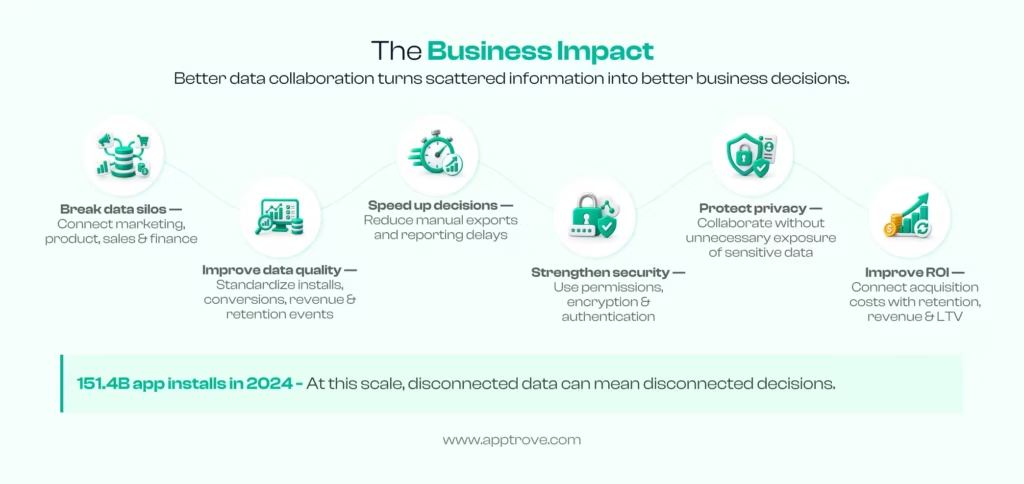
The major benefit of the data collaboration platform is that it turns disparate data into something useful for teams. Instead of comparing data as separate assets that belong only to certain departments or partners, organizations can form an interconnected data ecosystem while controlling access and the utilization.
For mobile marketing teams, it leads to improvements in measuring, optimizing and scaling campaigns.
More Accessible Data
A collaborative environment makes it much easier to find and access pertinent information. In this case, marketing teams can combine campaign performance with attribution and product analytics, CRM data, as well as revenue data without having to ask for repeated manual exports.
As a result, it leads to a better understanding of the customer journey and saves time searching for the information.
Improved Data Quality
When teams operate with separate spreadsheets and databases, discrepancies are almost guaranteed. Each team might employ other terms for the same actions like installations, conversions, active users, and revenues.
By introducing centralized management of information and standardizing datasets, teams can avoid discrepancies and have better information at their disposal.
Faster Decisions
The value of data lies in how fast it can reach the decision-makers. A data collaboration platform can help with automating connections and workflows of reporting, thus minimizing the need for manual data preparation.
In terms of mobile marketing, this means that poorly performing campaigns can be quickly identified; the process of budget allocation can go much faster, and changes in retention and conversion can be noticed sooner, thus avoiding high costs.
Improved Security
Increased collaboration does not automatically equal lower security. Companies can have very precise permissions, encryption, authentication, and auditing to ensure that only authorized users can reach specific data.
Reduced Operational Costs
Manual data transfers require both time and labour. This often requires hours of work from the analysts to pull, clean, reconcile and share data that is otherwise available in an automated way.
With the automation of workflow processes, businesses can cut down operational redundancy and enable their data and marketing teams to tackle more important custom analytics or decision-making tasks.
In the end, the true worth of a data collaboration platform lies not in its carrying capacity but in its usability in collaboration, customer understanding, and decision-making activities.
Data Governance and Collaboration
A data collaboration platform can connect large quantities of information, but connectivity without governance can result in misunderstanding. When several teams or organizations are using the same information, it is important for them to know its origin, its owner, its reliability, and what they can do with it.
Good management of data presents itself as a frame through which collaboration takes place.
Ownership of Data
Ownership of every important dataset should be clearly defined. The person is responsible for the quality of the data, access control, and correct usage of the dataset.
In mobile marketing, ownership might be shared with several teams. Marketing could own campaign data, product teams use user activity data, and financial teams manage revenues. Clear ownership is important for eliminating wrong definitions and facilitating solving problems with data.
Data Quality Management
Data that is not of good quality can make any analytics effort poor. Redundant records, missing events, as well as something inaccurate data can give rise to false conclusions. A platform for the collaboration of data should enable the processes of verifying, cleansing and standardizing data before someone proceeds to analyze it. For those marketers working via mobile, this means that definitions of installs, re-engagements, conversions, purchases, active users, retention and revenue events should remain stable.
Metadata is the information giving the data meaning – what it includes, where it is from, when it appears and how it has been interpreted. If no metadata exists, users may not be able to use data correctly.
Data lineage is a more advanced type of metadata. It not only indicates the movement of data, but traces it back to its source. For example, the marketer has the possibility to discover the sources of earnings due to this new technology.
One may conclude that metadata helps to enhance the credibility of the collaboration thanks to data ownership.
Conclusion
In conclusion, the data collaboration platform provides the opportunity of providing association of disunited datasets and disassociated operations. This platform creates a safe environment for data processing and acts as a means to eliminate barriers and improve the quality of data.
In regard to marketers, the biggest benefit lies in the capability of merging acquisition data with attribution and revenue datasets. The organization that collaborates while maintaining control over data will be the best. In the future, there is no need to collect data just for the sake of data; it is enough to make the existing dataset more reliable and adaptable.
from Apptrove https://apptrove.com/how-data-collaboration-platforms-simplifies-data/
via Apptrove


Comments
Post a Comment