What is Customer Experience?
The definition of customer experience means how a customer perceives a brand, starting from discovering a brand and visiting its website to buying a product, contacting support, receiving follow-up questions and making their final decision regarding returning.
Customer experience is more than customer service. It includes the whole relationship between a customer and a company. Every event creates a small impression over time. For example, a website loading quickly, a simple checkout process, a friendly support agent, an individually chosen offer or even an unclear return policy can form an idea about a brand.
In highly competitive markets, it is easy to copy products, match prices and create similar functionalities. The main distinguishing factor is the experience of using this product.
Why Is Customer Experience Important?
A customer experience that works effectively may have a strong impact on a company’s acquisition strategy, conversion rates, client retention, loyalty, and revenue. When customers can easily and positively engage with a company, they have little reason to leave and a good reason to come back.
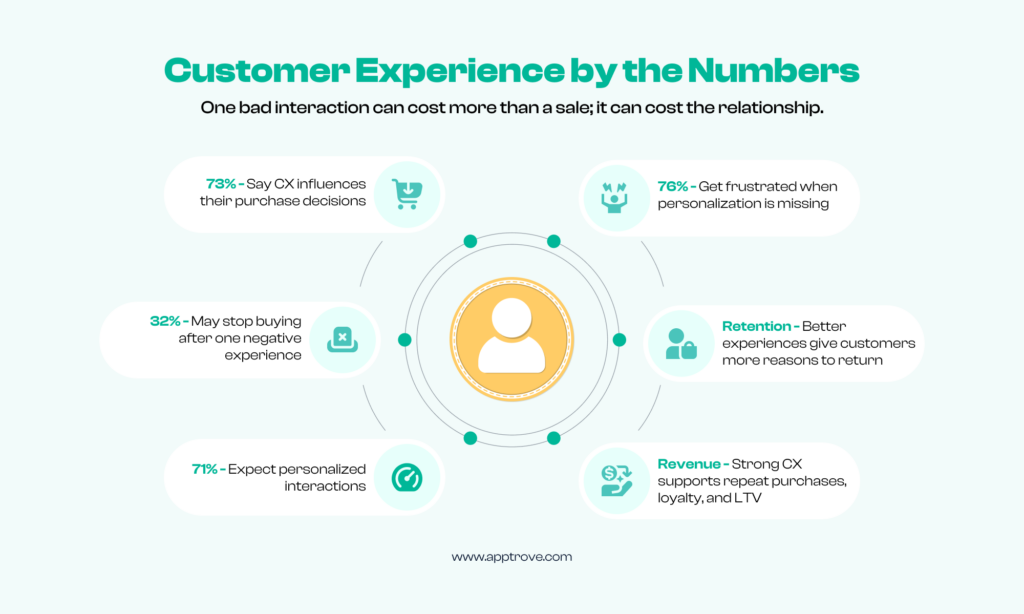
Opportunities that arise in this area are great indeed. According to research by PwC, a remarkable 73% of respondents said that customer experience greatly determines whether they make purchases or not. It is interesting to note that 32% of consumers said that after one negative experience, they can easily refuse to buy even from a brand they like. It shows that although the product might bring a customer to a company, the customer experience will ultimately define whether the person will come back or not.
Proper experiences are sure to increase customer satisfaction as well. When customers receive timely and relevant information, experience fewer difficulties, and solve their issues easily, their attitude towards a brand improves.
What Are the Major Components of Customer Experience?
A comprehensive customer experience strategy consists of multiple components working together rather than just one department or communication channel.
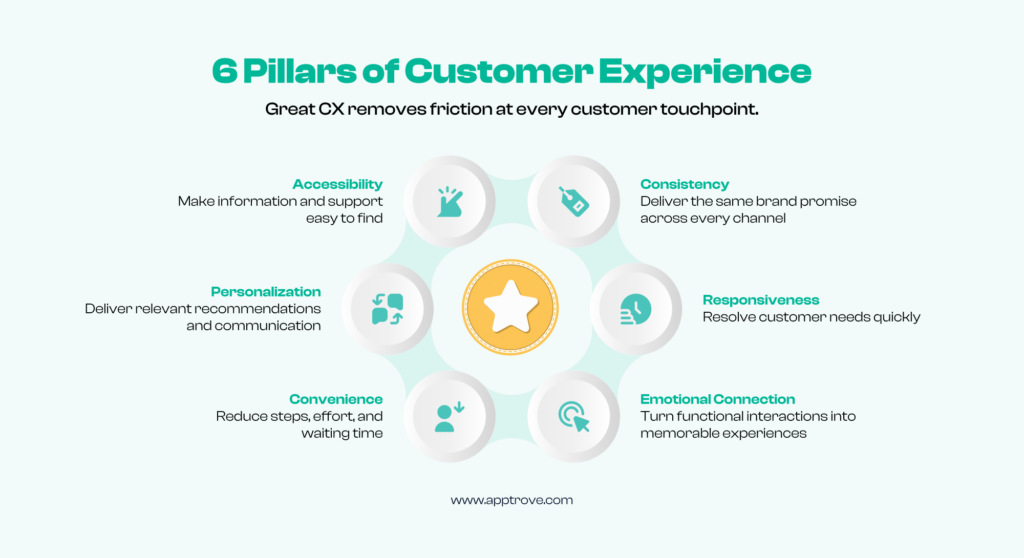
1. Accessibility
Customers need to be able to easily find the information, services, and help they are looking for without any hassles. Accessibility means applying its meaning to websites and mobile applications, physical shops, customer service, and all other places of information.
2. Personalization
Modern consumers increasingly expect companies to understand what they want and what they like. What is meant by personalization? It enables customers to receive useful advice and recommendations and gives them what they need without their asking for information.
However, personalization also needs some limits.
3. Convenience
Convenience is one of the key concepts to understand. It means creating conditions in which customers can solve their problems with minimal effort: less time, easier navigation, fewer steps required.
The principle is simple: you need to make the process of solving your problem as easy as possible.
4. Consistency
Brand recognition should be maintained at all channels. If your website promises something that the customer service contradicts, customers may lose trust.
Consistency over emails, social media, websites, applications, stores, and service providers guarantees a unified impression.
5. Responsiveness
Customers do not like waiting. Quick responses can prevent a lot of frustration.
6. Emotional connection
Not all interactions need to be spectacular. Sometimes, a small number of standard interactions can generate a good deal stronger emotional bond with the customer as compared to holding an awe-inspiring promotional initiative.
Customer Experience vs Customer Service
The two expressions are often confused; however, they denote different notions.
Customer service mainly concentrates on assisting customers prior to, during, or after the purchase phase. Support requests, phone calls, chats, refunds, and solving technical problems are among the most general cases of application.
Customer experience, though, has a much wider meaning. It embraces customer service and goes further, into advertising, product design, onboarding process, pricing, transaction, delivery, and every other form of interaction.
Think of customer service as one chapter of a book, and customer experience covers the entire book.
What Is Customer Journey?
Customer journey is represented as a series of steps customers need to pass through when interacting with a certain brand. Though there are different models in different companies, usually the model consists of the following steps:
Awareness
At this phase, the consumer finds the organization through advertisements, search engines, social networks, as well as from word-of-mouth.
Consideration
The buyer studies the product, checks alternatives, and reads reviews to understand whether the offering is adequate.
Purchase
The buyer makes a purchase, with the price, purchase experience, payment opportunities, and trust factors influencing this stage.
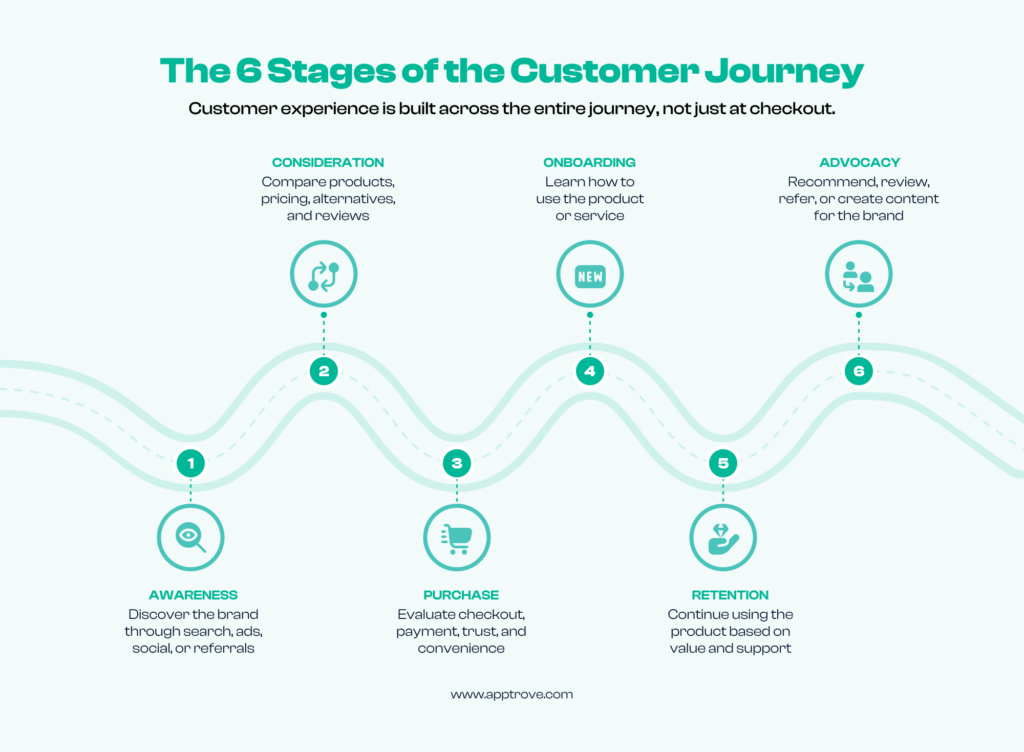
Onboarding
After the purchase has been made, customers need to know how to use the product or service. Good onboarding reduces confusion and ensures better use.
Retention
Customers keep on interacting with the company. Good customer support is not enough; product value and personalized communication also matter.
Advocacy
Happy customers may tell others about the company, give positive reviews, produce user-generated content, or buy from the company again.
It is important to note that customers may move from one stage to another at any time and skip some phases or even use several channels at a time.
How is customer experience measured by companies?
It is not easy to improve what cannot be measured; therefore, businesses apply a mixture of qualitative and quantitative metrics to learn what customers think of their experiences with them.
Net Promoter Score
Net Promoter Score (NPS) indicates the possibility of whether customers are willing to recommend a business, service, or product. The respondents normally rate their willingness on a scale of 0-10.
Customer Satisfaction Score
Customer Satisfaction Score (CSAT) measures how satisfied the customers are regarding a specific service or product.
For instance, upon resolving the customer support ticket, the customer is asked to rate the level of satisfaction.
Customer Effort Score
Customer Effort Score (CES) reflects how easy or difficult it was for the customer to perform the task or solve the issue. Low effort is desirable because unnecessary obstacles can negatively influence the customer experience.
Retention and Churn
Retention defines how many customers keep using the products of the business, and churn defines the customers who stopped using them.
These indicators are especially useful as they point to bad experiences which lead to customer churn.
Customer Lifetime Value
Customer Lifetime Value (CLV or LTV) refers to the total revenue generated by the customer during the period of using a certain service or product provided by a business company.
Personalization and Customer Experience
Personalization has gained considerable significance in contemporary customer service strategies. Companies are now adopting different customer messages rather than spreading similar ones to all visitors. An online shop can now suggest products in relation to customers’ browsing activities, while a SaaS business can adapt to a customer’s scenario of interest.
Interestingly, McKinsey’s research established that 71% of clients anticipate personalization from companies, while 76% of clients are upset by the absence of personalized interactions.
However, to succeed in personalization, one needs relevant data, responsible treatment of the data, as well as accurate segmentation. Just sending clients irrelevant notices because one has their contact information does not equate to personalization; it is simply noise.
Frequent Customer Experience Issues
Leaders in business encounter many recurring issues in their attempts to enhance the experience of their clients.
Siloed Departments.
The different departments (marketing, sales, the product group, and support) may possess unrelated information and work toward dissimilar goals.
Different Experiences
Clients may be provided varying messages based on the mode of communication used. Differing experiences can cause the loss of trust that is commonly experienced.
Heavy Use of Automation
Though automation can enhance efficiency, the excessive use of the technology could lead to frustrating experiences for the clients in need of the assistance of an agent.
Ineffective Use of Data
Companies often collect tons of information about the clients but fail to derive any useful insights from the accumulated data.
Ignoring Clients’ Opinions
Collecting the data in the form of surveys proves to be of little value if an organization does not take any steps toward implementing changes based on the testimonials from clients.
Ways to Enhance Client Experience
Improvement of clients’ experience may not require huge investments in technology. In many cases, the most significant improvements may be made by eliminating minor roadblocks in the process.
Typical Obstacles in Customer Experience
There are numerous challenges that arise in nearly all cases of enhancing customer experience.
Organizational Silo
The departments involved in marketing, selling, product development and customer support may have different goals and data, which can lead to inconsistencies in communication.
Variable Experience
The information provided to customers might differ according to how the customer has gotten in touch with the company, leading to a lack of trust.
Overuse of Automation
Automation can help save time and make processes faster, but it can also make customers unsatisfied with their interactions.
Data Misuse
Companies may collect significant amounts of data from customers but fail to use it effectively afterwards.
Overlooking Feedback
There is no point in collecting customer feedback if the organization does not act based on the information obtained.
Ways of Improving Customer Experience
Making customer experiences better does not necessarily involve heavy investment in new technology. In many cases, it is enough to remove the little sources of inconvenience from the process.
Hyper-Personalization
With advancements in technology and data analytics, organizations can enable hyper-personalised interactions for customers.
Proactive Support
Businesses today are able to identify potential problems in advance and offer their solutions before receiving a call from the customers.
Experience as a Competitive Advantage
With the ability to replicate products’ features or benefits, the experience of a customer with the brand becomes a unique factor that creates value for customers who have a clear understanding of their needs.
Conclusion
The important thing in customer experience is to make every interaction feel deliberate instead of accidental. Only customers do not see the organizational chart of the company; they see its structure, its website, product, advertising, emails, employees, payment system, services team, policies, and overall brand.
This means customer experience cannot belong only to the support department or marketing team, and it must be taken care of by the whole company.
Successful brands are those that know everything about the whole customer journey, can identify places of friction, use the technology sensibly, and provide customers with an experience which will make them think that doing business with the company is easy.
FAQs
1. What is customer experience?
Customer experience is how the customer perceives all interactions with the company from the perspective of their entire interaction with the company, starting from when he becomes aware of the brand and begin to use the product.
2. What is the difference between CX and customer service?
CX covers the full customer journey, while customer service is important when the customer has questions and problems.
3. Why is customer experience important?
A good customer experience can lead to an improvement in terms of satisfaction, loyalty, retention, advocacy, and revenue while reducing friction and customer churn.
4. What are the major customer experience metrics?
Some common metrics are NPS, CSAT, CES, retention rate, churn rate, customer lifetime value, conversion rate, and support-resolution metrics.
5. In what manner can businesses improve customer experience?
Businesses can improve it by learning what customers want, mapping the customer journey, reducing friction, personalizing necessary interactions, enhancing support, and acting on feedback.
from Apptrove https://apptrove.com/what-is-customer-experience-definition-glossary/
via Apptrove


Comments
Post a Comment