What is a Referral Program? How to Build, Track & Protect One That Actually Works
A very high percentage of app teams start a referral program with the assumption that it will run itself. Motivate users to share an invitation link and watch the installs roll in. In reality, this is not the way things go. Teams regularly get confused about which installs are referrals and receive expected rewards for installs that didn’t actually take place, and they don’t have a clean way to prove that the channel is working when they want to cut the budget.
While hundreds of brands employ referral programs to get more customers on their sales line, referral fraud exists and is a legitimate and expensive issue: when people take advantage of referral programs to make money and get unfair discounts on products or services. A properly executed referral marketing program may be one of the most cost-effective and trusted methods to app growth. A poorly tracked one simply shifts money from paid ads to reward payouts and has no greater view into what is actually working.
That’s the very place where the discrepancy is typically found: growth teams may be aware that a referral program can exist, but they simply cannot answer the main question: which installs did it actually earn? It is a measurement issue, not a marketing issue, and that is where a mobile measurement partner comes in.
What Is a Referral Program?
A referral program is a designed growth mechanism that rewards existing users with cash, credits, discounts, or in-app rewards for bringing new users to the app who then install and use the app. It validates “word-of-mouth” marketing with a ‘trackable link’, a defined reward (hopefully), and (ideally) a way to determine if the invited user actually followed through.
The basic setup is that someone at a user gives an invite link to a friend, who clicks it, installs the app, and rewards are issued upon first usage (install, signup, purchase, set number of days active).
The very mundane part is the part that isn’t simple. The part that is not simple is the part between “friend clicks the link” and “reward gets paid. This middle part is where most people fail at tracking their referral programs.
Why a Referral Program Still Outperforms Paid Acquisition
Despite all of this, the price of user acquisition has continued to rise, and app store discovery has become increasingly competitive each year. In that context, one of the few avenues that are still in the marketer’s favor are referrals.
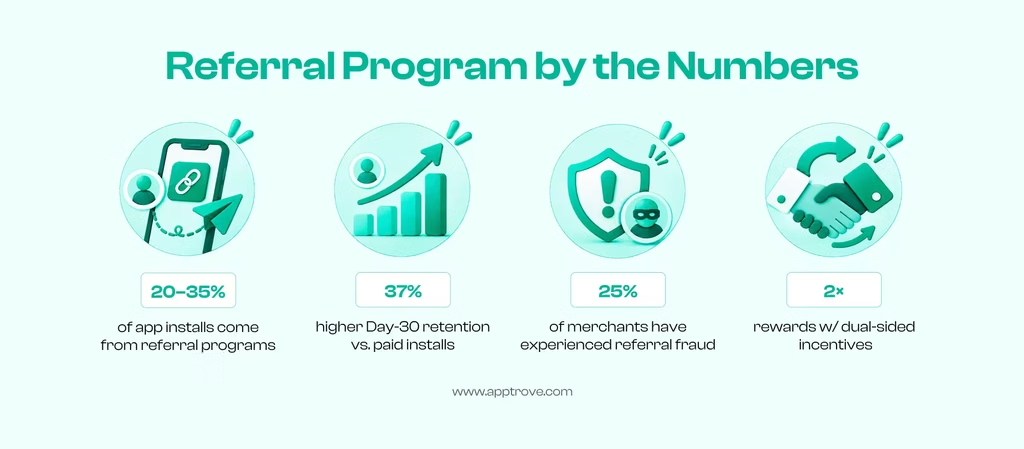
Apps that have well-established referral programs can count on 20-35% of their total app installs coming from their mobile app referrals. Referral-acquired users also have a Day-30 retention rate that’s 37% higher than that of users acquired through paid acquisition. In all studies conducted on this issue, the common denominator is that recommendations from trusted sources by consumers have far greater impact than any type of paid advertising—and that impact translates directly to better results for every downstream measure.
Its lower cost, higher retention, built in trust are the reasons a referral program makes it into the growth budget despite the demise of paid channels. The problem is, without the ability to measure these numbers accurately in its own app, a team can’t make any sense of them.
How Referral Program Tracking Works
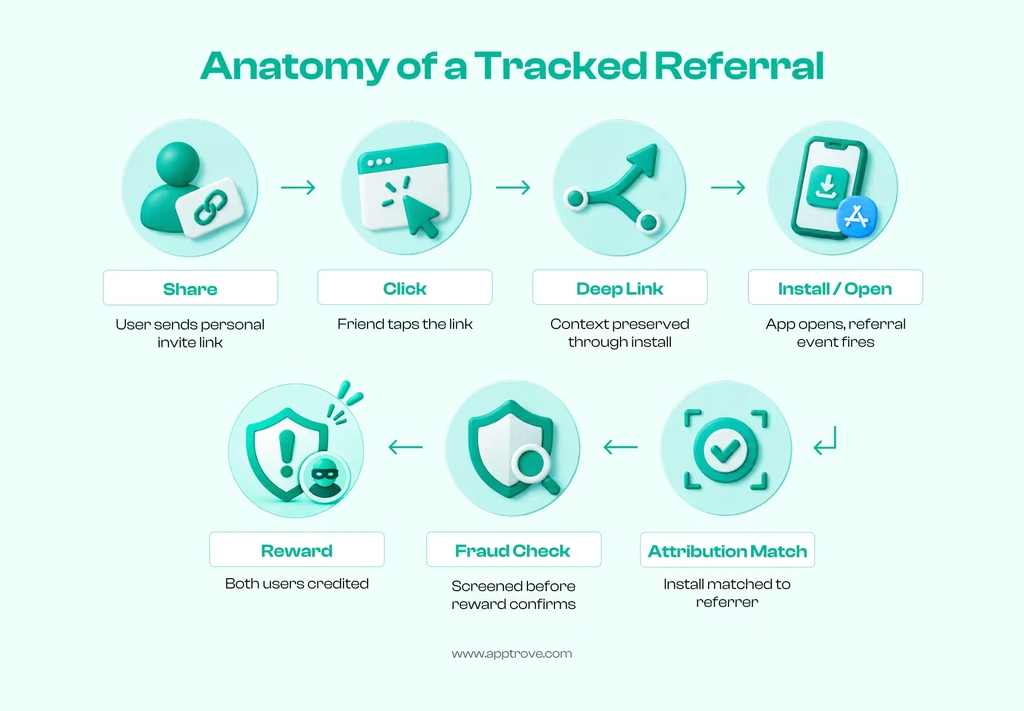
Without the tracking, a referral program is nothing more than a sham. These are the steps a well-designed referral program must take in order to be successful from start to finish:
- Share: User creates a personal referral link within the app, with their unique referrer ID.
- Click: A friend taps the link on the mobile web, WhatsApp, SMS or social.
- Deep link handoff: If the app is installed, the friend is directed to the appropriate screen. Otherwise, the link takes the user to the app store, and the referrer context is preserved via deferred deep linking, so the referrer does not go astray between click and install.
- Install / open: Application is installed / opened (both new installation and returning user), and the referral action occurs.
- Attribution match: Match the install back to the original referrer’s link and not just attributed as organic or paid installs.
- Qualifying action: The system determines if the new user has performed some action that can earn them the reward (signup, first purchase, N days active).
- Fraud check: The system verifies for self-referrals, device farms, and other manipulation before any reward is paid out.
- Reward trigger: Both users receive a reward, and the entire chain is a reportable, attributable data point.
The vast majority of that sequence relies on good deep linking; if you don’t send that new visitor to the right page, whether a new page or a specific page within your site, it’s not the sequence you expected they would follow, let alone the conversion. This is also where a referral program becomes a marketing problem and not an attribution problem that requires proper infrastructure – not a spreadsheet.
The Pain Points Nobody Warns You About
A referral program looks simple on a slide. In production, there are recurring issues:
Referral fraud eats the reward budget
Fraudulent referrals are expensive in money, in the time of investigating the fraud, and, in some cases, credit card fraud is also involved, to the extent that additional costs are borne for refunds and chargebacks. According to a 2023 study, 25% of merchants reported referral fraud, and 34% reported coupon/discount abuse, which is frequently related to the same referral program. The typical patterns are self-referrals via disposable accounts, device farms to simulate unique installs, and referral links on public coupon sites.
Attribution gets murky fast.
We can only imagine how a bunch of real installs would be confused and attributed to an organic source instead of a referral source, and how that makes the referral program seem less effective — or, if it isn’t, how it might look that way. We can only imagine how a real install could end up in the organic analytics column instead of the referral column, and how that would make the referral program look less effective — or, if it isn’t, how it would appear to be.
Retention gets ignored.
The majority of teams only look at the number of installations in a referral program. But a three-day churn is not equal to a stick. If you just count the number of installs and ignore segmentation based on retention and lifetime value, you don’t know if the channel is healthy or not.
Every one of these problems has the same root cause: the referral mechanic (who gets invited, what the reward is) and the referral program tracking (who actually converted, and whether it was real) are being treated as one thing when they need separate, dedicated infrastructure.
Why a Mobile Measurement Partner Matters in Referral Tracking
That’s the space a mobile measurement partner (MMP) fills. An MMP doesn’t operate the referral mechanic — it operates under it, credits each install to its real source, blocks fraudulent installations before they move on to earning rewards, and it reports what happens after the install, not just during the install.
In the case of a referral program, that means:
- Accurate attribution: All installs were properly attributed to the referrer, including deferred installs and app re-engagement, rather than falling into a generic ‘organic’ bucket.
- Fraud detection before payout: Rewards awarded based on actual referrals and not self-referrals or click farms.
- Post-install visibility: The visibility of the users after the installation, retention, engagement, and lifetime value of referred users in particular, not only the number of installations.
- Uniform attribution: The same attribution logic is followed, regardless of whether the referral is sent through WhatsApp, SMS, email, or in-app share, which means that the numbers are comparable across channels.
This is where Apptrove comes in with a referral program. Apptrove’s deep linking technology seamlessly conveys the context of the referral link from an external platform to an in-app location and, for non-installed users, to the specific location within the app. It’s also capable of providing fraud protection by verifying users’ referrals through seven stages of validation before a reward is confirmed, including detecting self-referrals and device manipulation that a standard in-app referral tool can’t prevent. With audience segmentation and cohort reporting, a team can not only determine how many users a referral program generated, but which cohorts earned their keep or doomed it, in terms of those who are sticking around and making money.
In other words: The referral system gets an invite out the door. The mobile measurement partner is the one who determines whether a growth team would receive a reward for the invite.
How to Build a Referral Program That Holds Up
Here are a few practical guidelines that have been found to distinguish a successful referral program that scales from one that slowly leaks budget:
Reward the qualifying action, NOT the click. Upon sign-up + activity or first purchase, not install only, to lower the risk of fake referrals.
Track and limit traffic by referrer. Some of the most obvious indications of fraud in virtually any referral program is a sudden surge from one referrer.
Always use deferred deep links. An app store detour that doesn’t maintain context doesn’t mean anyone will see the conversions in the numbers.
Separately reported users referred from segments. It’s important not to put referral installs in an “organic bucket” — this is what it’s there to prove.
Monitor fraud limits on a quarterly basis. Fraud techniques change; if you don’t review and update a rule set, there will come a time when it’s going to be exploited.
None of this requires an enterprise-scale MMP contract to get right. It requires attribution and fraud logic that’s actually built for the way referral links move across channels — which is the specific gap Apptrove is built to close for growing app teams.
FAQs
What is a referral program?
A referral program is a growth tactic that incentivizes current users to recruit new users who download and engage with an app. It operates on the basis of providing every user with a traceable unique link and will give a reward to users when the invitee accomplishes a specific act — such as signing up or making their initial purchase.
How does a referral program work for mobile apps?
A user provides a unique link, a friend clicks on the link, and the referral context stays with them even if the friend is installing the app from the app store. A user provides a unique link, a friend clicks on it, and the referral context persists through an app store install if necessary. Upon opening the app, the install is credited back to the friend who referred them, and the friend and the referred user are rewarded when the user completes the qualifying action.
What’s the difference between a referral program and an affiliate program?
A referral program is one that pays a set amount to current customers for bringing in people who they know. An affiliate program rewards third parties, typically at a higher-than-average rate, for traffic or conversions generated, with no personal connection to the new users.
How do you track referral program performance accurately?
Accurate referral program tracking requires deferred deep linking to preserve referral context through the install, attribution logic that matches installs back to the correct referrer, and fraud screening before rewards are paid — not just a raw count of links shared.
What is referral fraud and how common is it?
When a referral program’s reward system is used for personal gain by self-referrals, fake accounts or by manipulating the device itself to earn rewards without providing actual new users, it is considered referral fraud. One of the more prevalent growth-channel abuse patterns app teams face is referral fraud, which was reported by 25% of merchants in a 2023 study.
Why do mobile apps need a mobile measurement partner for referral programs?
A mobile measurement partner can ensure that each referral install comes from its actual origin, filter out any fraud before you receive rewards, and provide reports on retention and the lifetime value of the install after referral — something that an in-app referral widget might not be able to do.
What reward structure works best for a referral program?
Dual-sided rewards are achieved when both the one offering the reward and the other taking it benefit from it, and they are likely to be more effective than one-sided incentives. The increased risk of fraud is also mitigated by tying the reward to an action, not just the installation.
from Apptrove https://apptrove.com/referral-program/
via Apptrove


Comments
Post a Comment