Average Order Value
What Is Average Order Value?

Average order value is one of those metrics used to understand how much customers actually spend in a certain period of time. The measurement is very useful for the business to understand customers’ buying behaviors, evaluate results, and discover new possibilities to derive more money from the existing orders.
With the help of average order value, a company can measure the effectiveness of its pricing strategies and other tactics like cross-selling and upselling. If, for example, an online shop earns ₹2,00,000 from 500 orders, this means that the average order value is ₹400 which implies that every order generates ₹400 of revenues in the analyzed period.
High average order value means that customers are buying more products or that they are made of more expensive items. Of course, not every company is profitable just because its average order value is high. Factors like discounts, product costs, shipping costs, returns, etc., should be considered. It is important to analyze the average order value among other ecommerce metrics since it is impossible to distinguish between revenue growth and profitability growth without this metric.
How to Calculate Average Order Value
The calculation requires two inputs: total revenue for a defined period and the number of orders placed during that same period.
Average Order Value Formula
Average order value = Total revenue ÷ Total number of orders
For example, suppose an ecommerce store generates ₹6,00,000 in revenue from 1,200 orders in one month.
AOV = ₹6,00,000 ÷ 1,200 = ₹500.
The store therefore generates ₹500 per order on average.
| Metric | Value |
| Total revenue | ₹6,00,000 |
| Total orders | 1,200 |
| Average order value | ₹500 |
The process of computing the average order value is simple; however, it is important to be consistent in carrying out this calculation. Organizations should decide on one unique reporting period for the calculations, and they should also explain how they understand revenue and orders. For example, there may be situations when calculating revenue one should exclude sales discounts and write-offs, taxes, delivery costs, and other expenses that may impact revenue.
Gross vs. Net Order Value
Gross sales refer to sales before the deductions while net sales refer to the sales after the deductions. Thus, the concrete treatment of returns, taxes, and shipping costs depends on the reporting framework.
If businesses want to ensure the accuracy of the comparisons, they need to keep records of their average order value calculation method.
Why Is Average Order Value Important?
This metric connects the behavior of customers with revenues. The average order value tells whether customers spend more money in their orders and shows whether marketing initiatives are successful.
1. Identifies Growth Opportunities
By increasing average order value it is possible to raise revenues without having to increase the website traffic at the same time. Product bundles and other additional product recommendations can help.
2. Supports Marketing Decisions
Through campaigns, businesses are able to acquire customers who make all types of purchases. The measurement of the average order value through different channels provides a way to determine whether certain channels such as paid search, social media marketing, email or organic traffic lead high value transactions.
3. Promotes Smart Promotional Decisions
Using the order value information, businesses can determine a minimum spending level for free shipping, discounts, loyalty program rewards or gifts. The levels should be based on profit margins not simply set arbitrarily.
4. Helps with Accurate Business Forecasting
When combined with order quantities and conversion rate information, the metric will help businesses forecast revenues in different sales situations.
5. Provides Useful Insights on Customer Spending Patterns
Average order value provides some insight on how much customers spend on their purchases but it gives information on the average spending per order and not total spending in the whole period of cooperation with the brand.
Variable Elements that Affect Average Order Value
There are some factors influencing the amount that customers spend per transaction. Understanding these factors will help companies to find out the opportunities to improve their order values without affecting their conversion rates.
Product Pricing and Assortment
The purchase of higher cost items can improve the average order value in case customers agree to buy such items. In addition, having items in various price categories allows companies to meet various customer needs.
Discounts and Promotions
Discount, offer to get a certain product for free with the purchase of other items, and other types of discounts can make items more popular. Nevertheless, too many discounts may reduce profitability even despite an increase in sales volume.
Product Bundling
By selling products in a bundle stores may encourage clients to buy more items. Cross-selling means offering products of similar kind, while upselling means offering more expensive products of higher quality.
Shipping Options and Delivery Conditions
Consumers may try to purchase more items in order to qualify for free delivery from the store. This limit should take into account not only fulfillment expenses but also cost of goods sold and habits of shoppers.
Customer Types and Device Use
New clients and returning ones behave differently. People who shop on mobile phones and those who use computers show different buying behavior too.
Average Order Value Benchmarks and Statistics
Industry metrics help understand performance level but they should not be used as fixed standards of success. Takes into account such factors as type of goods sold, region, pricing, currency, discounts, and methods of reporting.
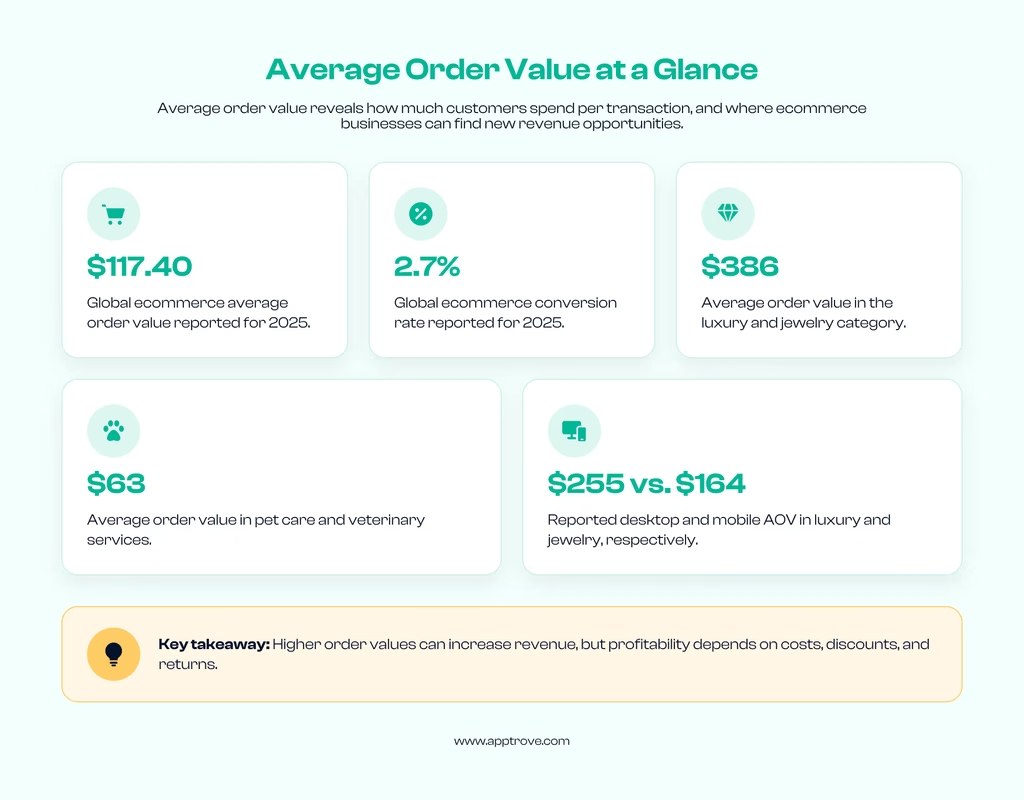
- $117.4: Average order value of global ecommerce sales by 2025 after losses due to returns and discounts.
- 2.7%: Global ecommerce conversion rate in the year 2025.
- $386: Average order value of global ecommerce sales in luxury and jewelry according to data from a measuring period of 12 months.
- $63: Average order value of global ecommerce sales in pet care and veterinary services.
- $255 vs. $164: Average order values of desktop and mobile ecommerce sales in luxury and jewelry domain respectively.
This means businesses have to compare their own performance results with respective industries rather than just rely on statistics from one source. The sources do not utilize the same methodology, therefore their numbers cannot be summed up.
Ways to Improve Average Order Value
To improve average order value, you need to educate your customers about potential purchases and motivate them to make them. The most effective solutions are the ones that connect your offers with buyers’ needs.
1. Offer Product Bundles
Offer bundles with products that are generally bought together. For instance, a skincare retailer might sell a package that includes a cleanser, moisturizer and sunscreen.
Bundles help with the selection of products and can lead to an increased number of items bought in each order. It is best to compare bundle pricing with the prices of individual items.
2. Introduce Minimum Purchase for Free Shipping
Look for the minimum purchase value for free shipping when there is excess margin to cover the shipping costs.
For instance, if this is close to ₹500 for a shop, then the shop can try setting ₹650 as the threshold.
3. Proper Upselling
Upsell items that have added value with a bigger price, but also an increase of functionality and quality. You should focus on value in upselling rather than make it uncomfortable for customers.
4. Implement Cross-Selling
It is advisable to suggest additional items in the product page, cart, or during checkout. For example, a smartphone retail company could suggest a battery pack or cover along with the phone. It is important to keep a close watch on the improvement of orders without causing any obstruction.
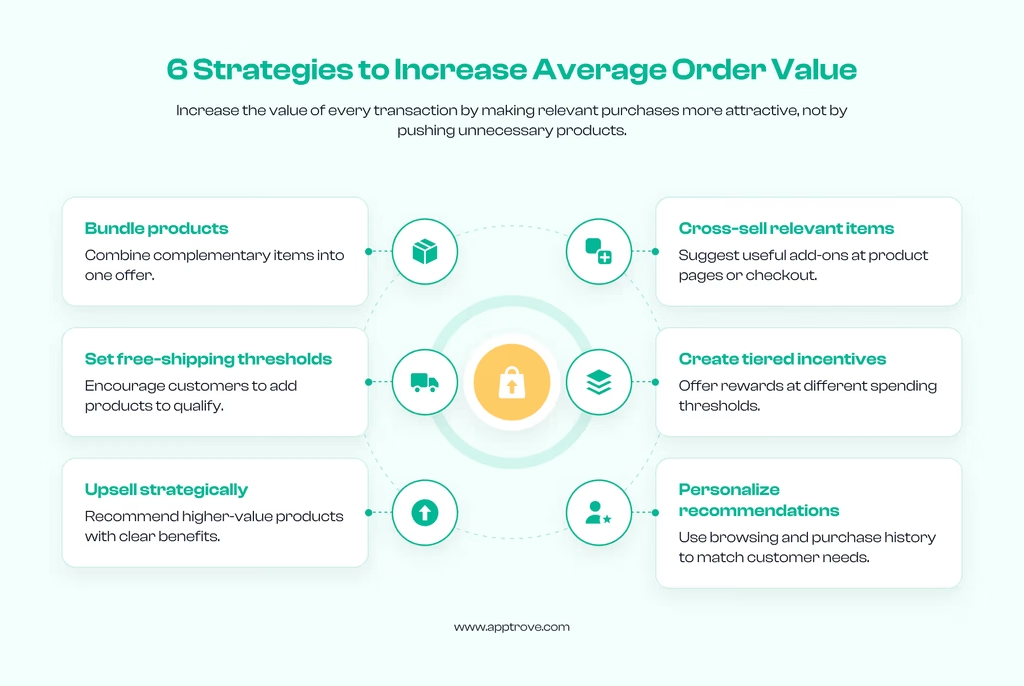
5. Offer Tiered Incentives
Promote saving programs based on threshold purchases, such as performance from INR 1,000 or gain better loyalty from ₹1,500. Ensure that higher rewards do not distract customers from purchasing while still keeping profit margins.
6. Personalize the Recommendations
Use personalization services to design recommendations based on what customers have previously bought, their internet browsing history, and their various assortment preferences. Personalization makes it easier for buyers to choose wisely when their interests are matched.
7. Run Tests Before Scaling Up
Use controlled experiments to compare various packages, delivery thresholds, and offers at checkout. You should evaluate the results based on order values, conversion rates, average values of baskets, and profit contributions instead of just sales.
Average Order Value vs. Other Ecommerce Metrics
The metric becomes more useful when analyzed alongside other indicators of business performance.
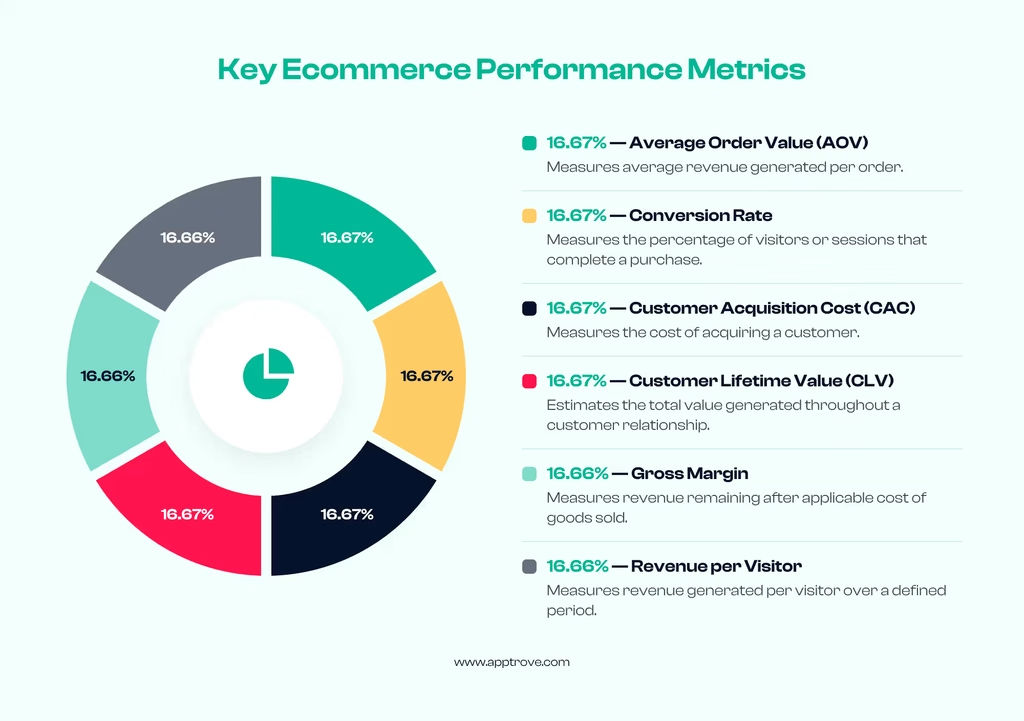
| Metric | What it measures |
| Average order value | Average revenue per order |
| Conversion rate | Percentage of visitors or sessions completing a desired action |
| Customer acquisition cost | Cost of acquiring a customer |
| Revenue per visitor | Revenue generated per visitor over a defined period |
| Customer lifetime value | Estimated value generated across the customer relationship |
| Gross margin | Revenue remaining after the applicable cost of goods sold |
These metrics provide different insights. A retailer might observe an increase in average order size along with a decrease in conversion metrics, or it may have larger sales revenue but lower profit since it has to execute discounts and incur higher fulfillment costs at the same time.
Average Order Value and Customer Lifetime Value
Average order values measure the transaction value for a single purchase, on the other hand, customer lifetime value determines the total value of a customer during a long-term relationship.
A customer who orders several small items in various orders will have a bigger lifetime value than a customer who made only one big purchase and never bought anything else.
Average Order Value and Conversion Rate
Conversion rate indicates the effectiveness with which the shop converts visitors/sessions into a purchase. Average order value refers to how much each order brings.
Revenue might increase if the average order value increases, but also due to the better conversion rate, increased number of visitors, or a combination of any of these measures.
How to Track and Optimize Average Order Value
Efficient measurement begins with uniform reporting and straightforward business targets.
Performance Figures Analysis
Categorize results according to product type, type of acquisition, type of device, geography, type of customers who place an order for the first time or have already bought something, and the promo campaign. Categorization will help establish where the order values are non-alike and which changes need further tests.
Observation of Changes in Time
Analyze similar periods and take into consideration seasonality, promo campaigns, or changes in product selection. A temporary increase during the main sale does not imply sustainable growth.
Calculation of Efficiency
Consider product margins, delivery expenditures, fulfillment costs, and price discounts while evaluating the changes in the business. High order values may be beneficial only if they are profitable for the company.
Conducting Experiments
Create a baseline, make one defined change, and compare it to the control group. Examine the data on the conversion rate, the number of orders, returns, and contribution margin, which is crucial for evaluating alterations.
Thus, this method enables one to understand whether the substantial increase is genuine or just a seasonal effect or traffic changes.
Common Mistakes When Measuring Average Order Value
- Using different definitions of revenue: Making comparisons between gross sales for a certain period and net sales for another period can skew outcomes.
- Overlooking eligibility orders: Orders that have to be cancelled, refunded, or duplicated can make an impact on calculations that have not been approached correctly.
- Relying on an average across the board: This leads to good value purchases that are masking poor performance in separate customer segments.
- Offering too big a discount: Bigger baskets of products do not mean better margins.
- Ignoring conversion: The promotion may affect the average order value positively, but its impact on the rate of those who complete the checkout process cannot be overlooked.
- Setting benchmarks as goals: Good performance depends on the product pricing and market conditions.
To Wrap It Up
Average order value is a useful indicator in e-commerce that helps to discover revenue per customer even if it does not mean good profit. Although it is very helpful in analyzing the purchases and finding ways to earn more money, the average order value does not reflect a general situation because big orders do not equal profitability, high retention, or efficient marketing. To understand the whole picture, this metric should be used in combination with acquisition cost, conversion rate, gross margin, and customer lifetime value.
FAQs
1. How much average order value is good?
There is no average order value that everybody can agree on. Average order value should be set depending on the product category, pricing, geography, and customer behavior.
2. How often does an average order value need to be calculated?
E-commerce businesses that work in the average range track average order value on a weekly basis, while those working in bulk track it daily.
3. Does having a bigger average order amount imply a bigger earning?
Not necessarily. When additional expenses such as discounts, costs of products, delivery fees, and returns exist, income might be decreased despite high customer spending.
4. Can companies boost the average order amount?
Indeed. Methods like product making use of bundles, good cross-selling, rewards for minimum amount spent, and better personalized suggestions can increase the average order among customers without making a notable increase in customer traffic.
5. What tools can help measure average order value?
Analyzing revenue amounts and order numbers can help to get this value using e-commerce analytical systems, web analytics systems, point-of-sale systems, and BI systems.
from Apptrove https://apptrove.com/what-is-average-order-value-apptrove-glossary/
via Apptrove


Comments
Post a Comment