Last Touch Attribution
What Is Last Touch Attribution?
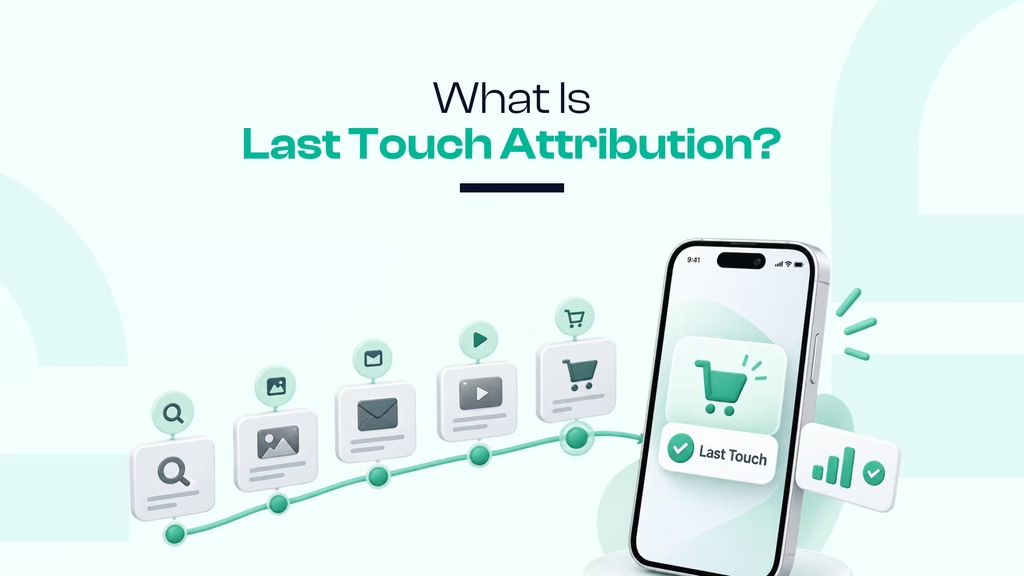
The last touch attribution model is a technique used in measurement of marketing, focusing 100% of the credit for the conversion on the last eligible marketing interaction prior to the conversion. This last interaction can be derived from either a paid click, email marketing, paid advertisement on social networks, or referral visits, among others.
In contrast to multi-touch attribution models that allow sales credit to be shared among many touchpoints, the last-touch attribution model only relies on the last eligible interaction in reaching a sale. The attribution helps marketing professionals identify the campaign or channel that was responsible for the last known interaction before the customer made a purchase or subscribed to a service.
For example, suppose a customer finds information about a company’s software via LinkedIn, reads the company’s blog via organic search, attends the company’s webinar, and finally receives an email advertisement, which ultimately results in the sale. According to the last touch attribution models, the last advertisement interaction received 100% of the credit for the sale and the customer’s previous interactions received 0% of the credit.
How Does Last Touch Attribution Work?
The process consists of recognizing the conversion event, collecting all applicable marketing actions, identifying the final qualifying touchpoint, and attributing the full conversion value to that interaction.
Step 1: Determine the Conversion Event
Firstly, identify what outcome you are measuring. Typical conversion events comprise purchases, leads, activated subscriptions, app installs, and in-app purchases. A well-defined conversion allows the tracking system to measure the desired outcome consistently.
Step 2: Track Marketing Interactions
Capture the necessary campaign and engagement data. Possible interactions range from paid ads to organic visits, email clicks, referral traffic, etc. What interactions are taken into consideration depends on the tracking platform and attribution rules.
Step 3: Define the Conversion Path
You need to order eligible touchpoints in succession and identify the last one that qualifies for conversion.
The window of attribution determines how far back the system takes into account the interactions. Any touchpoint that is outside the window may not count even though it played a part in making the purchase.
Step 4: Define the Conversion Value
The last eligible interaction will have 100% of the conversion credit, and the previous ones will not count at all.
For instance, if a person interacts with three campaigns before buying a product for $500, only the last eligible campaign will earn $500.
Step 5: Assess Marketing Campaign Effectiveness
Marketers will need to analyze generated conversion revenue, its acquisition cost, and return on advertising investment.
The results will enable us to see which interactions close the conversion journey. But it does not mean that the final interaction generated all the interest in the product.
Last Touch Provenance Calculation
The calculation is straightforward:
Conversion amount = Total conversion value × 100%
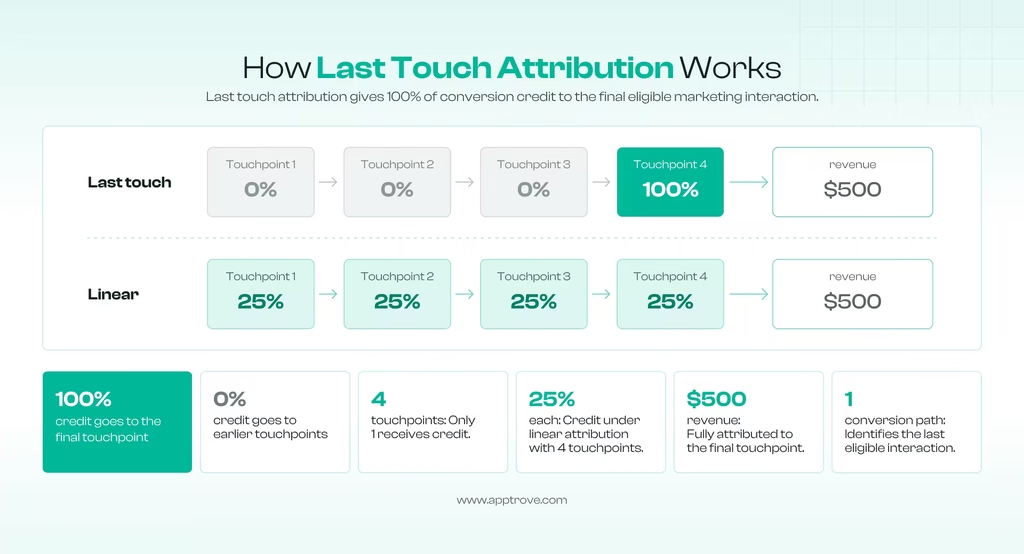
The last qualified touchpoint gains all mutually interacting points, while the other points will remain irrelevant.
| Touchpoint | Conversion credit | Attributed revenue |
| LinkedIn advertisement | 0% | $0 |
| Organic search | 0% | $0 |
| Product webinar | 0% | $0 |
| Final email click | 100% | $500 |
| Total | 100% | $500 |
This example shows the difference between giving revenue credit to a specific marketing channel and figuring out how many touchpoints contributed to the decision to buy.
Last Touch Attribution Examples
Example 1: SaaS Marketing (Business-to-business)
A user learns about a certain SaaS company through a LinkedIn ad. He downloads the whitepaper, attends a product webinar, then finally clicks on an email that contains an offer to purchase a subscription.
In the end, the email click is considered the last touchpoint and gets 100% of credit for the conversion.
The marketing department can use this data to evaluate their email campaigns aimed at conversion. However, this report does not tell us whether the white paper or this webinar played an essential role in the process of forming the intention to buy.
This distinction becomes very vital in B2B marketing since the decision-making process may involve several decision-makers, product evaluations, and long sales cycles.
Example 2: Ecommerce Marketing
The customer finds out about this product from social media, reads the customer reviews, makes a visit to its website via organic search, and finally sees retargeting ads before buying a $200 product.
When qualifying as the final touchpoint, the retargeting advertisement would accrue $200 in revenue. With this reporting method, advertisers know whether they had successful ad campaigns targeted at closing shopping cart abandonment or persuading customers to buy their products. However, in the event the consumer already made their purchase decision before seeing the ad, the importance attribution on advertisements designed for retargeting may be misleading.
Example 3: Mobile App Marketing
In this case, a user watches a video ad about the fitness application, browses its website, and ultimately clicks on an advertisement that leads to downloading the mobile application.
In this case, if the last interaction qualifies under the established rules, the ad campaign is credited with the app download.
In mobile attribution, one needs to consider who provides the measurement, the attribution window, the available identifiers, privacy policy, and whether the interaction involved a click or an impression.
The same method can be applied to analyze such downstream events as registrations or subscriptions and in-app purchases.
Key Benefits of Last Touch Attribution
1. Reporting is Simple and Clear
The method is established as to what touchpoint gets the total credit for the conversion. Therefore, the reporting process becomes simple for marketing, accounting, and financial personnel alike.
2. It Works for Conversion-Based Campaigns.
Promoting actions that produce rapid results, such as cart abandonment emails, short-time promotions, and ads yielding effective responses, can derive benefits from the last-interaction method since it brings the last means of contact to the forefront.
This helps brands learn about the campaigns used most often just prior to the conversion.
3. Supports Campaigns Optimization
The last-touch approach may assist in identifying ads, landing pages, and messages utilized in the process of conversion.
They can use all this information in the process of experimenting with calls to action and different landing pages focused on conversion.
4. It Requires Less Complexity from the Point of View of Modeling
In contrast to the algorithm-based solutions, the model does not need statistical estimates to be calculated for every action. It is just necessary to employ the interaction data along with the rules developed in advance.
But still, precise outcomes depend on great tracking, constant event definitions, and right channel classification.
5. Gives an Effective Reference Performance
People can make a comparison between last touch results and figures from other attribution principles to define which change took place in channels’ efficiency if earlier interactions are regarded.
These are some of the most crucial benefits of last touch attribution. These differences can show how final conclusions are affected by the last interaction that was recorded.
Drawbacks of Last Touch Attribution
1. Does Not Take into Consideration Earlier Marketing Touchpoints
The main drawback is that zero attention is paid to all types of earlier interactions. It is possible that educational texts, webinars, or branding campaigns triggered certain demand and incorporated in attribution but such options are not recognized in the table.
This leads to managers not appreciating activities of the campaigns that make people acquainted with products or help businesses develop better relationships with the audience.
2. May Overrate Branded Search and Retargeting
Clients who know brands may search for their names before the purchase. In a similar way, retargeting advertising may reach people whose intention to buy was already seen.
In case this credit is given only by marketers, they may confuse the above-mentioned facts with the fact of their impact on
3. Does Not Establish Causality
The last recorded contact is not always the reason for a conversion. A customer may have made a purchase decision even before seeing the last ad.
Thus, if the goal is to find out the total number of conversions that were achieved by using marketing channels, incremental experiments, controlled hold-out tests, or better causal approach could be used.
4. Based on Tracking Accuracy
Events that are missing, unimproved campaign parameters, behavior across different devices, limitations regarding consent, and integrated analytical systems may impact what is treated as the final contact
The generated report consists of a conversion path and reflects conversions that took place but does not necessarily show the full list of all contacts the customer had with a brand.
5. May Simplify Long Sales Cycles
B2B deals and big purchases often have a lot of steps such as research sessions, negotiation talks, demos, and sales conversations.
Thus, giving all the credit to a final contact creates a misleading picture of how the conversion was achieved.
Last Touch Attribution vs. Other Attribution Models
Attribution models differ in the way they distribute liability for conversions. The choice of a model is based on the purpose of the business, sales cycle
| Attribution model | Credit allocation | Primary purpose |
| First-touch | 100% to the first eligible touchpoint | Evaluate initial discovery |
| Last-touch | 100% to the final eligible touchpoint | Evaluate the final recorded interaction |
| Linear | Equal credit across eligible touchpoints | Understand channel participation |
| Time-decay | More credit to recent interactions | Emphasize conversion proximity |
| U-shaped | Greater credit to the first and last interactions | Highlight discovery and conversion |
| Data-driven | Credit based on estimated contribution | Model differences in touchpoint influence |
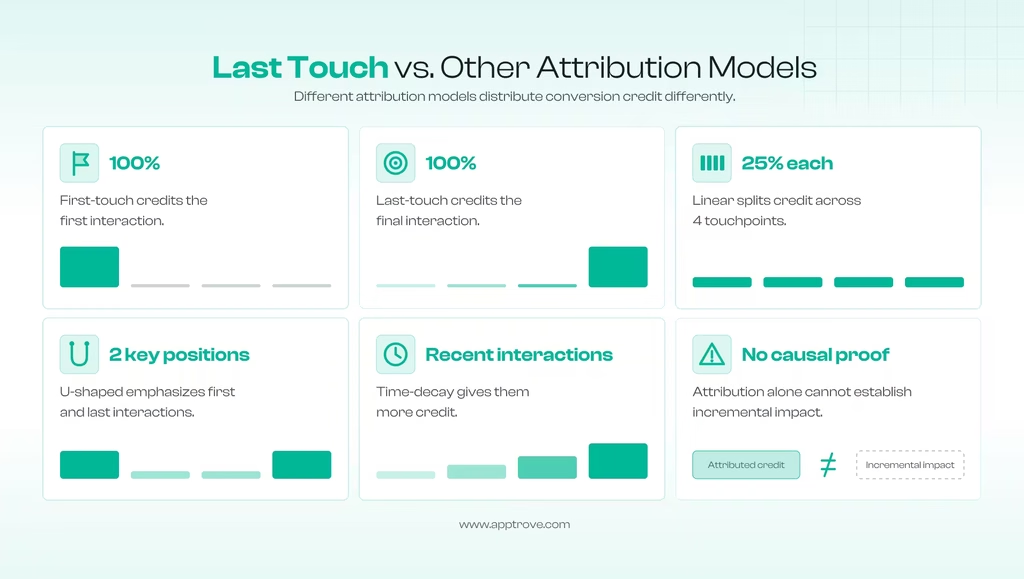
Last-Touch vs. First-Touch Attribution
In first-touch attribution, the first interaction is given full credit, which means it can help assess how consumers find out about the brand.
On the contrary, last-touch attribution assigns credit to the last interaction, which can help marketers understand the touchpoints that play a role in triggering conversions. Each approach answers different questions and provides marketers with different reports about how effective their campaigns are.
In the case of linear attribution, all eligible interactions receive equal credit.
For instance, consider a situation when a consumer makes a purchase of the value of $400 after having made four different interactions. Under linear attribution, the consumer will receive $100 for every interaction. Last-task attribution will credit the last interaction only with the purchase amount.
Last Touch vs Data Driven Attribution
Data-driven attribution uses existing conversion and behavioral data to analyze how much each interaction contributes. Its calculations rely on how effective the specific platform is and how thorough it is.
Role of Last Touch Attribution in Mobile Marketing
Attribution helps mobile marketers track the relationships between advertising activity and app installations and app usage after installations. The most recent qualified touchpoint will show which advertising campaign is credited for the install.
App install measurement
Mobile measurement companies assess the aforementioned advertising activities and relate them to the app installation events according to their attribution methods.
The length of the lookback window determines how long a touchpoint remains eligible for crediting. For example, Apple Ads has a lookback window of 30 days for ad clicks and 24 hours for ad views for standard installs and re-installs. Other measurement companies have different lookback parameters.
Invigoration of app post-install events
In addition to installs, the marketers can measure registrations, subscriptions, purchases and other events in the app.
Accounting for Privacy Restrictions
Factors affecting mobile measurement include compliance-related issues associated with the collection of consent, operating system features, aggregated reports, and differences in the methodologies of ad networks.
When measuring mobile campaign effectiveness, it is important not to make assumptions based on data presentation in every platform, as there might be discrepancies in data availability.
Steps of Implementing Last Touch Attribution
Step 1: Setting Up Conversion Goals
Identify below the objectives that are pivotal for your business: sales revenue, high-quality leads, subscriptions, or app downloads.
Step 2: Creating Uniform Campaign Tracking
Using the same campaign name across all communications, source, and medium parameters along with the definitions of the events and the identifiers approved will support the campaign classification reliability.
Step 3: Setting Up Attribution Time Frames
You need to define the time period that would match your buying cycle and measurement potential of the system being used, differentiated by types of conversions.
Step 4: Establishing the Touchpoint Eligibility
Decide if only clicks and impressions, direct visits, or other interactions will be counted. It is also necessary to write down how repeatable interactions as well as absence of source data will be treated.
Step 5: Confirm the Outcomes
Look for duplicate conversions, events that are missing, inconsistencies in source categorization, and differences between acknowledged revenue and financial details.
Step 6: Evaluate Different Approaches
Use other suitable alternative models while checking results and investigating ways of working that vary critically. When possible, support the main budget-related decisions by tests.
Metrics for Evaluation Together with Last Touch Attribution
Attribution reports are more beneficial if used along with business performance indicators.
- Attributed revenue: The revenue assigned to a particular marketing activity.
- Conversion rate: The percentage of eligible visitors or clients who perform the desired action.
- Customer acquisition cost (CAC): This is the cost of acquiring a client according to the constant calculation.
- Return on advertising spent (ROAS): This is determined as attributed advertising revenue divided by the advertising expenses.
- Retention rate: This is the percentage of customers who are active in a certain period of time.
- Customer lifetime value (CLV): This is the value derived from a client over the whole period of the relationship with him or her.
Is Last Touch Attribution Available in Google Analytics 4?
There are two specific last-click models offered by GA4 which are the organic last click and the paid last click. GA4 provides an option of utilizing a data-driven attribution model.
When applying the organic last click model and paid last click model, there is no credit assigned in the case of direct traffic unless the conversion path consists of direct visits only. In case with paid last click, the credit goes to the last eligible channel interaction.
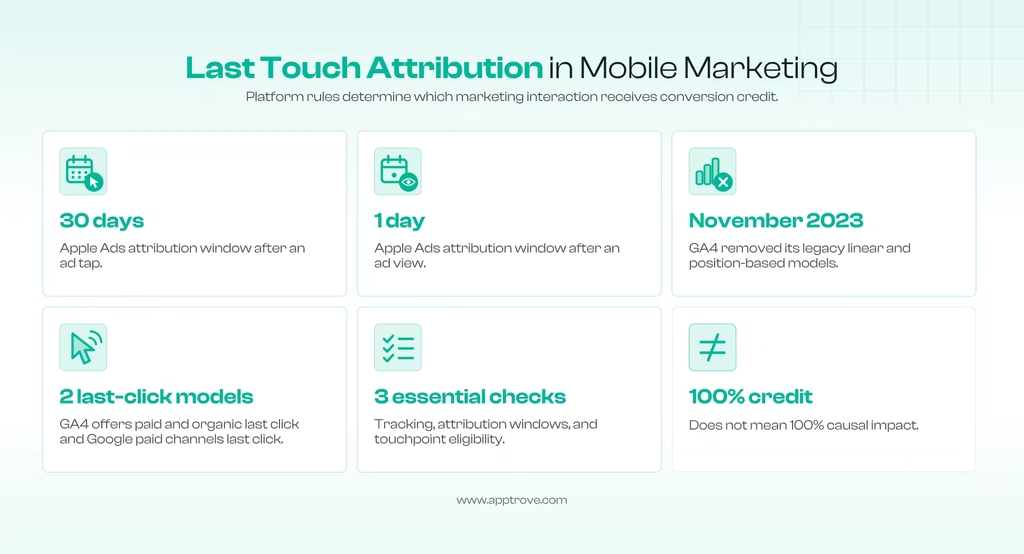
Google discontinued the use of the first-click, linear, time-decay, and position-based models in November 2023. As a result, companies looking for these models may need third-party analytics solutions.
It is essential to note that in the case of last touch measurement the specific implementation by the platform itself will matter.
Best Practices for Using Last Touch Attribution
Ensure consistency in tracking campaigns across multiple platforms. Ensure communication of what conversion means by providing definitions and patterns of attribution.
Review if direct traffic is credited under the model used. Compare conversion statistics against recognized transactions and CRM systems. Analyze expenses by channel along with sales and customer quality. When measuring the incremental effect it is good practice to contrast attribution reports with facts available by tests.
These actions will help marketers understand performance reports better and avoid falling into the trap of excessive investments into channels with no influence on conversion.
Final thoughts
Last touch attribution provides a simple way to determine the last interaction leading to conversion. The transparency of its formula allows its application to the measurement of different direct response and conversion-driven advertising activities.
Nevertheless, the attribution model is only one option among many when it comes to measuring campaign effectiveness. The early interactions could also play an essential role in awareness creation, consideration, and intention to purchase.
Marketers need to combine attribution reports with acquisition costs, retention metrics, reliable tracking, and incrementality experiments to enhance their analytics capabilities.
FAQs
1. What is the purpose of last touch attribution?
Its purpose is to determine what marketing interaction contributed to the conversion the most.
2. How is last-touch attribution determined?
The last touchpoint will get the whole value of the conversion. If the purchase is $300, the touchpoint will get $300.
3. Does last-touch attribution apply to mobile applications?
Yes
4. What is one of the main weaknesses of last touch attribution?
It doesn’t take into account the earlier interactions that contributed to consumers’ decision-making process, which may lead to disappointing results from brand awareness initiatives, educational assets, and other engagement efforts.
from Apptrove https://apptrove.com/what-is-last-touch-attribution-glossary-apptrove/
via Apptrove


Comments
Post a Comment