OEM Integration: A Practical Guide to Mobile App Attribution and Growth
OEM integration helps mobile app marketers connect campaigns across smartphone manufacturers’ advertising and app distribution ecosystems with their attribution and analytics setup. It enables businesses to evaluate eligible campaign activity alongside app installs, post-install events and other performance signals, rather than treating OEM campaigns as a separate source of downloads.
App discovery happens across more than social media, search advertising and conventional ad networks. Users may discover apps through manufacturer-owned app stores, native recommendations, device setup experiences, preload programmes and other on-device placements. Without an appropriate measurement setup, it can be difficult to understand which activities generate valuable users and which mainly contribute install volume.
A well-planned OEM integration connects the relevant partner information with the app’s measurement infrastructure. It establishes how campaign data is passed or recovered, how eligible installs are attributed and how post-install activity is evaluated.
This guide explains what OEM integration means, how it works, which data and technical requirements matter, and how businesses can measure the performance of supported OEM campaigns with a platform such as Apptrove.
What Is OEM Integration in Mobile Marketing?
OEM integration is the process of connecting an original equipment manufacturer’s advertising or app distribution ecosystem with a mobile app’s measurement infrastructure to track and evaluate eligible campaign activity.
An original equipment manufacturer, or OEM, is a company that manufactures devices such as smartphones. In mobile marketing, the term commonly refers to manufacturers that offer advertising, app discovery or distribution opportunities within their software and device ecosystems.
Depending on the partner, these opportunities may include native app recommendations, manufacturer-owned app stores, promoted listings, device-level advertising or preload programmes. The available campaign formats and technical requirements vary by OEM.
An integration helps connect the information generated through a supported campaign with the app’s measurement process. For example, when an eligible user discovers an app through a manufacturer’s advertising placement, the integration can help associate a resulting install with the relevant campaign when the required tracking information is available.
OEM integration is not a single universal technology or API. Its implementation depends on the manufacturer, campaign format, distribution method, available tracking parameters and measurement platform.
OEM Integration vs OEM Marketing
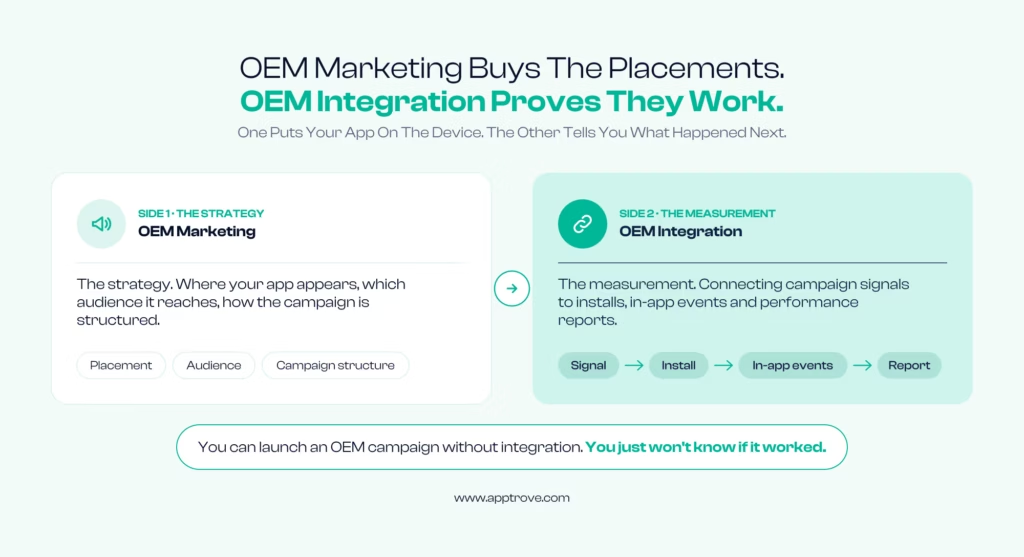
OEM marketing describes the strategy of promoting an app through device manufacturers and their advertising or distribution ecosystems, while OEM integration focuses on the technical connection that makes campaign measurement possible.
OEM marketing determines where an app should appear, which audience it should reach and how the campaign should be structured. OEM integration focuses on connecting supported campaign information with install attribution, in-app events and performance reporting.
Both are important, but they solve different problems. A campaign can be launched successfully through an OEM partner without having complete attribution data available in the app’s measurement dashboard.
For a broader introduction to the channel, read Apptrove’s guide to OEM marketing. This guide focuses on the integration and measurement work needed to evaluate OEM campaigns.
Why Is OEM Integration Important for App Growth?
OEM integration matters because manufacturer-led acquisition can be difficult to evaluate when campaign data and app performance data sit in separate systems.
An OEM may report campaign activity, while the app’s measurement setup records installs, registrations, purchases and retention. Without a suitable connection between these data sources, marketers may struggle to understand whether the campaign contributes to their business objectives.
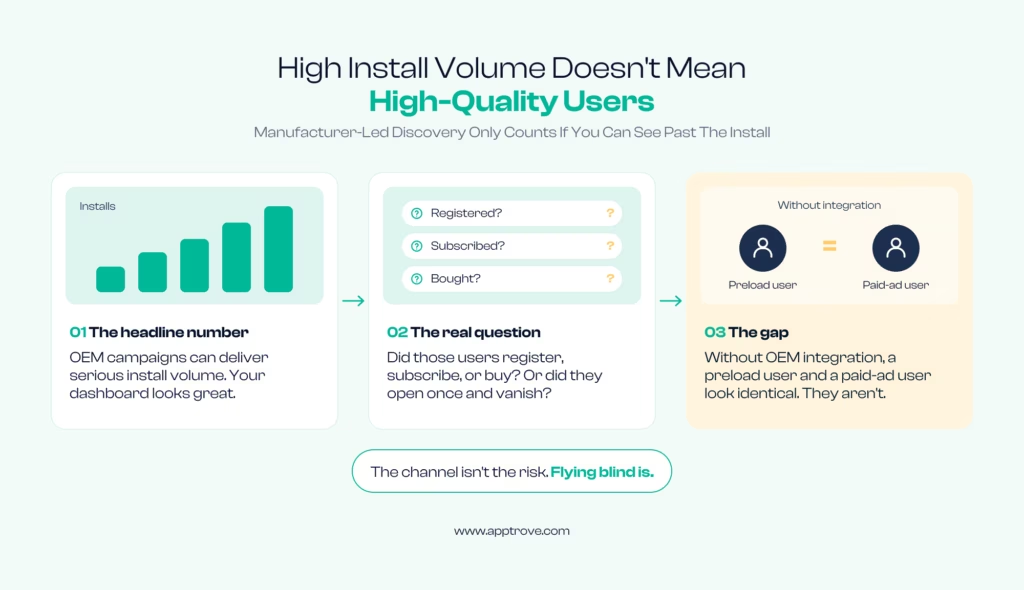
A well-configured integration can help teams improve visibility in four areas.
1. Install Attribution
OEM integration helps associate eligible app installs with the campaigns that generated them, subject to the supported tracking signals and attribution rules.
This makes it easier to distinguish performance across OEM partners, campaigns and placements when the required parameters are available. It also provides a more consistent basis for comparing OEM acquisition with other channels.
An integration does not guarantee that every install can be attributed. The result depends on the partner’s tracking method, the data received and the attribution framework in use.
2. Post-Install Measurement
Install data reveals only the beginning of the user journey. Connecting OEM attribution with in-app event measurement helps marketers assess whether acquired users register, complete onboarding, subscribe or make purchases.
This creates a more useful picture of campaign quality than install volume alone.
3. Cross-Channel Comparison
OEM integration can bring supported OEM campaign data into the broader acquisition measurement process. Teams can then compare it with other channels using consistent event definitions, attribution settings and cost data.
Comparisons should account for differences in campaign format, reporting windows and available data. Otherwise, differences between reporting systems may be mistaken for differences in campaign effectiveness.
4. Better Budget Decisions
Connecting campaign data with downstream performance makes it easier to evaluate whether an OEM campaign warrants continued investment or further testing.
The goal is not simply to add another traffic source to a dashboard. It is to establish whether that source contributes valuable users and sustainable growth.
Do Marketing Campaigns Actually Need OEM Integration?
OEM integration requirements depend on how users discover, download, and first open an app. Marketers should identify the exact campaign format before deciding which tracking method to use.
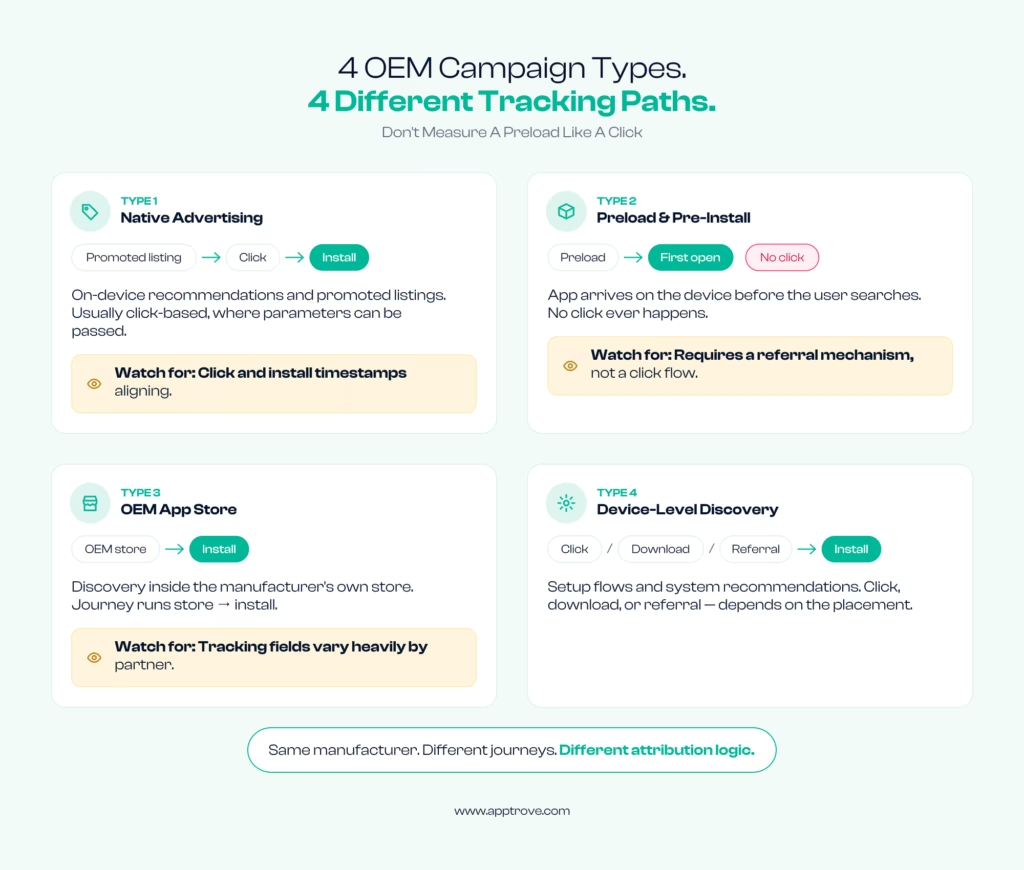
1. OEM Native Advertising
Smartphone manufacturers may offer advertising placements within their software environments. Depending on the partner, these could include native recommendations, notifications, promoted app listings or other device-level placements.
When a campaign supports trackable clicks or passes campaign parameters through an agreed mechanism, the integration can help connect the interaction with a subsequent install.
The available fields and attribution method depend on the OEM’s implementation and the measurement platform’s supported integration.
2. Preload and Pre-Installation Campaigns
Preload campaigns make an app available on a device before the user actively searches for or downloads it. Depending on the programme, an app may be included during manufacturing, distribution or initial device setup.
These campaigns need particular attention because a conventional click-to-install path may not exist. A user could open an app that is already installed on the device, which makes an ordinary advertising-click flow unsuitable in some cases.
Preload attribution may therefore use a dedicated referral or campaign-identification mechanism. For details on an Apptrove implementation, read the guide to configuring preload referrer attribution.
3. OEM App Store Campaigns
Manufacturer-owned app stores may promote applications through search, recommendations and featured listings. These campaigns can follow a discovery-to-store-to-install journey, although the available tracking fields and reporting methods vary by partner.
The integration should preserve supported campaign identifiers so that the app’s first launch can be associated with the appropriate source when the attribution method allows it.
4. Device-Level App Discovery
Some OEM ecosystems help users discover apps through device setup flows, recommendation feeds or other system interfaces. The correct tracking approach depends on whether the placement generates a click, initiates a download or supplies referral data through a separate mechanism.
Do not assume every OEM placement uses the same attribution logic. A preload campaign and a click-based recommendation campaign may require different configurations, even if both originate from the same manufacturer.
How Does OEM Integration Work?
OEM integration connects partner-side campaign information with the signals generated by the app and its measurement system. The exact sequence varies by partner, but most implementations require several coordinated steps.
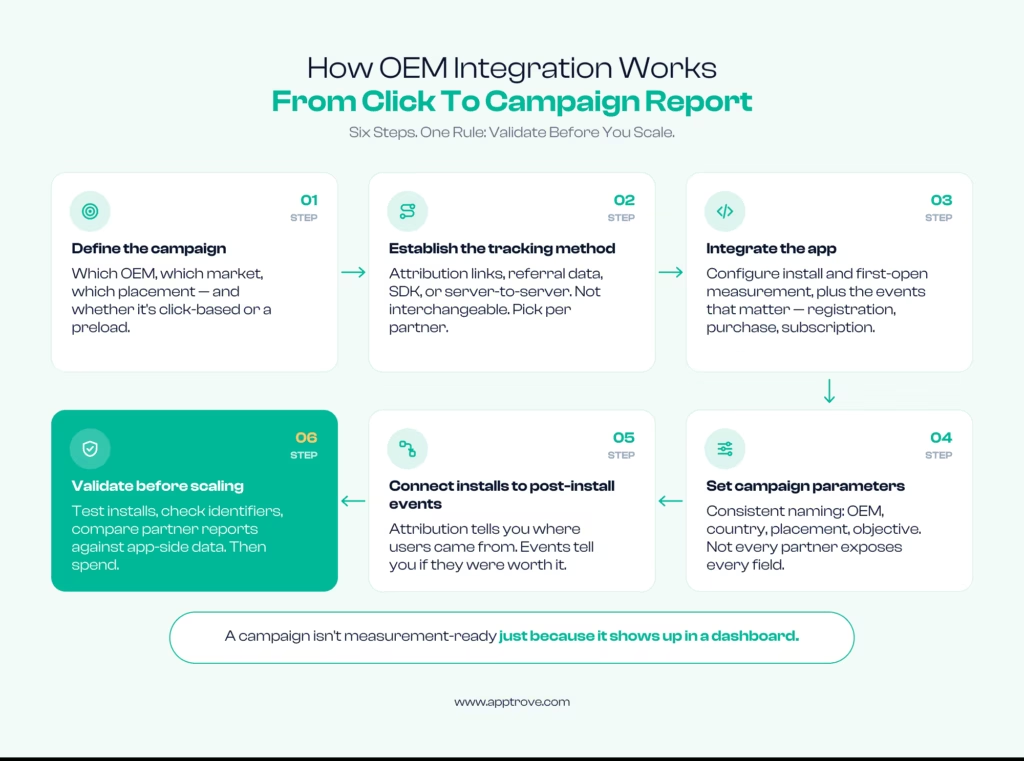
Step 1: Define the OEM Campaign and Placement
The process begins by identifying the OEM, campaign, target market and placement being measured.
Establish whether the activity is a click-based advertising campaign, an app store promotion, a preload programme or another type of device-level distribution. This classification determines which tracking signals can reasonably be expected and which attribution method may be appropriate.
Step 2: Establish the Tracking Method
The OEM and measurement platform need an agreed method for passing or recovering campaign information. Depending on the integration, this may involve attribution links, campaign parameters, referral data, an SDK or server-to-server communication.
These mechanisms are not interchangeable. A partner that supports click-level tracking may provide a different data set from one that distributes preloaded apps and relies on referral information.
For supported Google Play installations, the Google Play Install Referrer API can expose referral content, click and installation timestamps, and other relevant information. Its availability does not mean every OEM campaign uses this API, nor does it implement the complete attribution journey automatically. The integration still needs to process the available data correctly.
If an OEM campaign uses a web-to-app journey, the app may also need suitable link handling. Google’s documentation on Android App Links explains how verified website URLs can open corresponding content in an Android app. Link routing and install attribution remain separate functions.
Step 3: Integrate the App With the Measurement Platform
The app must be configured to record the signals needed for measurement. Depending on the partner and platform, the implementation may require an SDK, API configuration or another supported method of sending event data.
Install or first-open measurement provides the initial signal. Additional events, such as registration, onboarding completion and purchase, help teams assess what users do after installation.
Confirm the components required for the specific OEM integration instead of assuming that every partner follows the same setup.
Step 4: Configure Campaign Parameters
Campaign parameters help separate performance across sources, campaigns, ad groups, placements and creatives when the integration supports those dimensions.
Naming conventions should be consistent and easy to interpret. A campaign structure might identify the OEM, country, placement and campaign objective. This reduces ambiguity when multiple campaigns run simultaneously.
Not every integration exposes every parameter. The reporting plan must reflect the fields actually supplied by the partner rather than assume that all levels of detail will be available.
Step 5: Connect Attribution With Post-Install Events
Once the required installation signals are available, the measurement system can associate eligible installs with the appropriate campaign according to its attribution rules.
Post-install event measurement provides additional context. It allows teams to evaluate whether users register, make a purchase or return to the app after installation.
For a broader explanation of how app marketers connect campaign activity with user actions, see Apptrove’s guide to mobile attribution.
Step 6: Validate the Data Before Scaling
A campaign is not measurement-ready simply because it appears in a dashboard. The team should verify that campaign identifiers are mapped correctly, test installs appear as expected and downstream events are recorded with the appropriate information.
The final step is to compare partner-side reports with app-side measurement, investigate discrepancies and document any expected differences before increasing spend.
OEM Integration With Apptrove: A Practical Example
Apptrove’s documented integration with vivo illustrates how an OEM connection can make manufacturer-native advertising campaigns measurable within an app attribution workflow.
In its vivo integration announcement, Apptrove explains how campaigns running within vivo’s native advertising ecosystem can be attributed through the integration. The article describes placements including native advertising, on-device notifications, and app store interfaces.
The documented flow connects a user’s interaction with a campaign to the app’s first launch. When the app opens, the Apptrove SDK registers the launch and uses the available campaign parameters to attribute the install according to the integration’s logic.
This can help marketers evaluate supported OEM campaigns alongside other acquisition channels instead of relying solely on a partner’s campaign reports. The campaign and creative detail available for analysis depends on the configured integration and the information supplied.
How to Get Started With an OEM Integration in Apptrove
The precise setup depends on the OEM, but the onboarding process typically covers the following areas.
1. Confirm partner access and integration availability. Establish whether the campaign will run through a supported OEM integration and confirm any partner account, permissions or onboarding requirements.
2. Review the app’s measurement setup. Ensure that the app is configured to record installs and the in-app events required for reporting. Follow the implementation requirements for the specific app and platform.
3. Agree on campaign parameters. Confirm campaign naming, tracking links, referral parameters and any other information required by the OEM. For supported integrations, Apptrove’s team can help clarify the applicable configuration.
4. Validate tracking and attribution. Run appropriate tests to check that the expected campaign information is received and that installs and relevant events appear as intended.
5. Review live performance. Once the campaign is active, monitor the available campaign reporting and compare it with downstream conversion and retention data.
Apptrove’s preload referrer attribution guide is particularly relevant when an OEM campaign follows a preload flow rather than a conventional click-driven installation journey.
An integration available for one OEM should not be assumed to cover every manufacturer, placement or distribution method. Confirm current support, technical requirements and reporting granularity with Apptrove before planning a rollout.
What Data Should an OEM Integration Capture?
An effective OEM integration captures the information needed to connect campaign activity with app outcomes while respecting the limits of the partner’s data and applicable privacy requirements.
The exact fields vary by integration, but teams should review these data categories.
| Data category | Purpose in campaign measurement |
| OEM or media source | Identifies the manufacturer or partner associated with the activity. |
| Campaign identifier | Separates performance across supported campaigns. |
| Placement or creative | Enables analysis at placement or creative level where the partner provides those fields. |
| Click or referral information | Helps connect supported campaign interactions with later installation activity. |
| Install or first-open event | Records the app’s initial activation signal. |
| In-app events | Connects acquisition with registration, purchase or other relevant user actions. |
| Revenue and currency | Supports revenue and return analysis when the data is available and reliably measured. |
| Market or device dimensions | Helps evaluate performance across supported and permitted reporting segments. |
Teams should distinguish between information supplied by an OEM, data collected by the app, and attribution decisions produced by the measurement platform. A partner-reported click is not proof of an install, and a first open is not evidence of a completed purchase.
The integration should also avoid collecting unnecessary personal information. Campaign reporting can often be organised around approved identifiers and performance data rather than direct personal identification.
How to Measure OEM Integration Performance
OEM integration performance should be measured by validating the completeness of the data, assessing the quality of attributed users and comparing campaign outcomes against consistent benchmarks. The objective is to determine whether the integration is producing dependable measurement and whether the campaigns it supports contribute to business goals.
Establish a Measurement Framework Before Launch
Choose the campaign objective and the primary success metrics before the campaign begins. Align the OEM, marketing, analytics and development teams on event definitions, attribution windows, reporting periods and cost inputs.
Depending on the app’s objective, the measurement framework may include CPI, activation, cost per purchase, retention, revenue and ROAS. The selected metrics should remain consistent across comparable channels, with any differences in attribution methodology documented.
For more on the measurement foundations, see Apptrove’s guide to mobile attribution and its resource on in-app events.
Validate Data From the Partner to the App
Review the full measurement path from campaign interaction or referral through installation and subsequent in-app events. Confirm that campaign identifiers are received as expected, that installs are attributed according to the agreed rules, and that relevant events are recorded without unintended duplication.
Where partner-side reports and attribution-platform reports differ, investigate the reason rather than forcing the numbers to match. The systems may use different event definitions, reporting windows or measurement methods.
Compare Campaigns Using Consistent Conditions
Compare OEM campaigns using the same conversion definitions, time windows and cost treatment wherever possible. Segment results by supported campaign, placement, market or creative dimensions to identify patterns in performance.
Allow for reporting delays and ensure that the cohorts being compared have had a similar opportunity to generate downstream events. Where necessary, separate preliminary results from mature campaign data.
Evaluate Post-Install Quality and Longer-Term Outcomes
Do not stop the analysis at install volume. Connect OEM acquisition with the in-app events and retention periods that matter to the app’s business model. Apptrove’s guides to mobile app retention and in-app events provide further context for choosing relevant post-install measures.
Where the available data supports it, assess revenue and return over a consistent observation period. Avoid comparing cohorts with different levels of maturity or treating early results as conclusive.
Separate Attribution From Incrementality
Attribution identifies credit according to a measurement framework. Incrementality testing examines whether a campaign generated outcomes that would not otherwise have occurred.
This distinction is important when users may already have intended to download an app or when OEM campaigns overlap with other acquisition channels. Where the campaign size and available data make it feasible, a suitable holdout or controlled experiment can add evidence about incremental impact.
Read Apptrove’s guide to incrementality testing for more information on evaluating campaign impact beyond attributed conversions.
For iOS campaigns, privacy-preserving attribution frameworks such as Apple’s AdAttributionKit documentation explain how eligible ad campaigns can be measured through attribution signals and postbacks. The details available depend on the framework and integration, so reporting should reflect the data actually supplied rather than assume user-level detail is available.
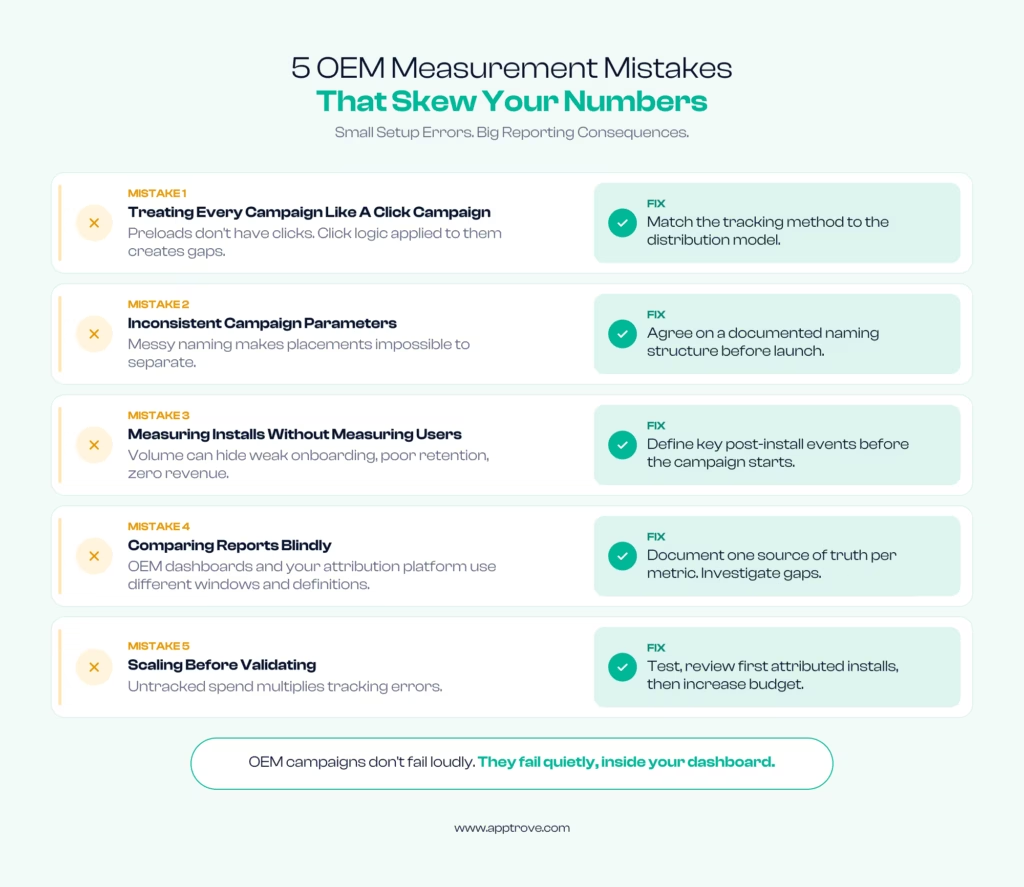
Common OEM Integration Challenges and How to Avoid Them
OEM integration can improve campaign visibility, but incomplete configuration and inconsistent reporting can still make performance hard to interpret.
Treating Every OEM Campaign Like a Click-Based Campaign
Some campaigns have a conventional click path, while preload campaigns may not. Applying one attribution approach to both can produce gaps or incorrect assumptions.
How to avoid it: Identify the placement and distribution model before choosing a tracking method. Confirm the evidence the partner supplies and how the measurement platform processes it.
Using Inconsistent Campaign Parameters
Missing or inconsistent campaign identifiers make it difficult to separate one placement or campaign from another. Broad naming conventions can also limit optimisation.
How to avoid it: Agree on a documented naming structure before launch and verify that the expected parameters reach the measurement system.
Measuring Installs Without Measuring User Quality
High install volume can conceal poor onboarding completion, weak retention or limited revenue.
How to avoid it: Define the key post-install events before the campaign starts. Evaluate acquisition cost alongside activation, retention and other outcomes that reflect the app’s business model.
Comparing Reporting Systems Without Context
OEM dashboards and attribution platforms may report different figures because they rely on different events, attribution windows, reporting delays or definitions.
How to avoid it: Document the source of truth for each metric. Compare like-for-like data and investigate discrepancies instead of assuming every number should match exactly.
Scaling Before Validating Tracking
Increasing spend before the integration has been tested can multiply tracking errors and make later analysis unreliable.
How to avoid it: Validate the setup with appropriate test scenarios, review the first attributed installs and investigate discrepancies before treating the campaign as a dependable growth channel.
Overlooking Privacy and Data Governance
A technically functional integration still requires an appropriate approach to collection, access, retention and sharing. Device-related data and user-level event information should be handled according to applicable laws, platform rules and partner agreements.
How to avoid it: Collect only the data required for the stated measurement purpose, restrict access appropriately and confirm the responsibilities of the app, OEM and measurement provider. Apple’s guidance on user privacy and data use explains its requirements for data collection, tracking permissions and third-party SDKs. Do not use unauthorised identifiers or device fingerprinting to compensate for unavailable attribution signals.
Which Apps Can Benefit From OEM Integration?
OEM integration can support different mobile app categories, but its value depends on whether the available placements and audience align with the app’s target market.
Gaming apps can evaluate whether device-level discovery generates users who progress beyond installation into onboarding and continued gameplay.
E-commerce apps can connect acquisition with account creation, product browsing, checkout and purchase. The quality of acquired users matters more than install volume when users do not become shoppers.
Fintech apps can monitor registration and eligible activation milestones. Because these apps may involve sensitive information and regulated user journeys, tracking and partner requirements need careful review.
Subscription and entertainment apps can compare acquisition with trial starts, subscriptions and continued use. This helps teams assess whether acquired users find sustained value in the product.
Travel apps can evaluate whether acquired users progress from opening the app to searching, booking or completing another meaningful action.
Across these categories, the principle remains the same: connect supported OEM campaigns to the events that reflect product value, then evaluate results using consistent measurement rules.
Start Better OEM Marketing with OEM Integration
OEM integration helps app marketers connect manufacturer-led discovery with measurable acquisition and post-install performance. By establishing the right tracking method, standardising campaign parameters and validating events before launch, teams can evaluate supported OEM campaigns alongside their wider acquisition strategy.
The most effective approach starts with the campaign’s distribution model rather than a one-size-fits-all integration. A click-based OEM ad, an app store placement and a preload programme may require different tracking methods and attribution logic. Their results should also be assessed using metrics that reflect user quality, retention and revenue, not just install volume.
Apptrove’s documented vivo integration and preload-referrer guidance provide starting points for measuring supported OEM campaigns. Confirm the requirements for your partner, validate the attribution setup and build a reporting framework that helps your team make informed decisions about where to invest.
Ready to evaluate your OEM campaigns more effectively? Explore Apptrove’s mobile attribution platform and discuss your OEM integration requirements with the team.
Frequently Asked Questions About OEM Integration
What does OEM integration mean in mobile marketing?
OEM integration connects a smartphone manufacturer’s advertising or app distribution ecosystem with a mobile app’s attribution and analytics setup. It helps marketers measure eligible installs and, where configured, the post-install activity associated with OEM campaigns.
Is OEM integration the same as OEM marketing?
No. OEM marketing is the strategy of promoting apps through device manufacturers and their ecosystems. OEM integration is the technical and measurement connection that helps track campaign outcomes.
Does OEM integration require an SDK?
The requirements depend on the partner and measurement method. Some setups use an app SDK, while others may involve attribution links, referral mechanisms, APIs or server-to-server communication. Confirm the required components for the specific integration.
How is a preload campaign attributed?
A preload campaign may use a dedicated referral or campaign-identification mechanism because an app can be available before a user actively opens it. The applicable setup depends on the distribution path, OEM and measurement platform. A standard click-based attribution flow should not be assumed to work for every preload campaign.
Can Apptrove measure OEM campaigns?
Apptrove documents an integration for campaigns within vivo’s native advertising ecosystem and provides guidance for configuring preload referrer attribution. Support, setup requirements and available reporting depend on the OEM and campaign type. App marketers should confirm the current configuration with the Apptrove team before launch.
What is the most important metric for OEM integration?
There is no single metric that suits every app. The appropriate measures depend on the campaign objective and business model. Teams should choose metrics before launch, maintain consistent definitions and evaluate both acquisition and relevant post-install outcomes.
How long does OEM integration take?
The timeline depends on partner onboarding, app measurement readiness, tracking requirements, campaign configuration and testing. Agree on the required steps with the OEM and measurement provider before committing to a launch date.
from Apptrove https://apptrove.com/oem-integration/
via Apptrove


Comments
Post a Comment