Retargeting vs Remarketing: Learn the Differences and Determine Which One to Use
When you explore retargeting vs remarketing, one thing becomes clear: not every visitor to your e-commerce site or mobile app is ready to convert on their first visit. Some may need more time to decide, while others might simply need a relevant reminder or a compelling reason to return.
The Baymard Institute states that the average rate of abandoned shopping carts worldwide is 70.19%, indicating that there are still a lot of consumers interested in making purchases but who did not push through.
Here is where you can take advantage of retargeting and remarketing. Both approaches allow you to reach out to consumers who have interacted with your brand before, but each of them utilizes different methods and channels, the engaged audience of consumers, and various types of consumer engagement.
Understanding retargeting vs remarketing helps you choose the right approach for your marketing goals, whether you want to recover abandoned purchases, bring inactive app users back, or encourage repeat conversions.
Retargeting vs Remarketing: How Does It Work?
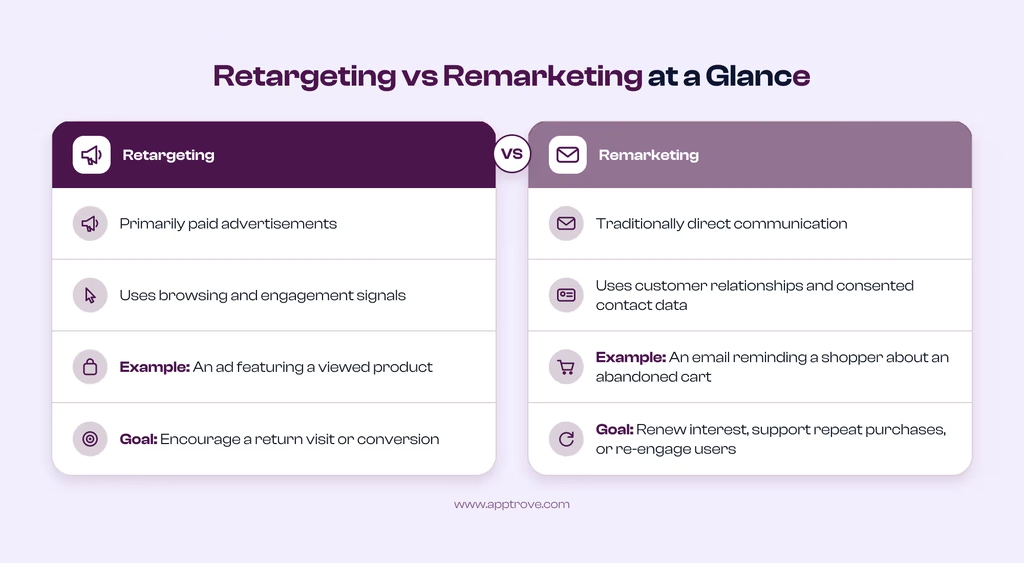
Retargeting vs remarketing comes down to how you reconnect with people who have already shown interest in your brand. Retargeting primarily uses ads to re-engage those who have visited your website, mobile app, or digital content but have not completed a desired action. Your audience might include people who viewed a product, browsed a category in your online catalogue, or installed your app without making a purchase.
For instance, if someone visits your store to check out running shoes and leaves the website without buying, later on, they might stumble upon ads with the same products.
Whereas remarketing could be defined as connecting with existing customers or individuals who have shown interest in your products in various ways, such as through emails, push notifications, and other mediums of direct communication. For example, an online shopping site may send a reminder to the user about the items left in their cart, or a subscription service may contact clients who are about to run out of their subscriptions.
Despite the distinction, it is possible to say that both aspects refer to one idea: helping people with their decision-making while not treating each interaction as an opportunity to attract new customers.
How Do Retargeting and Remarketing Differ in Practice?
The simplest way to establish the difference is to analyze how the two strategies communicate with a target market.
- Retargeting: Targets users who expressed interest in your goods or services based on their web activity to display specific ads.
- Remarketing: Reaches previously acquired leads and customers via direct messages.
- Aim: Both strategies are aimed at persuading users to revisit a website and make a purchase.
No approach is better than another. The choice of tactics depends on such factors as the selected audience, available data, their preferences in communication, and your ultimate goal.
What is the Importance of Learning About Retargeting vs Remarketing in Mobile Marketing?
Retargeting vs remarketing in mobile marketing is particularly important because a user’s journey rarely ends with an app installation. Someone may download your app but abandon it during onboarding, browse products without purchasing, or become a customer by completing their first transaction. Each behaviour presents a different opportunity to re-engage them.
Take the case of the e-commerce application. A user sees an ad and installs the app, but leaves without making a purchase. The retargeting campaign can prompt the user to return to the app and buy the product. An email or push notification can also remind a customer about the abandoned order, saved item, or the need to restock the product.
The retention problem makes it more relevant. Statista’s research showed that Android applications in the libraries and demo categories had only 48.31% retention one day after installation in 2024, and only 20.88% retention on the 30th day. The retention rate depends strongly on the application category, but it shows that one interaction is not enough. So the goal for your app is to make users come back for certain reasons.
What Retargeting Strategy Is the Best for Your Needs?
Don’t choose between retargeting and remarketing just because of the definitions. Understand which user behaviour you are aiming to change.
How Can Retargeting Turn Failed Conversions into Successes?
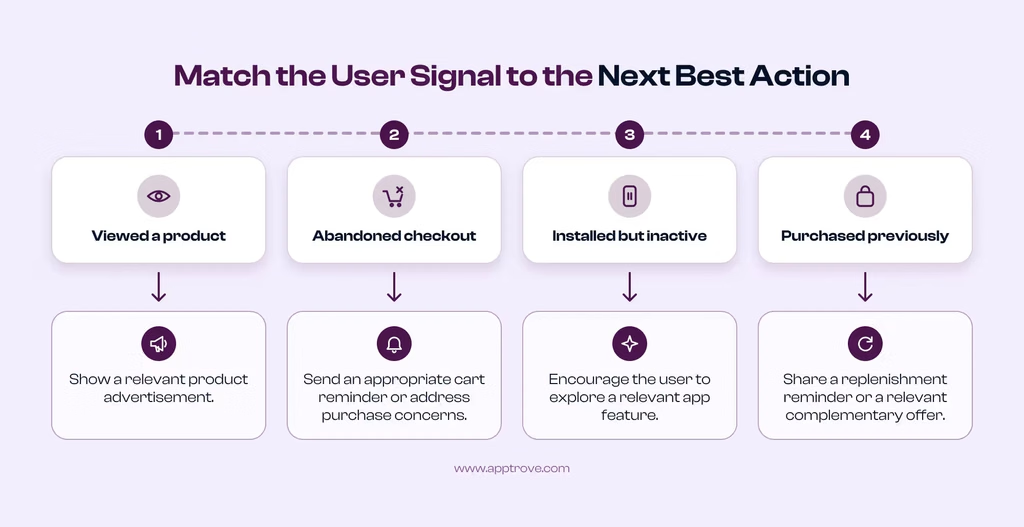
Retargeting is effective when you can clearly identify the user behaviour that conveys interest. You can segment the audience based on the products they have searched for or purchased and also by other relevant actions.
The content must be tailored based on the behaviour shown by the user. For example, the person who expressed an interest in a specific product would be more responsive to the message describing the relevant offer or product benefits. On the contrary, the person who dropped the cart would want to receive all the necessary information about the delivery options, payment methods, and possibly even additional guarantees before placing the order.
With mobile applications, it is important to always remember that both ads and destinations matter. Always use deep linking to guide returning customers straight to the specific product, offer, or page within the app.
How Do You Measure Retargeting vs Remarketing Performance?
While a campaign might garner clicks, not every marketing activity is necessarily effective. For this reason, it is necessary to measure success based on the actual action you want a user to take.
Regarding retargeting, some of the metrics which you should look out for include the click-through rate, conversion rate, cost per acquisition, return on ads spend, and the number of users that carry out the desired activity.
As for remarketing, delivery and interaction metrics are as important as the final result or outcome. Emails opened and clicks made may show the interest of a user, but any significant or measurable result, like repurchases, subscriptions renewed, onboarding completed, or sessions re-initiated, impacts the business more.
Mobile app campaigns must be enhanced by mobile app attribution, which helps to identify the marketing touchpoints that lead to app installation, re-engagement, and other in-app actions.
It is also important to know the attribution windows properly, differentiate between new customers and returning users, and keep in mind possible conversions that can take place without any campaign. Otherwise, you will risk attributing the results to your marketing activity that would have occurred in an organic way.
As an example, when a user clicks on the retargeting ad and opens your application, it doesn’t mean the ad caused an additional purchase. You should always try to compare the results to the right baseline or holdout groups.
What Are the Common Pitfalls to Avoid in Retargeting Campaigns?
Even if a campaign is well-thought-out, it can fail if it does not consider the customer’s experience.
First of all, do not show the same ad too often. Frequency capping and audience exclusions can definitely reduce the risk of irritation, especially if the person has already performed the action you want.
Secondly, do not use the same message for different segments of the target audience. A first-time visitor, a lapsed customer, and a loyal customer have totally different needs. The key to successful segmentation is to segment customers based on their actions rather than making large-scale assumptions.
Thirdly, remember to take privacy and consent into consideration when planning your campaign. Collect the proper type of data and have permission to reach out to your target audience. Always have a way for your customers to adjust their settings.
Finally, always assess the quality of your campaigns instead of counting engagement only. Repeated clicks, views, and given attribution do not guarantee an increase in revenue or customer lifetime value.
Conclusion: How Can You Implement the Combination of Retargeting and Remarketing Concepts?
Back to comparing retargeting vs remarketing: don’t forget that the difference may not be as significant as the intention of the contact made. Retargeting allows you to reconnect by means of appropriate advertising, while remarketing ensures a relationship through relevant communication.
You don’t have to choose one option over another; your good plan can apply both, based on how people behave. If you link this procedure with correct attribution and valid metrics, you will see how certain actions bring users back and what contributes to long-lasting outcomes.
The best approach is not the one that gets to your audience the most, but the one that offers people a reason to return.
FAQs
1. What is the difference between retargeting and behavioural targeting?
Retargeting reconnects with people who have already interacted with your brand. Behavioural targeting uses observed interests or actions to tailor advertising, potentially reaching users who have never visited your website or app.
2. Why does audience segmentation matter for retargeting campaigns?
Audience segmentation separates users by meaningful behaviours, interests, or lifecycle stages. It helps you tailor messages, exclude irrelevant audiences, control spending, and avoid treating every previous visitor as equally likely to convert.
3. How does attribution help you evaluate remarketing performance?
Attribution connects eligible marketing interactions with subsequent actions, helping you understand which channels receive conversion credit. It does not independently prove incremental impact, so compare attributed results with baselines or controlled experiments.
4. When should you stop retargeting a user?
Stop or suppress campaigns when users convert, withdraw relevant consent, become ineligible, or exceed your frequency limits. Reassess inactive audiences regularly to avoid wasted spend, repetitive messages, and unnecessary advertising exposure.
5. What role does deep linking play in mobile app retargeting?
Deep linking takes users from an advertisement or message to a relevant destination inside an app. It preserves context, reduces navigation friction, and makes it easier to complete the action that prompted the campaign.
from Apptrove https://apptrove.com/retargeting-vs-remarketing/
via Apptrove


Comments
Post a Comment