App Store Optimization Tools: How to Improve App Visibility, Rankings, and Organic Downloads
Your app may have excellent features, a smooth interface, and a product users genuinely need. But how will people discover it when thousands of other applications compete for their attention?
According to Apple’s 2025 App Store Transparency Report, an average of 463.5 million customer accounts searched the App Store every week. That is a significant discovery opportunity, but reaching the right audience requires more than simply publishing an app.
This is where App Store Optimization (ASO) becomes important. With the right app store optimization tools, you can understand search behaviour, identify relevant keywords, improve your app listing, and measure how effectively your store presence converts visitors into downloads.
However, choosing tools without understanding what they actually measure can lead to misleading conclusions. Let’s explore the different types of tools, their capabilities, and how you can use them to build a more effective ASO strategy.
What Are App Store Optimization Tools and Why Do They Matter?
App store optimization tools are software solutions that help you improve your application’s visibility, discoverability, and conversion rate across app marketplaces such as the Apple App Store and Google Play Store.
They provide insights into different aspects of app discovery, including keyword rankings, search trends, competitor positioning, user reviews, ratings, and listing performance.
Think of them as research and measurement resources for your app’s storefront. Instead of guessing which keywords might attract users or which screenshots might encourage downloads, you can make decisions using available performance data.
Their importance becomes clearer when you consider the wider mobile ecosystem. According to Sensor Tower’s State of Mobile 2025 report, global app downloads reached 136 billion in 2024, while consumer spending on mobile apps reached $150 billion.
For your app, this means discoverability is only one part of the equation. You also need to attract users who are likely to engage with your product and contribute to long-term growth.
What Types of App Store Optimization Tools Should You Know About?
Not every ASO tool serves the same purpose. Some help you discover keywords, while others focus on creative performance, listing analytics, or audience feedback.
Understanding these categories will help you build a toolkit around your actual marketing objectives.
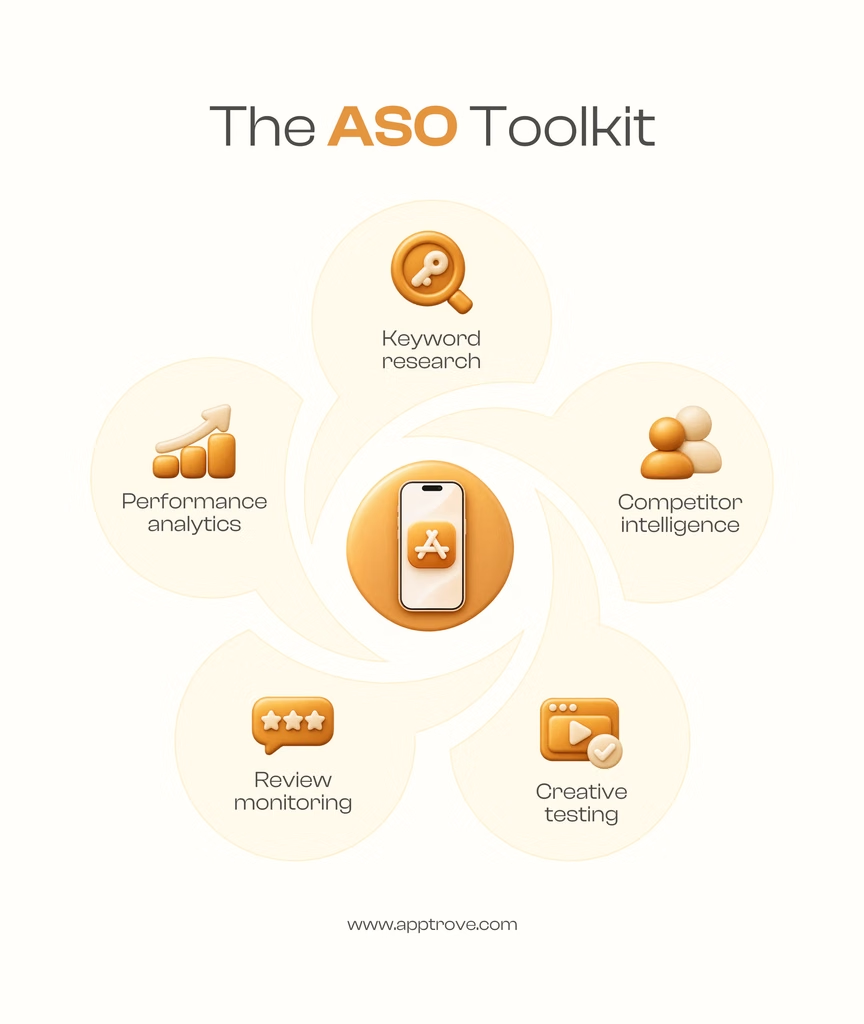
1. How Do ASO Keyword Research Tools Help You Find Search Opportunities?
Keyword research tools help you identify the search terms people use when looking for applications similar to yours.
They provide insights into keyword popularity, relevance, ranking difficulty, and search trends, depending on the platform and data available.
For example, if you operate a personal finance app, you might explore terms such as budget planner, expense tracker, money management, and savings calculator.
However, high search volume should not be your only consideration. A keyword might attract considerable traffic but have little relevance to your application’s actual functionality.
Focus on search intent, relevance, and realistic ranking opportunities rather than adding every popular term to your listing.
2. Why Do App Listing Analytics Tools Matter?
Listing analytics tools help you understand how people interact with your app’s store presence.
They can provide information about impressions, product page views, acquisition sources, and downloads. This allows you to identify whether your visibility is improving and whether visitors are taking the next step.
For instance, if your app receives plenty of impressions but relatively few downloads, you may need to reconsider your screenshots, description, or value proposition.
3. How Do Creative Testing Tools Improve App Store Conversions?
Your app icon, screenshots, and preview videos often shape a potential user’s first impression.
Creative testing tools help you compare different versions of these assets and understand which presentation encourages more people to download your app.
For example, you could test whether highlighting your app’s core functionality in the first screenshot performs better than showcasing its interface.
Apple’s Product Page Optimization feature supports testing different icons, screenshots, and previews. One documented example recorded an 8% conversion increase after testing an alternative app icon.
4. What Can Review and Rating Analysis Tools Tell You?
Reviews offer a direct view of how users perceive your application.
Review analysis tools help you identify recurring complaints, positive feedback, feature requests, and changes in customer sentiment.
Suppose multiple users mention difficulties during registration. This feedback could indicate an onboarding issue rather than a discoverability problem.
Connecting these insights with product improvements can help you create a more satisfying user experience.
What Features Should You Look for in App Store Optimization Tools?
Once you understand the different categories, the next step is evaluating what makes a tool useful for your app.
Rather than choosing a platform simply because it offers numerous features, prioritise capabilities that support your current objectives.
Beyond these essentials, consider three additional factors.
Platform compatibility: Ensure the tool supports the marketplaces where your app is available. App Store and Google Play optimisation processes have different metadata requirements and measurement capabilities.
Data reliability: Check how frequently information is updated, where estimates come from, and whether the tool clearly distinguishes actual performance from projected data.
Ease of integration: Your ASO insights should complement your existing marketing and analytics workflows rather than create another disconnected reporting system.
How Can You Choose the Right App Store Optimization Tools for Your App?
The best toolkit depends on your app category, growth stage, budget, and marketing objectives. You do not necessarily need multiple paid subscriptions to begin improving your store presence.
Here is a practical approach:
- Define your objective: Determine whether you want better keyword rankings, higher conversion rates, improved ratings, or increased organic downloads.
- Start with native analytics: Explore the reporting capabilities available through App Store Connect and Google Play Console before investing in additional subscriptions.
- Identify information gaps: If you need deeper keyword research, competitor intelligence, or creative testing, look for specialised tools that address those requirements.
- Evaluate usability and cost: Compare available features, data coverage, pricing, and reporting limitations.
- Test before committing: Use available trials or limited plans to determine whether the insights are genuinely useful.
Most importantly, remember that your ASO toolkit should evolve alongside your application. A newly launched app may prioritise keyword discovery, whereas an established app might need more detailed conversion analysis and localisation insights.
How Do You Measure the Performance of Your ASO Strategy?
Using app store optimization tools is only valuable when you translate their findings into measurable improvements.
Start by tracking a few essential metrics:
- Keyword rankings: Monitor how your app performs for targeted search terms.
- Impressions: Measure how frequently your listing appears to potential users.
- Product page views: Understand how many people visit your listing.
- Conversion rate: Calculate the percentage of visitors who download your app.
- Organic downloads: Measure installs generated without paid acquisition.
- Ratings and reviews: Monitor customer satisfaction and recurring feedback.
Do not evaluate these metrics independently. For example, improved keyword rankings may increase impressions, but if downloads remain unchanged, your listing may not be communicating enough value.
You should also connect store performance with post-install behaviour. Explore Mobile Attribution and App Analytics to understand where users originate and how they interact with your application after installation.
This distinction matters because more downloads do not automatically translate into better retention, engagement, or revenue.
Conclusion
App Store Optimization is an ongoing process that requires research, experimentation, and consistent measurement. The right app store optimization tools help you understand what influences discoverability and where your listing needs improvement.
Start with your objectives, use reliable data, and regularly evaluate your results. When keyword research, creative optimisation, user feedback, and performance measurement work together, you can build a stronger app store presence and attract users who are genuinely interested in your application.
FAQs
1. What is the difference between ASO and SEO?
ASO focuses on improving application visibility and conversions within app marketplaces, whereas SEO improves website visibility in search engines. Both involve keyword research, relevance, content optimisation, and performance analysis.
2. Why do app store rankings fluctuate?
Rankings change because of evolving search behaviour, keyword relevance, competition, downloads, ratings, reviews, and marketplace algorithm updates. Regular monitoring helps you identify fluctuations and adjust your optimisation strategy.
3. How often should you update your app store listing?
Review your listing monthly and whenever you introduce significant features, enter new markets, or observe declining conversion rates. Avoid unnecessary changes that make performance comparisons difficult.
4. When should you invest in paid ASO tools?
Consider paid tools when your organic growth objectives require deeper keyword intelligence, historical ranking data, competitor insights, or advanced testing capabilities beyond what native marketplace analytics provides.
5. What is keyword localisation in app store optimisation?
Keyword localisation adapts search terms, metadata, and listing content to the language and search behaviour of specific markets. It goes beyond translation by accounting for regional expressions and user intent.
from Apptrove https://apptrove.com/app-store-optimization-tools/
via Apptrove


Comments
Post a Comment