Push Notification Best Practices: How to Get Taps, Not Mutes
According to Business of Apps, a typical smartphone user in the US receives 46 app push notifications per day. This implies that the messages you send will contend not only with other mobile apps but also with the user’s patience. After one too many irrelevant notifications, it is likely that the notification will be switched off forever. Therefore, understanding push notification best practices is crucial. This guide will cover the issues of getting permission, crafting effective text messages, sending notifications at the proper time, and analyzing the data to determine which notifications have really re-engaged the user.
Following these push notification best practices can help you create concise, relevant, and engaging messages that encourage users to take action without overwhelming them.
What Are Push Notification Best Practices (and Why Should You Care)?
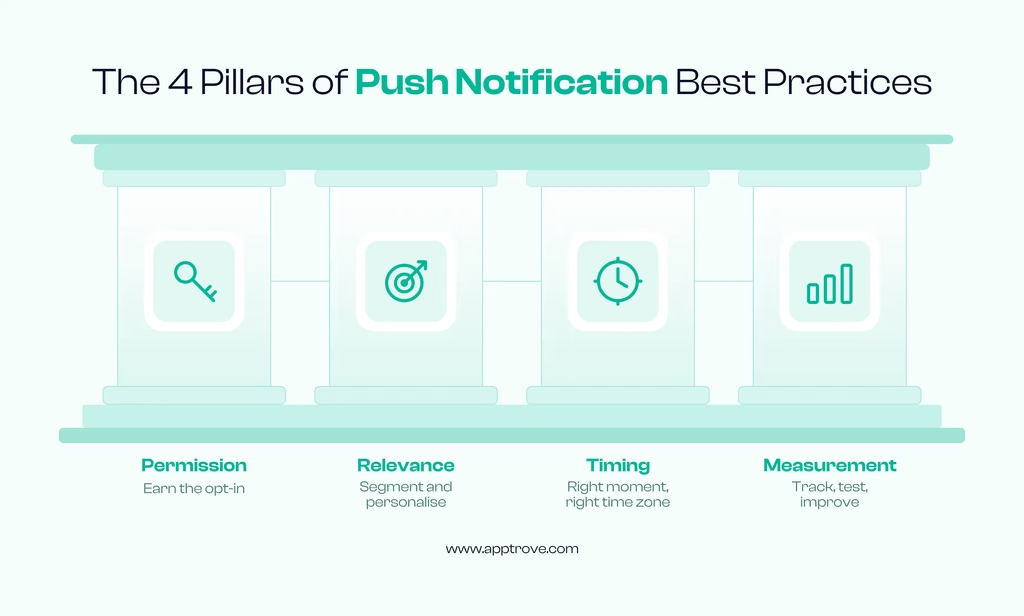
The best practices of push notifications include tested methods of sending timely, relevant, and authorized messages to users without bothering them. Consider these best practices to be guidelines when it comes to one of the most intimate spaces of a smartphone: the lock screen.
Using these best practices is what enables you to send useful messages, win users back, and motivate people to perform required actions. If these rules are not observed, the end-user is likely to disable notifications or even uninstall an application. Furthermore, it is almost impossible to reach the user whose notifications have been disabled.
How to Build a Push Notification Strategy Users Actually Welcome?
Creating a good push notifications plan happens before even writing down a single word. A good plan begins with obtaining explicit permission from users and respecting the time and effort of the people you are reaching out to.
How to Request Permission to Send Users Push Notifications?
Previously, Android users received push notifications automatically, thus giving a misleading impression of positive opt-in rates. However, in a 2026 industry report based on data collected from over 681 billion notifications, it was pointed out that Android 13+ device users have demonstrated a similar number of notifications received as compared to those with iOS devices, which means that companies need to obtain permission to send notifications now.
- Check in after delivering value. Don’t approach the user until they’ve done something on your platform that indicates they know enough to take the next step, for example, finish onboarding or save a product.
- Introduce a pre-permission screen. With just one good sentence that states the benefits of the feature (like order notifications, reminders, or discounts), users’ expectations will be set before the real mobile system prompt.
- Be ready to ask again. Users who say no today might change their mind next time you ask them to allow notifications, once they have understood how useful your app is.
One of the most important push notification best practices is to make the value of opting in clear before asking users for permission. When users understand what they will gain, they can make a more informed choice about receiving notifications.
Why is Segmentation Better than Broadcasting in Your Push Notification Strategy?
A single incoming message for everyone is the best way to become ignored. Segmentation makes it possible to categorize users and makes every alert feel personalized. An industry benchmark by SHNO stated that 2025 is the year when personalized messages increased the percentage of opened messages by 37% on average. The simplest solution is to sort the users of the app into four groups: newcomers, active members of the app community, lost customers, and potential customers (consider using a cart abandonment alert in your campaign).
Among the most effective push notification best practices, audience segmentation helps brands deliver messages based on user preferences, activity, and lifecycle stage rather than sending the same notification to everyone.
How Can Push Notifications Be Crafted So That Users Are Motivated to Click?
You are allowed only a few words to convey your idea, and a maximum of two seconds are given to read them. Thus, choose carefully.
What Makes Push Notification Messages Effective?
Messages that work ought to read as a helpful tap on your shoulder but not as a call of some sort. Keep the following points in mind:
- Lead with value: it’s better to communicate the benefits due to the fact that long messages will be cut.
- Be specific: “Your package has been shipped” is better than “Regarding your order”.
- Provide a single clear action (follow one instruction).
- Use context (meaning put a name, mention previous action, location, or anything else only when it’s needed).
- Stay human: be friendly but don’t be aggressive, and avoid the ALL CAPS rush and a ton of exclamations.
How do deep links make push notifications effective?
An overly simple message is sent to the phone screen, and nothing happens because a link is missing. Deep links allow taking users directly to the needed screen: product, cart, or lesson. Let’s do fewer steps to increase the chances of conversion.
When Should Push Notifications Be Sent?
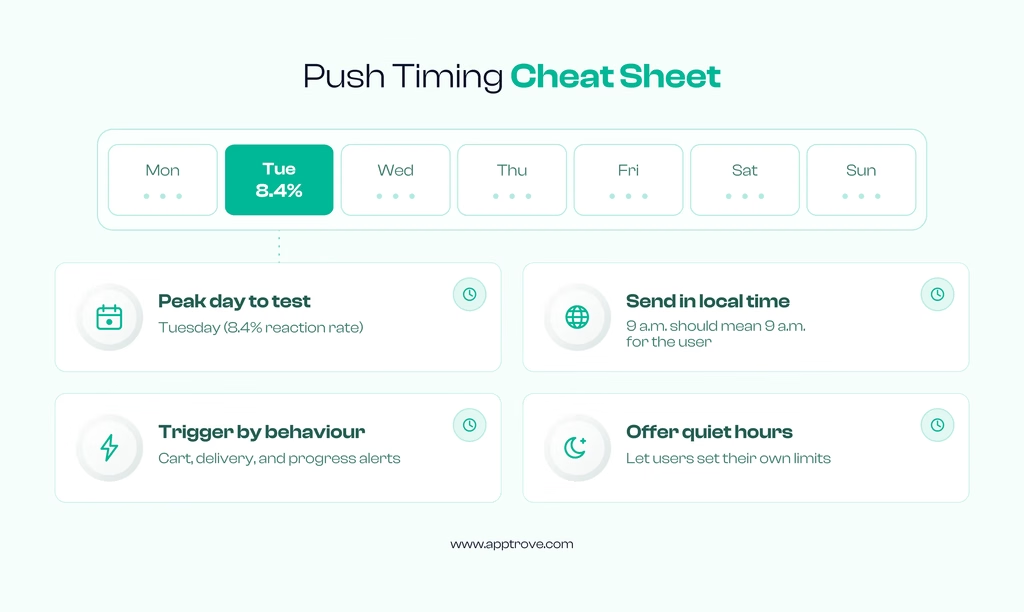
There is no blanket answer for this, even though there are effective practices available. According to Business of Apps data, the push notification response rate is at its peak on a Tuesday, at about 8.4%. Nonetheless, treat this as a suggestion rather than a rule, since each audience behaves differently. Follow the rules below to make sure your notifications are received well by users:
- Follow time zones. A message delivered at 9 a.m. should be received at that very time.
- Use behavioral triggers. Notifications based on users’ behavior are generally more effective than planned mass notifications.
- Mind the frequency. An industry report from 2026 indicates that the average Android company sends almost 15% fewer messages year on year due to the restraint they practice.
- Define silence hours: Let your users specify the time they don’t want to receive notifications.
Steps for Measuring and Enhancing Push Notifications
Only by monitoring your results can you apply best practices. It’s important to watch four key numbers, as follows: the opt-in rate, tap rate, conversion rate, and opt-out rate. Another essential part of push notification best practices is regularly reviewing campaign performance and using those insights to refine message timing, frequency, and personalization. Should you notice the rate at which users opt out of push notifications increasing, it can mean that either the number of messages being sent or the notifications themselves are losing relevance.
Start experimenting with various variables one at a time: message copy, time of day when the notification is sent, and artwork that accompanies it. Start measuring not only the number of clicks on the link but also the conversion rate and in-app events, and how well push notifications retain customers.
The Value of Adhering to Push Notification Best Practices
Productive push notifications are less about selling and more about providing a helpful service. Gain consent from consumers at the right time, segment your audience correctly, keep your notifications easy to understand, send the notifications at the proper time, and keep track of what happens afterward. Accordingly, you should make these points an essential part of your notification strategy to create a useful channel. By following these push notification best practices, you can build a notification strategy that respects user preferences, improves engagement, and drives meaningful in-app conversions.
FAQs
1. What distinguishes transactional push notifications from promotional ones?
Transactional notifications provide information that the user is looking for, such as notifications about order confirmations, OTPs, or delivery updates. Promotional notifications, on the other hand, talk about deals and promotions. Since users usually have a lower tolerance for promotional notifications, it is wise to use them very carefully.
2. What are the benefits of silent push notifications?
Silent pushes refresh content or synchronize information behind the scenes without exploding someone’s phone with notifications. In this way, the application remains updated, so when a person opens it, they see the necessary data without taking extra action.
3. How many push notifications must be sent weekly?
There is no set number. The first step is to send one to three notifications per week, and then watch the numbers of opt-outs and engagement. Applications with news or delivery updates can send more notifications than utility applications.
4. When is it the right time to make use of rich push notifications?
Rich push notifications are effective with images, buttons, or GIFs when their visual aspect is meaningful: launches, order status, event notifications. However, for urgent messages, plain text is better for readers as it is quicker to comprehend and delivered more reliably.
5. What is Notification fatigue?
Notification fatigue refers to a situation when individuals start disregarding messages and alerts due to the overwhelming number of notifications they receive. To avoid such fatigue, it is recommended to space alerts, personalise notification messages, and provide users with the option of controlling their settings.
from Apptrove https://apptrove.com/push-notification-best-practices/
via Apptrove


Comments
Post a Comment