VTR (View-through rate)
An essential metric for digital advertising is view-through rate (VTR), which gauges how much an ad captures the viewer’s attention (i.e., was it viewed). View-through rates are most relevant to video advertising when advertisers seek to know if an advertisement was delivered but not whether it was watched; therefore, view-through rates are critical indicators of ad quality due to the high number of impressions that can be created, with very few impressions receiving a user’s attention.
Simply put, VTR is a ratio of video views to ad impressions; therefore, view-through rates are particularly beneficial when measuring brand awareness, reach, and top-of-funnel campaigns where there may be little or no clicks as the key performance metric (KPI).
The VTR meaning
The actual meaning is the percentage of video views out of the total number of ad impressions. In contrast to click-through metrics, VTR measures passive engagement; therefore, VTR is commonly used to measure how well an advertising creative “lives” in the consumer’s mind, by how long they view a video advertisement without any action taken.
The VTR meaning has slight differences based on the rules of the platform being used, but the core principle is the same: VTR reflects how long a consumer watched an advertisement. For this reason, the measurement of VTR is now being used as a measure of the overall effectiveness of the advertisement, message, and/or branding strategy of an advertiser/advertising campaign.
VTR Full Form and Common Terminology
VTR (Or View Through Rate) can also be referred to as “View Rate” or “Video View Rate” and though these terms can often be used interchangeably, it’s essential to know how different platforms refer to “Views”, as this will help the different parties that work on performance dashboards, media plans and other reporting frameworks, synchronize, through clarity in language, what they are measuring as well as how success will be defined.
The use of View Through Rate is unique in that it plays a large role in the continual evolution of advertising measurement and the move away from simple delivery metrics. The number of impressions alone does not indicate that they had any impact.
The Importance of VTR
View Through Rate will provide advertisers with the ability to analyze their performance by determining whether or not those impressions generated actual attention and awareness.
Advertisers utilize View Through Rate as a tool to:
- Assess the effectiveness of their creative
- Compare placement and format options
- Identify the impact of creative fatigue
- Refine their audience targeting.
As Attention is a Limited Resource, View Through Rate Allows for the Prioritization of Quality versus Quantity.
VTR Formula Explained in Detail
The View Through Rate (VTR) formula is simple:
- For the most general VTR measure:
- VTR = (No. of Views)(No. of Impressions) = VTR%
It is simply a method of determining the percentage of impressions that lead to a counted view.
Advertisers also have another method of calculating VTR based on only completed views:
- VTR Based on Completed Views
- VTR = (No. of Completed Views)(No. of Impressions) = VTR%
Both methods of calculating VTR are valid because the definition of a “View” is consistent across both measures.
How to Calculate VTR:
- Identify how you want to define a view (e.g., minimum length of time someone has watched the video or completion of video).
- Gather total impressions for the time period you have selected.
- Gather total views based on the same criteria you have identified.
- Divide the number of views by the number of impressions.
- Multiply this result by 100.
Tracking your data accurately using the correct method for calculating VTR allows for consistency in reporting and will provide meaningful comparisons across multiple campaigns.
VTR Meaning Across Different Ad Formats
Video ads that are skippable can give you an idea of how catchy the beginning of your video is. The view-through rate of a video ad indicates whether or not the viewer continues watching. A higher view-through rate means that the creative hook was effective at drawing in the audience.
Video ads that are non-skippable usually have higher view-through rates, but that doesn’t necessarily mean they were engaging, so it’s common for advertisers to use other metrics to look at them too.
Rewarded video ads will typically have very high view-through rates because users who watch them receive something in exchange for watching them (in-game currency for example). They’re commonly seen in mobile apps and games.
In the context of video ads being embedded in a feed, the view-through rate is strongly influenced by how users scroll through feeds, how relevant the content is to users, and how visually impactful the ad is. Strong branding in the first few seconds of video ads will help ensure users make it all the way through!
VTR Full Form in Attribution Contexts
The term “VTR,” or “view-through rate,” is also used when discussing attribution; advertisers investigate what happens after a potential customer sees the ad but does not click on it; this is known as “view-through attribution.”
While both involve “viewing” an ad and then “attributing” action, this case is separate from engagement-based view-through rates and should be reported separately to avoid confusion.
Benchmarks and Performance Expectations
View-through rates do not have a universal benchmark; they can be significantly affected by the length of an advertisement, who is targeted, what platform you post on, and where you place it. Shorter videos tend to have higher VB rates, whereas longer videos depend more heavily on the quality of the story being told than on the number of people engaged.
To obtain the most useful information possible, advertisers should not simply refer to the average VTR, but should compare “VTR” against:
- Previous VTR for that advertiser
- Variability among individual VTRs within that advertising program
- Similar ad formats and placements
This context provides more actionable information.
VTR Formula With a Practical Example
By using the VTR formula, you can evaluate the following situation:
Total Impressions = 100,000
Total Views = 18,000
Calculation for viewing through = (18,000 ÷ 100,000) × 100 = 18%
If 7,000 were viewed until the end, then we would say the photography-based viewing hours 7%.
The comparison of these numbers shows how much time a person spent looking at an ad after they had originally seen one; therefore, they give marketers insight into initial and continued levels of participation from their target audience.
How to Calculate The VTR
To understand how to calculate the vtr for optimization, we suggest advertisers usually segment their vtr by
- Creative Version
- Group of Audience
- Type of Placement
- Device Type
Doing this will allow teams to see what patterns of vtr exist for the various segments and to allocate dollars toward those segments that want the most quality attention, combined with good completion rates on their products.
VTR Meaning in Creative Testing
A second practical definition of VTR comes from creative testing. When testing multiple creatives simultaneously, VTR can be an important indicator of which creative messages work best. If a creative has a higher VTR, the creative likely had clearer messaging, better pacing, and a stronger emotional/informational hook.
VTR also comes up frequently in reporting dashboards used by media buyers, analysts, and brand managers. On these dashboards, VTR is found alongside impressions, reach, (among others) to provide a more complete perspective of overall campaign performance.
It is paramount to label views clearly so that all stakeholders involved in a campaign understand what exactly VTR represents.
Common Pitfalls When Using VTR
- Inconsistently defined VTR across campaigns distorts comparisons and affects the validity of insights.
- VTR should not be looked at independently; however, it does work well in conjunction with completion rates, specific cost metrics and downstream metrics.
- High VTR for forced views or placement does not always generate high levels of engagement or brand lift.
VTR Formula and Cost Efficiency
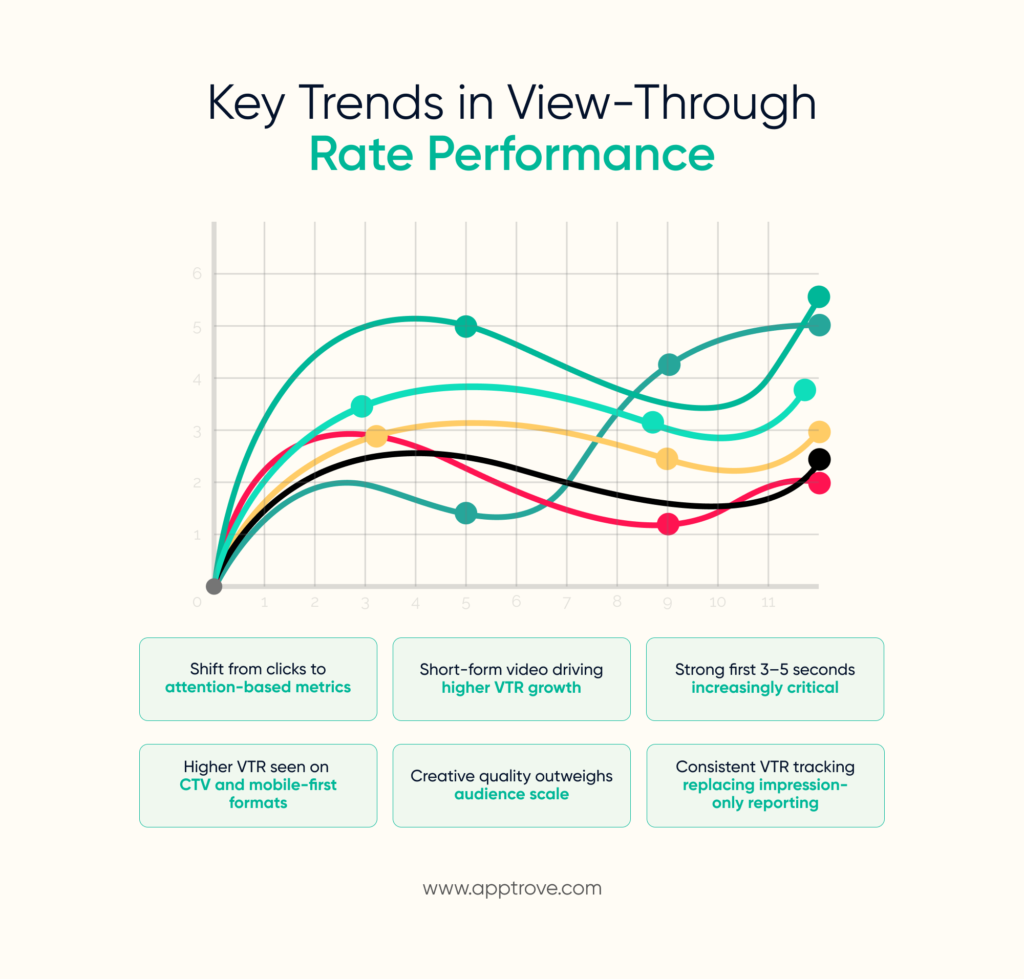
When you analyze the vtr of your media, you will often see it is being evaluated in conjunction with other performance-based metrics, like cost per view or cost per completed view. This allows buyers to determine whether or not they are achieving higher vtr at a cost-efficient rate.
Managing the view-through rate with a corresponding cost allows for a balance of the value of attention paid to an ad versus the actual cost of obtaining that attention.
Calculating VTR for Long-Term Trends
To measure VTR for long term trends, you must establish the definition of your views, reporting window and segmentation logic consistently over time to identify real changes in performance versus measurement noise.
What does VTR mean to Brand and Performance Teams?
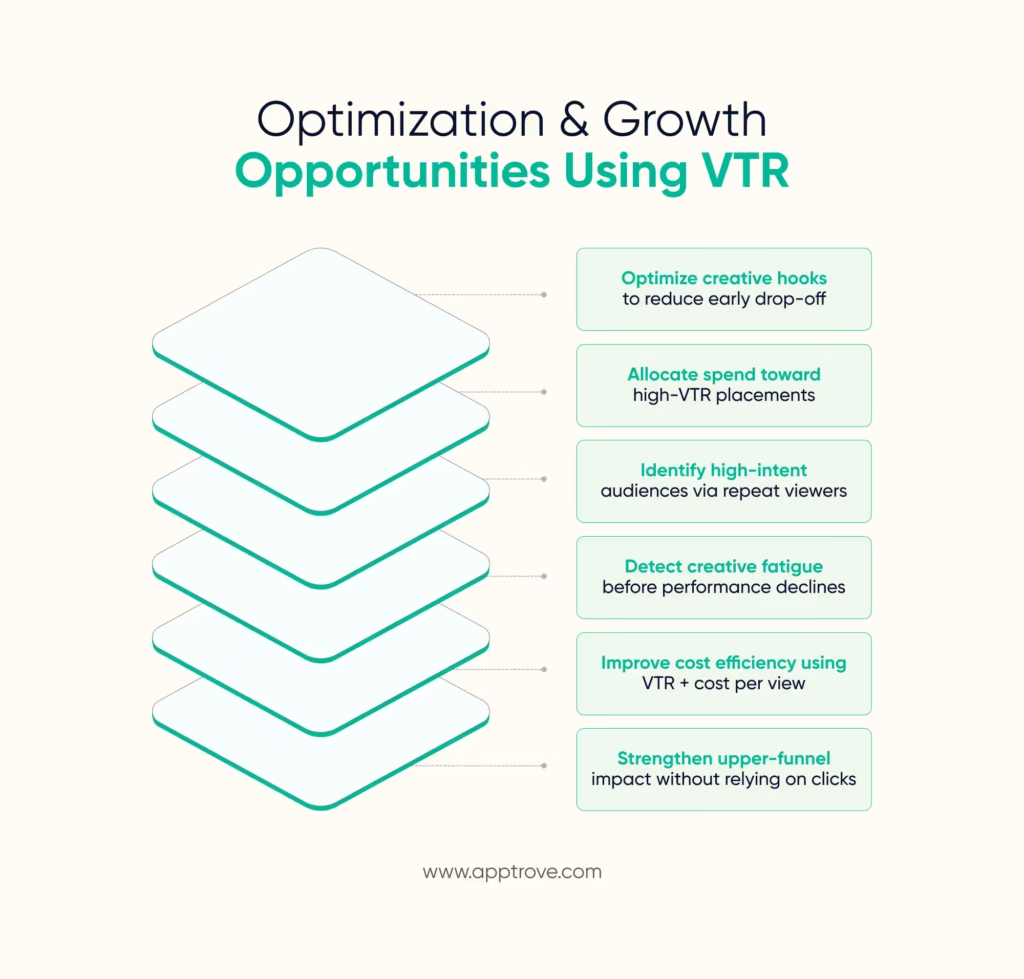
While VTR’s broad definition holds for both brand and performance teams, each has slightly different interpretations. Brand marketers tend to view VTR as an indication of overall message delivery and recall potential. In contrast, performance marketers typically use it to gain insight into the top of the funnel and support their attribution model.
A consistent understanding of how the metric is calculated and interpreted benefits both brand and performance team’s objectives.
View Through Rate Across Different Verticals and Industries
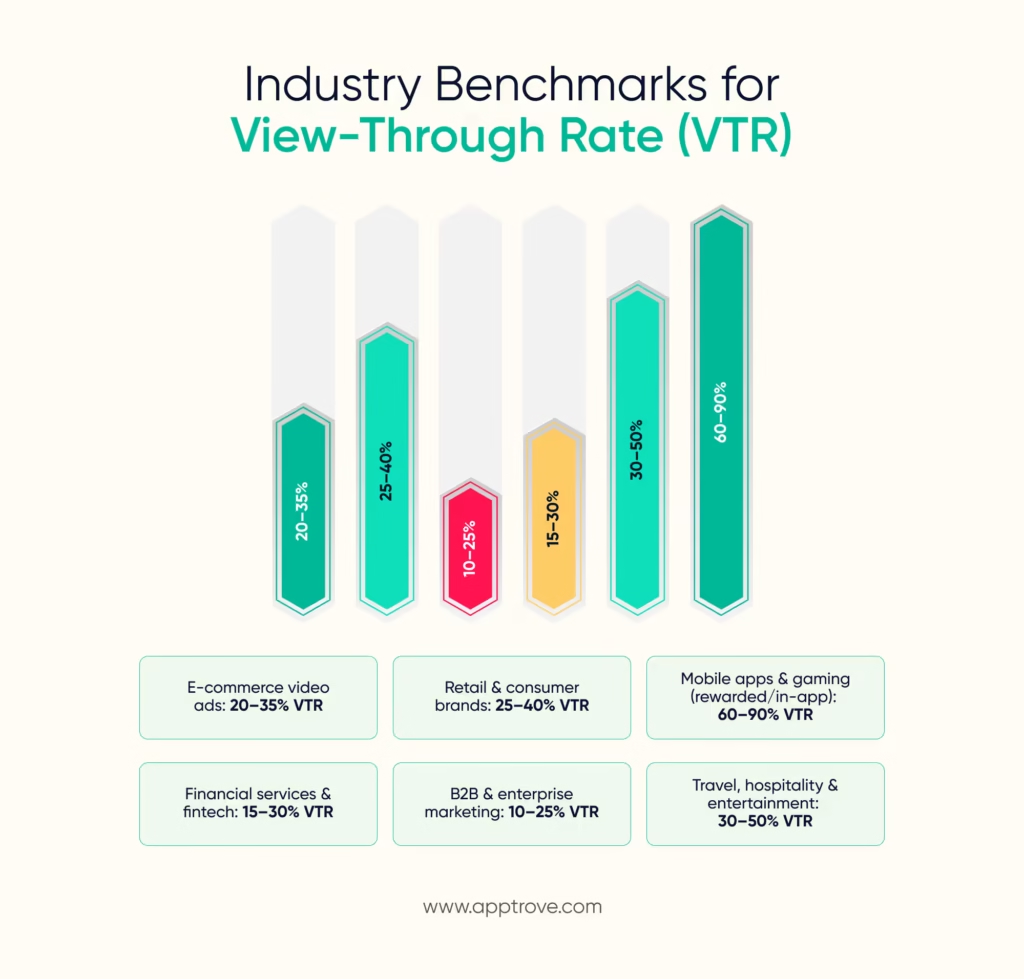
There are significant differences between industries, audience behaviour, and purchase cycles, which ultimately lead to differences in how the view-through rate is defined, interpreted, and optimized for digital advertising. While view-through rate has a core definition, the application of that definition varies widely in terms of the way advertisers track view-through rate as it relates to their specific industry segment.
Understanding how the View-through Rate Varies Across Industries
helps with tracking and measuring the correct use of the metric rather than using a generic benchmark of one size fits all. For example,
E-Commerce
the relationship between view-through rate and product discovery and consideration is an important metric for video advertisers to consider when developing ads for their products. E-commerce advertisers frequently use video ads to illustrate product features, usage scenarios, and seasonal promotions. A high view-through rate in the e-commerce space indicates that the creative has effectively communicated value quickly, which is important in highly competitive e-commerce environments.
Retail advertisers often rely on view-through rate as a means to support various objectives, including:
- Identifying which products/videoclips pique the viewer’s interest
- Testing out lifestyle-focused video advertising versus product-focused video advertising
- Supporting retargeting strategies by identifying engaged viewers
Because purchase decisions can happen much later than when a consumer is making a purchase (i.e., after searching or going to a specific website), view-through rate metrics are a way for an advertiser to quantify the interest that has been created by their advertising creatives early on, even if they have not been clicked on.
Mobile Apps and Gaming
View-through rate is the primary performance metric in mobile app marketing (especially for games), where the two predominant formats of video ads used to market mobile apps include rewarded video and in-app video, and users normally complete the entire view of the video ad before engaging with the ad. High view-through rates frequently equate to high intent to install, as well as increase post-install engagement.
In the mobile app marketing vertical, view-through rates are helpful for determining:
– User acquisition efficiency
– Quality of users acquired
– Retention and lifetime value modeling
Since a significant number of users who installed the app after viewing the video but did not click on it, view-based engagement metrics are very valuable in measuring campaign effectiveness.
Financial Services and Fintech
Financial service products are usually more complex than other types of product and therefore take longer to evaluate. This additionally means that they generally have a higher level of trust between the brand and the consumer. The view-through rate demonstrates how well these more sophisticated messages are being presented to the audience. Many marketers use educational videos as part of their marketing campaigns.
This can include providing the benefits of the service, the safety and security that goes along with it and the purpose for which it is intended. When using these educational videos, the marketers expect to create more long-term engagement based on the user watching the entire video versus expecting more immediate engagement from the user.
When the financial service or fintech marketer sees an increase in the view-through rate, they can draw the following conclusions:
– The message is clear to the audience
– The marketer has been effective in creating trust in their messaging
– The audience is of relevance
– There is the possibility of delayed conversion – the view-through rate provides an indication of message resonance.
Healthcare and Wellness
When it comes to healthcare and wellness the view-through rate generally gives us an indication of how much awareness/education there is around our campaign or initiative versus immediate action. Campaigns focus on educating the target audience about their conditions, prevention methods, and lifestyle changes; therefore, it is critical that the quality of engagement via view-through rate supports whether or not the recipient clearly understood the content of the message (which will help reduce early drop-off).
View-through rate enables us to determine:
- Is the content approachable and easy to understand?
- Does the tone of the creative match the sensitivity of the intended audience?
- Does the message have a low early drop-off rate?
Due to legal and ethical guidelines, using a passive form of measurement rather than an active form such as clicks can often make the best ROI measurement.
When it comes to education and EdTech, video is one of the most effective ways for education-based advertisers to communicate their value proposition, outcome/results, and learning experience.
Education and EdTech
view-through rate will often correlate to how much interest there is in long-form, credible types of explanation about your product, appearing at the beginning of your campaign.
Generally speaking, a high view-through rate indicates:
- Effective storytelling
- Alignment with the intent of the learner
- Clear articulation of the benefits of your product/service
As enrollment decisions are rarely made instantly, the view-through rate will help you measure the success and assess the effectiveness of your upper and mid-funnel activities.
Travel and Hospitality
Visual inspiration is critical for travel and hospitality. The view-through rate is one of the key metrics for determining emotional engagement as video pulls users into the experience of a destination, things to do when on a trip, and the amenities offered at hotels/resorts.
For Travel & Hospitality, view-through rates impact:
– Measuring the attractiveness of a destination
– Creative testing of visuals and pacing
– Planning for the seasons and promotional offers
Content with a high view-through rate is frequently used as aspirational content and generates future planning (vs. immediate booking).
B2B & Enterprise Marketing
View-through rates also assist B2B marketers in understanding consumer engagement with complex value propositions. Decision-makers typically consume content passively before reaching out to make a purchase. Video ads can showcase solutions, highlight problems they may have, and establish a brand’s authority in their given field.
For B2B marketers, view-through rates play a role in:
– Achieving awareness and thought leadership goals
– Developing account-based marketing strategies
– Analyzing long sales cycles
Clicks are not always the best indicator of customer interest; therefore, view-based metrics serve as critical early indicators.
Media, Entertainment, and Streaming
The View Through Rate (VTR) is frequently used as an indication of a content’s attractiveness in entertainment and streaming; it heavily relies on strong beginnings and pacing to grab attention.
As a result, higher VTR in this industry is indicative of:
- “Hook” for storytelling
- Genre/audience fit
- High-quality creative post- production.
VTR can also be used to help anticipate downstream activities (eg, Content search, Subscription, App Opens).
VTR Full Form: Final Glossary Definition
The VTR (View-Through Rate) is the percentage of ad impressions that create a counted video view. This is an essential metric for measuring the quality of ad placement and creative effectiveness in the world of video advertising.
Formula & Summary for VTR Calculation:
Summary:
- To find the vtr, divide the number of views by the number of impressions and multiply by 100.
- There are various ways to calculate vtr depending on the definition of ‘view’.
- VTR really relates to attention, and not necessarily to interaction.
If used correctly, the view-through rate is a reliable, scalable method to measure how well advertising has gained audience attention.
from Apptrove https://apptrove.com/what-is-vtr-view-through-rate-apptrove/
via Apptrove


Comments
Post a Comment