ROI vs ROAS Guide on Measuring Marketing Performance in 2026
Introduction
Marketing has changed dramatically over the last few years. The costs of acquiring customers continue to rise, privacy laws keep getting stricter, and user journeys have never been more fragmented than they are today. In fact, Salesforce reports that marketers now use an average of 10 customer engagement channels, highlighting just how complex and fragmented the modern customer journey has become. Therefore, how you measure success must also change or evolve. Metrics that used to be sufficient are now lacking in some critical areas. Consequently, there has been more importance placed on measuring ROI versus measuring the ROAS because ROI vs ROAS is not simply a technical comparison; it represents an important strategic decision.
If you have been optimizing your campaigns based solely on revenue returns, then you might have asked yourself whether you are really making a profit or just becoming more efficient at spending money. That question is central to understanding the difference between ROI and ROAS. One measures performance over a short time period, while the other assesses value over a longer period of time. Relying on either one of these metrics alone can result in making backward decisions, such as scaling campaigns that do not produce genuine profit or discounting efforts contributing to long-term growth/ending in either poor decision or outcome.
As we move into a more privacy-focused environment, understanding your return on investment (ROI) and return on advertising spend (ROAS) is no longer just an option – it’s necessary. You’ll need to gain a better understanding of your marketing performance – specifically, connecting together advertising spending, user behaviour, and overall business results. Tools like Apptrove are designed to help you do this by converting fragmented data into usable insights that are compliant with the fast-evolving privacy landscape.
This guide will help you understand how ROI and ROAS differ from one another, when to use each measurement, and how combining the two will allow you to make better and more profitable marketing decisions in 2026 and thereafter.
ROI vs ROAS — The Increasing Importance of These Metrics
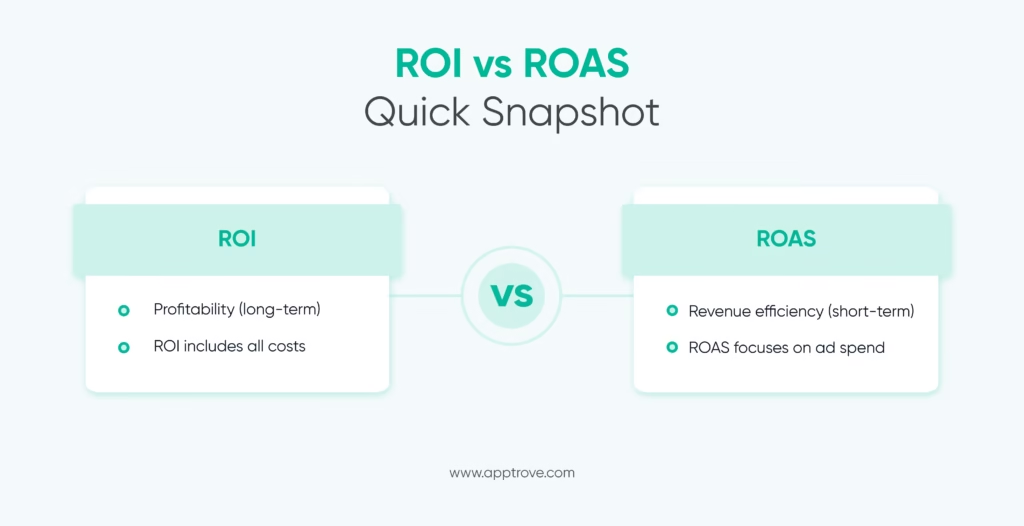
The way we measure marketing success is rapidly changing, which means if you’re using only one metric to measure success, you may be missing the big picture. Comparing ROI vs ROAS is now critical due to increasing privacy regulations, rising costs of acquisition, and an increase in complex customer journeys.
Recent changes to privacy-first measurement will change the collection and interpretation of data. Since there are limited ways to track users on a user level, superficial metrics can no longer provide a complete picture. As such, ROI vs. ROAS is a critical comparison, as you require a combination of high-level performance indicators and more in-depth metrics about profitability to make informed decisions.
In addition to changes in privacy laws, the cost of acquiring new customers has increased across almost all channels. In fact, Contentsquare’s 2025 Digital Experience Benchmarks Report found that brands spent 13.2% more on digital ad spend in 2024, while conversion rates fell 6.1% year over year, and the cost of an online visit rose 19% over the past two years. The cost of bringing in users has increased, so optimizing campaigns based only on revenue is no longer an effective strategy. A campaign could generate a high return on ad spend (ROAS), but still fail to generate a profit after all costs are considered. This is where comparing ROI vs. ROAS helps differentiate between a campaign that looks attractive on the surface and one that actually supports continued growth.
In addition, we’ll be working to enhance our understanding and use of the full funnel. Marketing does not just end with an install or a conversion; there should be an understanding of how marketing impacts retention, engagement, and lifetime value. ROAS can provide a good, quick snapshot for campaign-level performance; however, ROI can show how marketing fully aligns to generate overall profitability. By incorporating ROAS and ROI, you can clearly relate these numbers together.
Ultimately, it is about balancing short-term benefits against long-term success. While ROAS is great for quick optimization and scaling, ROI helps make sure that you have a solid foundation for sustainable growth when developing your longer-term strategic plan. Keeping ROAS and ROI in view will help you avoid getting caught in the trap of pursuing quick solutions that might not be sustainable over the long term.
What is ROI vs ROAS? Understanding the key distinction
To achieve better quality marketing decisions, you are going to require clarity, not just clarity about the items or metrics you are currently tracking, but also about the importance of the value/importance of each of those items to your organization’s success on the whole. This is where an understanding of the difference between ROI and ROAS becomes most apparent, as while both of these metrics can be used to measure performance, they each answer very different types of questions regarding how your business is performing as a whole.
What does ROI mean in the distinction between ROI vs ROAS?
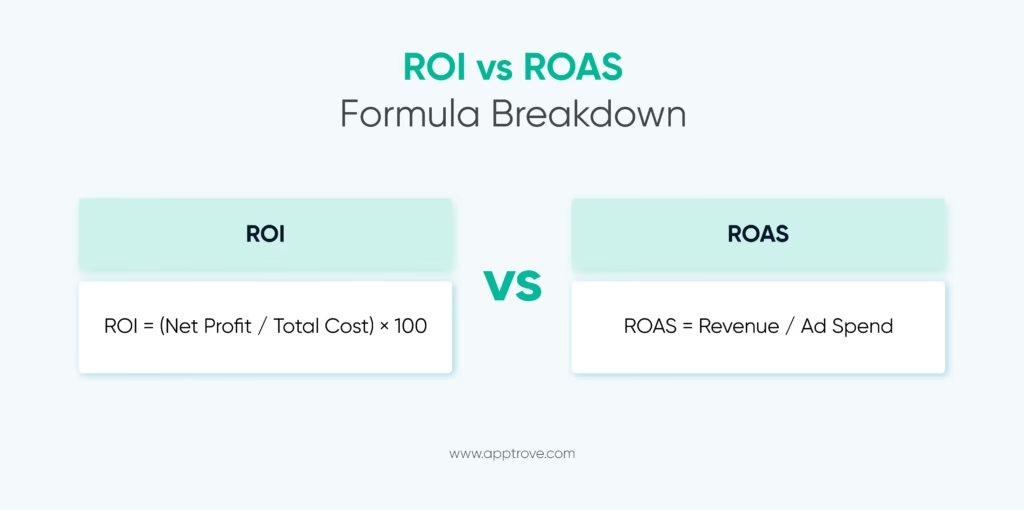
Return on investment (or ROI) refers to the overall profitability of your marketing efforts; thus, ROI will consider all of your costs as a result of running a marketing campaign and will look at the return in total dollars generated for that campaign, rather than just the revenue generated from a campaign through advertisement spend.
The standard formula for calculating ROI is as follows;
ROI = (Net Profit / Total Cost) x 100%
The value of using overall, comprehensive data as it relates to ROI is that it takes into consideration everything that a business would incur as a result of running and executing a marketing campaign (i.e. advertising expenditure, creative production costs, tools and/or technology used, staff salaries which worked on the marketing campaign, agency fees that were charged to perform the marketing, and overhead related to operating the marketing campaign).
As a result, when evaluating the data and producing a determination of ROI, you will have much greater clarity to evaluate the true financial performance of your overall organization.
When you evaluate ROAS vs. ROI, the determination of ROI necessitates that an organization step back and look at its overall organization and evaluate whether it is developing and operating a sustainable, profitable business model or simply generating revenue.
What Is ROAS in ROI vs ROAS
ROAS (Return on Ad Spend) solely accounts for the efficient use of your ad budget in terms of revenue produced from an ad campaign. It focuses more closely on the day-to-day effectiveness of a single ad campaign.
ROAS calculations are done using the formula below:
ROAS = Revenue ÷ Ad Spend
As opposed to ROI, ROAS focuses exclusively on the direct costs incurred while advertising (e.g., creative, media, etc.). This concise listing of costs allows you to see which campaigns and which creative or media are successful and make necessary adjustments to their parameters instantly.
Similarly, in comparing ROI vs ROAS, ROAS answers the question: “Which campaigns are working now?” while ROI provides information about the profitability of those campaigns, factoring in other cost components.
ROI vs ROAS- Key Differences
The key differences between ROI and ROAS are based on the scope of analysis, the purpose of the analysis, and the impact of the analysis. ROI provides a comprehensive view of your entire business, while ROAS focuses specifically on ad-level performance. Therefore, ROAS is the better metric for short-term optimization and quick decision-making, while ROI is most beneficial for defining long-term strategy. ROAS is used to scale what seems to be working, while ROI determines whether those actions will lead to sustainable profitability.
When comparing ROI to ROAS together, you will achieve a more balanced perspective. By not optimizing in isolation and instead aligning your campaign results to actual business results, you will ultimately create significant growth.
ROI vs ROAS in Mobile Marketing: Which Should You Focus on?
Mobile marketing changes quickly, but how you measure your performance can be smarter than it is now. Depending on where you are looking to measure a mobile marketing campaign, like it may be through ROI (Return on Investment) or ROAS (Return on Advertising Spend), it’s important to understand when and how to use these two things in different places in the customer journey from acquisition to retention.
Let’s use an example to illustrate. During the process of acquiring users, the goal of a mobile marketing campaign is primarily to get as many installs as possible for as cheaply as possible, so the goal of ROAS becomes key. It is through ROI that helps determine, based on the amount of revenue a merchant has generated in comparison to the amount they spent in ads to acquire those consumers, which ad channels, campaigns, and/or creatives have worked best at generating revenue relative to cost. However, simply having installs doesn’t mean anything. Once the consumer is in the app, the most important things become retention and lifetime value, which is where ROAS and ROI begin to differ, as the cost for acquiring and keeping those consumers will change the longer you retain them.
This topic leads us into discussions on performance versus profit. ROAS is an indicator of performance and indicates what is currently succeeding. This means you can pause any ad you do not see as successful; you can also increase your money spent (scale) on good-performing campaigns. However, if a campaign has strong ROAS numbers but is not profitable when you calculate operational costs, discounts given, and the number of customers who left after making their purchase (churning), then it may still not be a profitable campaign. ROI provides you with insight into profitability. Therefore, by comparing both ROI and ROAS, you can make sure you are not scaling your campaigns based only on the ROAS, S even if your overall profitability does not improve.
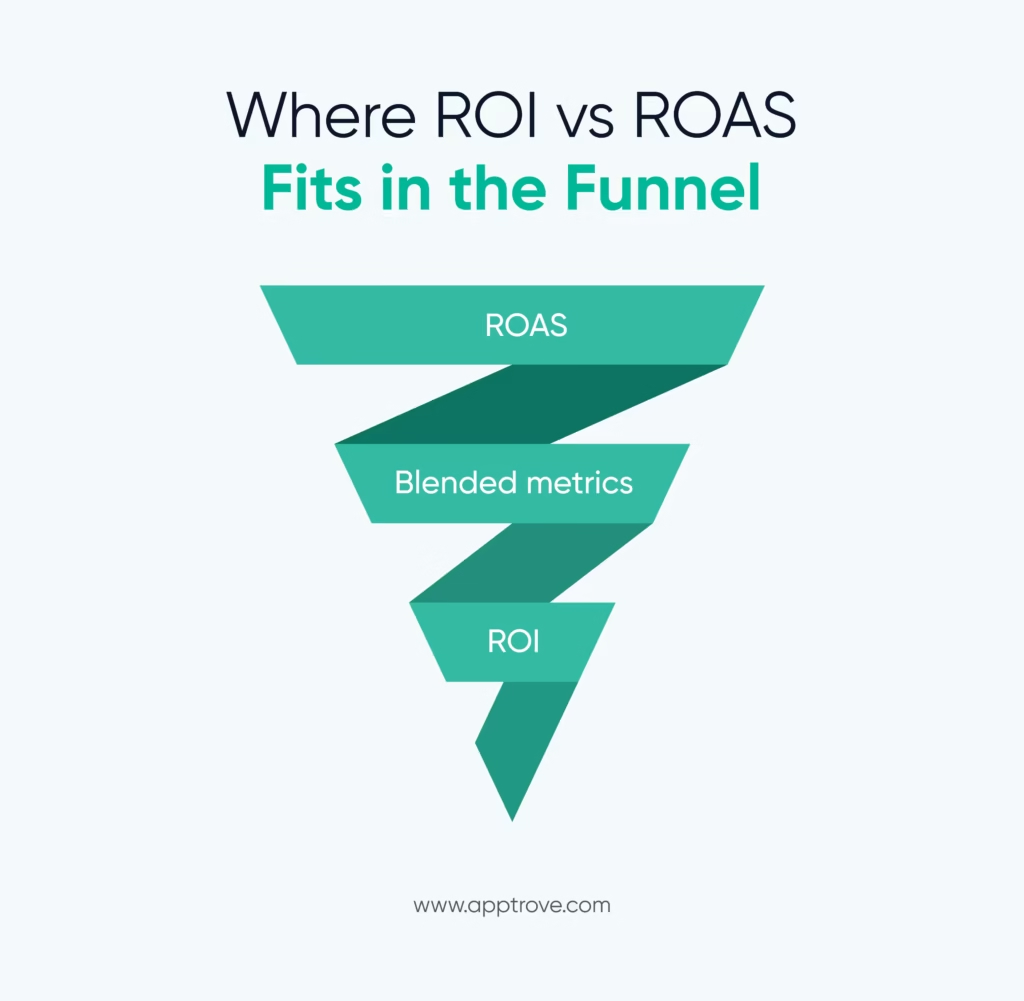
To find the best way to do this, evaluate where the different metrics sit across your funnel. Depending on which stage a user is in their journey, your priority will change, just like your measurement.
- Top of the Funnel – You typically will measure reach & installs, initial conversion rates to measure how well you are acquiring new users, and what ROAS (return on ad spending) you are generating from that spend.
- Middle of the Funnel – You need to look at combined metrics such as ROAS, retention, engagement & early revenue signals in order to give you enough data/information to measure how well your users are engaging with your app.
- Bottom of the Funnel – Long-term value is ascertained through metric ROI (return on investment). This tells you that your entire funnel strategy is driving sustainable profitability.
By aligning both ROI and ROAS to the stages of your funnel, you can now transition from isolated campaign optimization to a full-scale growth strategy that supports short-term success and long term effectiveness.
Accurately Measuring ROI vs ROAS
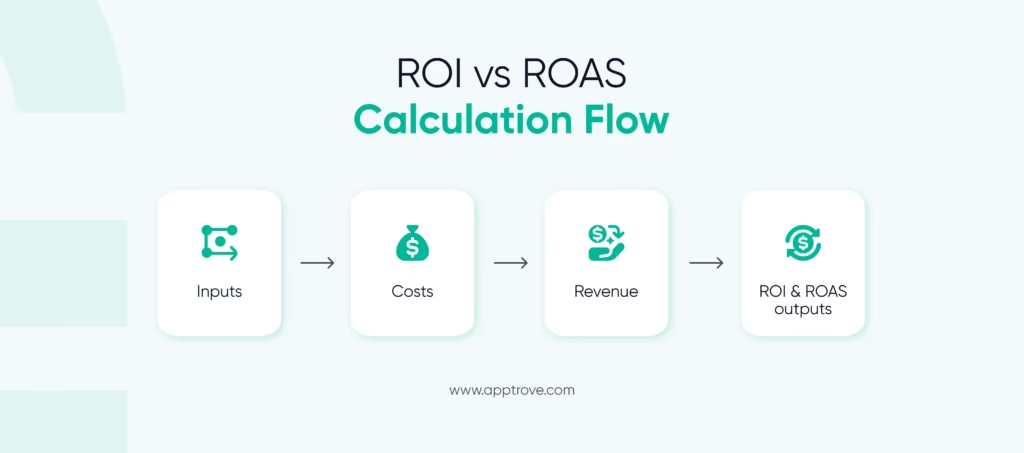
It is easy to understand the difference between ROI and ROAS, but it becomes more difficult when attempting to calculate them correctly. Flawed input will result in flawed decision-making; therefore, if you wish to fully depend upon the calculated numbers from these metrics, you must have a structured method to include both visible and non-visible components that can have an impact on performance.
A Step-by-Step Guide to Calculating ROI
For you to have an accurate ROI, you need to look beyond just the visible costs and also look at the total investment in campaigns.
To calculate your return on investment, you first need to calculate your total revenue generated by marketing efforts and then subtract the following total costs that are typically more than just ad spend:
1. Media spending
2. Costs related to producing creative
3. The cost of tools and analytics platforms used
4. Salaries and operating expenses of the team
5. Fees for your agencies or vendors
After you have calculated your net profit, you can calculate your return on investment using the following formula.
ROI = (Net Profit / Total Costs) x 100
The key to this calculation is to include the entire investment. Many marketers fail to get an accurate ROI calculation because they are not taking into consideration all of the hidden costs. Therefore, ROI will provide you with an accurate return, compared to Return On Advertising Spend (ROAS), only when you include all of the associated costs.
Calculating ROAS Step by Step
ROAS is a simpler metric than the ROI metric and is appropriate for tracking performance across the entire campaign level. It is also focused only on your advertisement spends’ effectiveness at generating revenue.
Here is how to calculate ROAS:
1. Find the revenue generated from a particular campaign
2. Find the total amount of advertising spend for that particular campaign
3. Divide the revenue by the total ad spend
– ROAS = Revenue / Total Ad Spend
Because of this ease of calculation, ROAS is a very actionable metric and can be used to evaluate performance by channel, creative format, audience segment, or at the individual campaign level. ROAS is used to make quick optimization decisions compared to the very broadly defined ROI metric, but the two do not take into account the total and overall business costs for producing a return on investment.
Common Errors in ROI vs ROAS Calculation
Even seasoned marketers might confuse ROI with ROAS if the calculations are not completed properly. Here are some typical blunders to avoid:
- Neglecting indirect expenses: When operational costs or creative costs are omitted from the calculations, this can inflate your ROI, leading to a too positive a conclusion
- Incorrect attribution: When using an improper attribution model, you may assign revenue to the wrong campaigns, which will ultimately affect your ROI and ROAS
- Putting too much emphasis on the short-term: High existing ROAS campaigns do not necessarily mean they will be profitable over the long-term when viewed through ROI
In order to use ROI and ROAS as a means of helping to maximize a business’s profitability, both your ROI and ROAS must be accurately calculated and provide context to make smart, informed marketing decisions for continued growth and sustainability.
ROI vs ROAS — when to use each metric
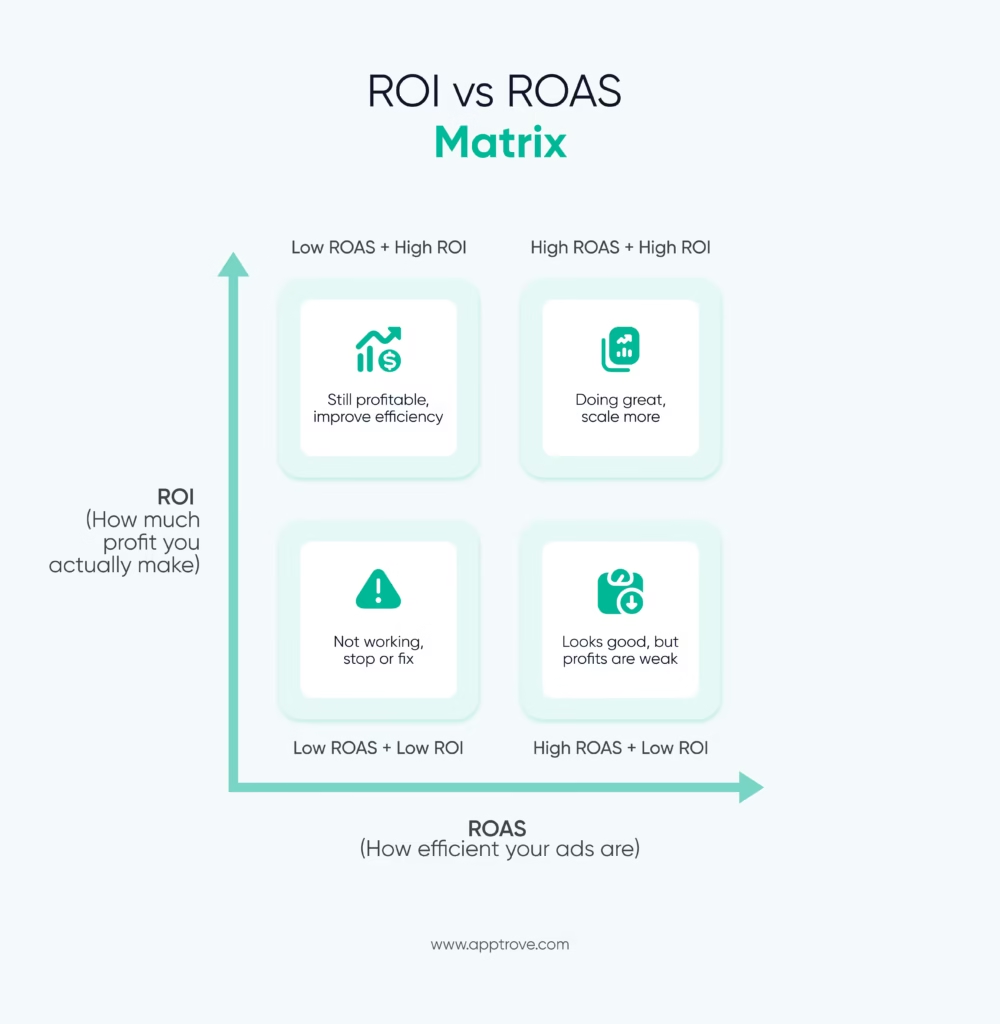
Understanding both ROI and ROAS metrics is critical for improving your marketing strategy. You cannot interchangeably substitute the two metrics since they each have their own distinct purpose based on your growth stage (i.e., early-stage growth versus scaling) and the type of campaign you are managing, as well as the types of decisions you are making.
In the growth stage, most marketers are focused on quickly acquiring new users as well as validating new marketing channels. During this stage, you will use ROAS as your primary metric because it allows you to determine which campaigns yield immediate results after launch so that you can optimize towards those campaigns. However, once you reach the scaling stage, using ROI instead of ROAS becomes increasingly important because ROI confirms that your business’s growth is both profitable and long-lasting.
Brand Campaigns vs Performance Campaigns – Both should be taken into consideration when we think about these. A performance campaign has measurable actions (i.e., clicks, installs, and/or conversions). Meaning, Return on ad spend (ROAS) can be a powerful metric; you can track your returns in real time and make decisions based on that information. Whereas brand campaigns will generally take longer to have their desired outcomes. Brand campaigns do not have a direct link to actions; they create the platform for future conversions and/or continually build on your business’s awareness and trust. Therefore, in those instances, the metrics of ROI and ROAS lean heavily towards ROI as it allows you to view the overall impact of a conversion on your business, not just that specific sale.
At the end of the day, budget allocation decisions are where ROI and ROAS meet. Relying solely on ROAS could lead you to use budget dollars towards a campaign that has a short-term impact on revenue and will not perform as well over time. Likewise, relying on ROI could result in overlooking potentially large campaigns that you may have been able to efficiently scale. To get the best results possible, it is crucial to use both measurements together: use ROAS as your guide when making short-term optimization decisions and use ROI to validate your long-term results.
When you align your measurement of ROI vs ROAS with your business environment, you will find yourself moving from making reactive decisions to creating a strategy for your company to be successful. You will not only be focused on short-term wins, but your marketing efforts will be cohesive and create a well-rounded marketing “engine” that creates both profits and efficiencies.
Importance of Accurate Measurement of ROI vs ROAS and Attribution
As you analyze ROI vs ROAS, accurate measurement is dependent upon one key factor—attribution. Without proper attribution, ROI and ROAS will lead you to optimize your campaigns incorrectly, based on inaccurate or incomplete data.
Attribution models, which determine the distribution of credit for a conversion over the course of a customer’s journey, play a key role in measuring the accuracy of your ROI and ROAS. As different attribution models exist (e.g., last-click vs multi-touch vs data-driven), the attribution model you choose to implement will directly influence your measured values of ROI and ROAS. An example of this can be seen when you use a last-click attribution model because last-click attribution overvalues last interactions while disregarding the customer touchpoint interactions that helped a customer towards a conversion, which may cause some campaigns to have artificially high ROAS and other campaigns to have artificially low ROAS, thereby skewing your ROI calculations as well.
Another important concept is the difference between incrementality and last-click attribution. Incrementality measures the actual effect of your campaigns and what would have converted without marketing. Last-click attribution is simply attributing the last interaction as the source of conversion, no matter what value or contribution it made.
Last-click can lead to over-inflated performance measurements when looking at ROI compared to ROAS for channels that are more towards the bottom of the funnel than at the top of the funnel.
To have the most accurate picture of ROI compared to ROAS, you need a blended approach, which incorporates all three concepts: sound attribution methodologies, use of Privacy-compliant tracking methodologies, and Incrementality Tests will result in ensuring your metrics will reflect what really is happening as opposed to what assumptions tell you are happening and help you to make decisions that will result in both immediate success with your marketing and also long-term profits for your business.
ROI vs ROAS in the Era of Consumer Privacy
The evolution of privacy-first marketing represents more than just a modification of existing regulations; it has also drastically changed the media measurement landscape. When evaluating ROI and ROAS, you will likely discover you no longer have access to the same granular data about individual users that previously powered your measurement and analysis.
One of the most critical changes is the disappearance of user-level data altogether. Compliance with enhanced privacy frameworks and the use of limited identifier tracking means that brands are no longer able to track the path to conversion for each individual user from first impression through to purchase. The loss of user-level data will greatly alter the way in which you measure and compare ROI and ROAS. In the past, metrics that relied on exact tracking will now require a more holistic and probabilistic measure of accuracy; therefore, the way you define “accuracy” will also have to change.
The shift toward aggregate measurement. Instead of measuring the individual actions of users, you will be measuring (and reporting) aggregate data (conversion value, cohort performance, campaign level). This change may seem limiting in the beginning, but it helps to develop more effective long-term measurement practices for your business. Aggregated data provides an opportunity to measure broader trends rather than individual isolated incidents. These broad trends will provide stable and scalable decisions made regarding ROI and ROAS.
Sometimes, not having enough data leads to gaps in your knowledge that need to be filled. Modeling methods and predictive analysis will begin to play a critical role when it comes to solving these gaps. Modeling methods will provide the means to generate advanced mathematical models to estimate user behaviour/activities, predict overall customer value (over time), and attribute value to all touch points on the customer journey, even when you are unable to track touch points.
As a result,lt you will be able to continue to effectively measure your ROI relative to your ROAS even if your visibility is limited.
As mentioned, in a privacy-first world, ROI versus ROAS is simply the idea that the best available information will guide decision-making, ing but it may not be perfect. Aggregated data and predictive modelling allow businesses to improve their performance quality while still protecting consumer privacy.
ROI vs ROAS Benchmarks: What Good Looks Like
One question you will continually ask when determining your ROI compared with the ROAS is, What is a good number? Unfortunately, this question does not have a straightforward answer because there is no defined benchmark for what good looks like; there are simply too many variables involved to create one standard across all industries, companies, or stages of growth.
To simplify things, let’s look at the variability across industries. Margins, customer life cycles, and customer acquisition costs can differ significantly, so any comparison must take into account the specific industry a company operates in. For example, a subscription-based app may show lower short-term ROAS than an eCommerce business, because subscription models often generate greater profitability over time through customer lifetime value.
At the same time, customer acquisition costs have increased by up to 60% over the past five years across industries, with the sharpest rises in more competitive sectors. This reflects growing competition and saturation in digital markets, which continues to push performance benchmarks higher. As a result, ROAS expectations can vary widely depending on the industry and competitive landscape.
This means that when assessing the relationship between ROI and ROAS, it is essential to do so within the context of your specific business model and market conditions, rather than relying on general benchmarks or comparisons across different industries or stages of growth.
Another critical consideration regarding good ROAS vs good ROI is understanding that good ROAS does not always equal good ROI. A campaign can theoretically have a strong enough revenue relative to its advertising cost (resulting in good ROAS). However, there may be another factor that can eliminate, or at least drastically decrease, the profitability of that revenue: operational costs, discounting, and churn. This ultimately is why ROI vs ROAS is important; ROAS is an indicator of efficiency; however, ROI indicates whether efficiency actually leads to business value.
This is also why relative benchmarks are much more important than hard numbers. Instead of asking yourself, Is my ROAS acceptable? You should ask yourself the following questions:
– Does this ROAS fit my profit margins?
– Is my ROI increasing?
– Am I getting short-term returns vs long-term growth?
When you consider ROI vs ROAS in terms of context, benchmarks become even more meaningful. Instead of chasing arbitrary numbers, you create a measurement strategy that is specific to your individual success metrics and your growth plan.
Ways to Optimize Your ROI Compared to Your ROAS Without Increasing Your Budgets
Optimizing your ROI as compared to your ROAS does not always need additional spending; rather, it simply requires better optimisation methods. By optimising your funnel as a whole, you will be able to achieve better performance with existing budgets, thus providing you with more profitability from your existing budgeted amount. The best way to accomplish this is through refining the items you currently have rather than just increasing how much money you are spending.
Improve Creative Performance
Your creative ads may be your primary point of contact with users and can have a large effect on your return on investment (ROI) as opposed to your return on ad spend (ROAS) if you improve them even slightly. Rather than only creating static ads, adopt an ongoing testing and iteration process.
Examine several alternative visual depictions, copy, and call to action (CTA) messages;
Determine which creatives appeal to various audience segments.
Regularly refresh your creatives to avoid fatigue.
When all of your creative ads are optimized, the conversion rates will increase and thus provide you with a higher level of return on ad spend (ROAS) and therefore a better return on investment (ROI).
Enhance Targeting of Prospective Customers
Finding potential customers can often result in large volumes of conversions. However, the quality of any conversions obtained will typically be lower than the numbers produced by targeted campaigns. By segmenting and targeting your audience more accurately, you can improve both your ROI (return on investment) and ROAS (return on advertising spend).
- Fine-tune your audiences using behavioral and contextual signals
- Segment Users according to the journey they’ve taken (intent, lifecycle stage,e or other engagement metrics)
- Readerwhoat are of poor quality or low purchase intention should be excluded
Targeting Prospective Customers effectively allows advertisers to spend their budget on those with greater chances of completing a purchase and retaining them as customers, resulting in increased short and long-term returns.
Place Emphasis on Retention and LTV
User acquisition is just one part of the equation. If those users do not remain or provide value, your ROI compared to ROAS will be affected. For this reason, you should focus on retention as well as lifetime value (LTV) beyond installs.
- Initiate effective Onboarding experiences.
- Utilize a personalized engagement strategy.s
- Incentivize repeat usage and/or purchasing patterns.
Higher retention increases the amount of revenue a user generates, thus boosting ROI even though your initial ROAS does not change.
Marketing should be in Compliance With User Experience.
Marketing and the user experience should align with one another. If a user clicks on an advertisement but experiences issues within an application, your conversion rate (and thus the return on investment for advertisements versus return on ad spend) will be negatively affected.
- Make sure the landing page and application experience for a user match their expectations based on the advertisement they clicked.
- Minimize onboarding and conversion flow.s
- Continuously optimize the user experience through additional analysis of the user’s journey.
When your marketing and user experience align, you not only increase your conversion rates, but you also build trust, which ultimately will lead to larger long-term returns without an increase in expense.
Following the recommendations above will enable a systematic approach to improving your return on investment compared to your return on ad spend. This is not about spending more, but rather about ensuring that every dollar you spend goes towards improving the user’s entire journey.
ROI vs ROAS: Evolution in Marketing Analytics
Marketing has changed over the years, and so too has the method of measuring marketing success. The discussion surrounding ROI vs Return on Ad Spend (ROAS) is transitioning from being a choice between the two to creating a smarter, holistic approach to measuring marketing performance.
An evolving trend to facilitate this is predictive analytics. Organizations now have the capability to use predictive modelling to determine outcome forecasts (e.g, user lifetime value, likelihood of repeat purchaser, and potential revenue), rather than relying solely on historical analysis. These forecasting capabilities allow marketers to take a proactive versus a reactive approach to making marketing decisions. Furthermore, when comparing ROI vs ROAS, utilizing predictive models gives marketers an opportunity to determine which marketing initiatives will not only generate positive revenue today but also deliver long-term returns on investment.
Additionally, as the industry moves toward unified measurement frameworks, isolated metrics will not suffice due to the fragmentation of users’ journeys across devices, platforms, and privacy-safe environments. A collective view of all three areas (campaign performance, user behaviour, and business outcomes) will be needed for adequate measurement solutions; i.e., the relationship between ROI & ROAS is ideal when they are measured within a holistic measurement strategy (encompassing the entire customer lifecycle).
In terms of future success, the optimization of only one marketing campaign cannot solely define your success, but the ability to successfully align short-term performance with longer-term growth will define success; therefore, ROI vs ROAS has a vital positioning in the balance between both.
As an example of the above concept, if you want to see how ROI vs ROAS works in real-world measurement settings, you can have a simple, no-pressure, free demo to help you understand these concepts within a real-world environment.
FAQs
1. What is ROI vs ROAS, and why is it important?
ROI vs ROAS can aid in understanding profitability and revenue efficiency. While ROAS only measures campaign performance, ROI vs ROAS includes evaluating the long-term impact of the business and sustainable growth strategies.
2. How do you calculate ROI vs ROAS accurately?
When performing ROI vs ROAS calculations, remember that for ROI, all costs should be included; however, only include ad spend for ROAS. This way, you will gain an accurate understanding of both profitability (as measured by return on investment) and a good impression of how individual campaigns performed.
3. Why is ROI vs ROAS different for every business?
Different industries, stages of growth, and price structures are contributing factors to how ROI vs. ROAS is interpreted. Different business models affect how people interpret ROI vs. ROAS, making benchmarks contextually-dependent, not universally applicable.
4. Who should focus more on ROI vs ROAS?
Both marketers and executives use ROI compared to ROAS in their decision-making processes. Marketers focus primarily on the use of ROAS and how to optimize their spending, whereas leadership teams are more interested in using ROI vs ROAS to quantify their profitability and growth impacts.
5. How can you improve ROI vs ROAS over time?
Improving ROI vs ROAS requires better targeting, creative testing, and retention strategies. By optimizing both acquisition and lifecycle engagement, ROI vs ROAS improves without necessarily increasing ad spend.
from Apptrove https://apptrove.com/roi-vs-roas-marketing-profitability-guide/
via Apptrove


Comments
Post a Comment